


Page 26 - JSOM Spring 2020
P. 26
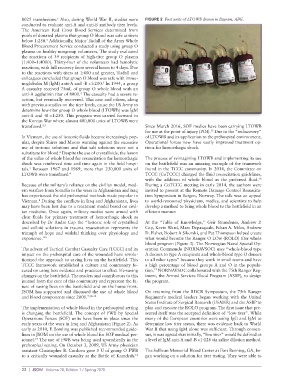
8025 transfusions.  Also, during World War II, studies were   FIGURE 2  First units of LTOWB drawn in Bagram, AFG.
                         5
          conducted to evaluate anti-A and anti-B antibody titer levels.
          The American Red Cross Blood Services determined from
          pools of donated plasma that group O blood was safe at titers
          below 1:250.  Additionally, Major Tisdall of the Army Whole
                    5
          Blood Procurement Service conducted a study using group O
          plasma on healthy nongroup volunteers. The study evaluated
          the reactions of 39 recipients of high-titer group O plasma
          (1:400–1:4000). Thirty-four of the volunteers had hemolytic
          reactions, with full recovery from several hours to 4 days. Due
          to the reactions with titers at 1:400 and greater, Tisdall and
          colleagues concluded that group O blood was safe with immu-
          noglobulin M (IgM)  anti-A and -B <1:200.  In 1944, a group
                                            5
          A casualty received 75mL of group O whole blood with an
          anti-A agglutinin titer of 8000.  The casualty had a severe re-
                                  4
          action, but eventually recovered. This case and others, along
          with previous studies on the titer levels, cause the US Army to
          determine low-titer group O whole blood (LTOWB) was IgM
          anti-A and -B <1:250. This program was carried forward to
          the Korean War where almost 400,000 units of LTOWB were
          transfused. 4,5                                    Since March 2016, SOF medics have been carrying LTOWB
                                                             for use at the point of injury (POI).  Due to the “rediscovery”
                                                                                        15
          In Vietnam, the use of isotonic fluids became increasingly pop-  of LTOWB and its application to the prehospital environment,
          ular, despite Shires and Moore warning against the excessive   Operational forces now have vastly improved treatment op-
          use of isotonic solutions and that salt solutions were not a   tions for hemorrhagic shock.
          substitute for blood.  Despite the use of crystalloids, the lesson
                          6
          of the value of whole blood for resuscitation for hemorrhagic   The process of reimagining LTOWB and implementing its use
          shock was reinforced time and time again in the field hospi-  on the battlefield was an amazing example of the teamwork
          tals.  Between 1967 and 1969, more than 230,000 units of   found in the TCCC community. In 2014, the Committee on
             7
          LTOWB were transfused. 4                           TCCC (CoTCCC) changed the fluid resuscitation guidelines,
                                                             with the addition of whole blood as the preferred fluid.
                                                                                                            16
          Because of the military’s reliance on the civilian model, mod-  During a CoTCCC meeting in early 2014, the authors were
          ern warfare from Somalia to the wars in Afghanistan and Iraq   invited to present at the Remote Damage Control Resuscita-
          has experienced the old prehospital methods made popular in   tion Symposium in Bergen, Norway. The talk was an appeal
          Vietnam.  During the conflicts in Iraq and Afghanistan, lives   to world-renowned physicians, medics, and scientists to help
                 8
          may have been lost due to a treatment model based on civil-  develop a method to bring whole blood to the battlefield in an
          ian medicine. Once again, military medics were armed with   efficient manner.
          clear fluids for primary treatment of hemorrhagic shock as
          described by Dr Andre Cap the “historic role of crystalloid   At the “Table of Knowledge,” Geir Strandenes, Andrew P.
          and colloid solutions in trauma resuscitation represents the   Cap, Kevin Ward, Marc Depasquale, Ethan A. Miles, Andrew
          triumph of hope and wishful thinking over physiology and   D. Fisher, Robert A Sikorski, and Pat Thompson helped create
          experience.” 9                                     what would become the Ranger O LOw (ROLO) titer whole
                                                             blood program (Figure 3). The Norwegian Naval Special Op-
          The advent of Tactical Combat Casualty Care (TCCC) and its   eration Commando (NORNAVSOC) uses “whole-blood type
          impact on the prehospital care of the wounded have revolu-  A donors to type A recipients and whole-blood type O donors
          tionized the approach to saving lives on the battlefield. This   to all other types” because they work in small teams and have
          TCCC framework established a culture and community fo-  a high percentage of blood groups A and O in the popula-
          cused on using best evidence and practices to effect life- saving   tion.  NORNAVSOC collaborated with the 75th Ranger Reg-
                                                                 17
          changes on the battlefield. The readers and contributors to this   iment, the Armed Services Blood Program (ASBP), to design
          journal form the core of this community and represent the fu-  the program.
          ture of saving lives on the battlefield and on the home front.
          JSOM has supported and discussed the use of whole blood   On returning from the RDCR Symposium, the 75th Ranger
          and blood components since 2001. 7,10–12           Regiment’s medical leaders began working with the United
                                                             States Institute of Surgical Research (USAISR) and the ASBP to
          The implementation of whole blood in the prehospital setting   plan and execute the ROLO program. The first issue that pre-
          is changing the battlefield. The concept of FWB by Special   sented itself was the accepted definition of “low titer”. While
          Operations Forces (SOF) units have been in place since the   many of the European countries were using IgG and IgM to
          early years of the wars in Iraq and Afghanistan (Figure 2). As   determine low titer status, there was evidence back to World
          early as 2010, F. Bowling was published recommended guide-  War II that using IgM alone was sufficient. Through consen-
          lines in JSOM on the use of whole blood for SOF medical per-  sus, it was agreed that initially, “low titer” would be defined as
          sonnel.  The use of FWB was being used sporadically in the   a level of IgM anti-A and -B <1:128 via saline dilution method.
                13
          prehospital setting. On October 3, 2009, US Army physician
          assistant Christopher B. Cordova gave 5 U of group O FWB   The Sullivan Memorial Blood Center at Fort Benning, GA, be-
          to a critically wounded casualty at the Battle of Kamdesh.    gan working on a solution for titer testing. They were able to
                                                         14

          22  |  JSOM   Volume 20, Edition 1 / Spring 2020

