


Page 149 - JSOM Spring 2020
P. 149
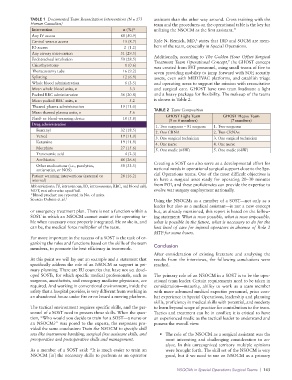
TABLE 1  Documented Team Resuscitation Interventions (N = 173   assistant than the other way around. Cross training with the
              Human Casualties)                                  team and the procedures on the operational table is the key for
              Intervention                          n (%)*       utilizing the NSOCM as the first assistant.”
              Any IV access                        88 (50.9)
                                                                                  6
              Central venous access                 15 (8.7)     Kyle N. Remick, MD,  states that 18D and SOCM are mem-
              IO access                             2  (1.2)     bers of the team, especially in Special Operations.
              Any airway intervention              51 (29.5)
              Endotracheal intubation              50 (28.5)     Additionally, according to The Golden Hour Offset Surgical
                                                                 Treatment Team Operational Concept,  the GHOST concept
                                                                                               7
              Cricothyrotomy                         1 (0.6)     was created from FST personnel, using small teams of five to
              Thoracostomy tube                     16 (9.2)     seven providing mobility to jump forward with SOF, security
              Splinting                             12 (6.9)     assets, even with MEDEVAC platforms, and establish triage
              Whole blood administration             6 (3.5)     and operating areas to support the mission with resuscitative
              Mean whole blood units, n               3.3        and surgical care. GHOST have two team loadouts: a light
              Packed RBC administration            36 (20.8)     and a heavy package for flexibility. The makeup of the teams
              Mean packed RBC units, n                5.2        is shown in Table 2.
              Thawed plasma administration         19 (11.0)
                                                                 TABLE 2  Team Composition
              Mean thawed plasma units, n             5.6
              Fluid- or blood-warming device        10 (5.8)          GHOST Light Team       GHOST Heavy Team
                                                                       (5 or 6 members)
                                                                                                (7 members)
              Drug administration                                1. Two surgeons – 01 surgeon  1. Two surgeons
                Fentanyl                           32 (18.5)     2. One CRNA             2. Two CRNAs
                Versed                             19 (11.0)
                                                                 3. One surgical technician  3. One surgical technician
                Ketamine                           19 (11.9)     4. One nurse            4. One nurse
                Morphine                           27 (15.6)     5. One medic (68W)      5. One medic (68W)
                Tranexamic acid                      4 (2.3)
                Antibiotics                        46 (26.6)
                Other medications (i.e., paralytics,   58 (33.5)  Creating a SOST can also serve as a developmental effort for
                antiemetics, or NOS)                             national needs in operational surgical support close to the Spe-
              Patient warming interventions (external or   28 (16.2)  cial Operations teams. One of the most difficult objectives is
              internal)                                          to have a surgical asset ready for operating 20–30 minutes
              Abbreviations: IV, intravenous; IO, intraosseous; RBC, red blood cell;   from POI, and these proficiencies can provide the expertise to
              NOT, not otherwise specified.                      evolve war surgery employment nationally.
              *Blood product use reported in No. of units.
              Source: Dubose et al. 5                            Using the NSOCMs as a member of a SOST—not only as a
                                                                 leader but also as a medical assistant—is not a new concept
              or emergency treatment plan. There is not a function within a   but, as already mentioned, this report is based on the follow-
              SOST in which an NSOCM cannot assist at the operating ta-  ing statement: What is now possible, what is now impossible,
              ble when necessary once properly integrated. He or she is, and   what is possible in the future, what is necessary to do for the
              can be, the medical force multiplier of the team.  best level of care for injured operators in absence of Role 2
                                                                 MTF for some hours.
              Far more important in the success of a SOST is the task of or-
              ganizing the roles and functions based on the skills of the team
              members, to promote the best efficiency in teamwork.  Conclusion
                                                                 After consideration of existing literature and analyzing the
              At this point we will lay out an example and a statement that   results from the interviews, the following conclusions were
              specifically address the role of an NSOCM as support in pri-  reached.
              mary planning. There are EU countries that have not yet devel-
              oped SOSTs, for which specific medical professionals, such as   The primary role of an NSOCM in a SOST is to be the oper-
              surgeons, anesthetists, and emergency medicine physicians, are   ational team leader. Certain requirements need to be taken in
              required. And working in conventional environment, inside the   consideration—maturity, ability to work as a team member
              safety that a hospital provides, is very different from working in   with more advanced medical expertise personnel, prior com-
              an abandoned house under fire or on board a moving platform.  bat experience in Special Operations, leadership and planning
                                                                 skills, proficiency in medical skills with potential, and modesty
              The tactical environment requires specific skills, and the per-  to learn beyond scope of practice for contribution to the team.
              sonnel of a SOST need to possess those skills. When the ques-  Tactics and treatment can be in conflict; it is critical to have
              tion, “Who would you decide to train for a SOST—a nurse or   an experienced medic as the tactical leader to understand and
              an NSOCM?” was posed to the experts, the responses pro-  possess the overall view.
              vided the same conclusion: Train the NSOCM to specific skill
              sets like instrument handling, surgical first assistant skills, and   •  The role of the NSOCM as a surgical assistant was the
              preoperative and postoperative skills and management.  most  interesting  and  challenging  consideration  to  an-
                                                                     alyze. In this unrecognized territory multiple opinions
              As a member of a SOST said: “It is much easier to train an   were brought forth. The skill set of the NSOCM is very
              NSOCM [in] the necessary skills to perform as an operator   good, but if we need to use an NSOCM as a primary

                                                                          NSOCMs in Special Operations Surgical Teams  |  143

