


Page 153 - JSOM Spring 2020
P. 153
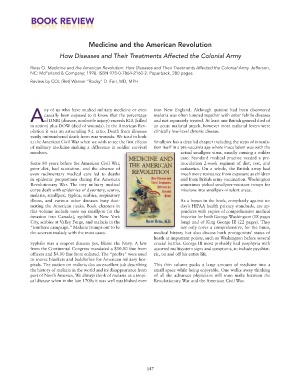
Medicine and the American Revolution


                          How Diseases and Their Treatments Affected the Colonial Army

              Reiss O. Medicine and the American Revolution: How Diseases and Their Treatments Affected the Colonial Army. Jefferson,
              NC: McFarland & Company; 1998. ISBN 978-0-7864-2160-2. Paperback, 280 pages.
              Review by COL (Ret) Warner “Rocky” D. Farr, MD, MPH


                   ny of us who have studied military medicine or even   into New England. Although quinine had been discovered
                   casually been exposed to it know that the percentage   malaria was often lumped together with other febrile diseases
              Aof DNBI (disease, nonbattle injury) exceeds KIA (killed   and not separately treated. At least one British general died of
              in action) plus DOW (died of wounds). In the American Rev-  an acute malarial attack, however most malarial fevers were
              olution it was an astounding 9:1 ratio. Death from illnesses   clinically low-level chronic disease.
              vastly outnumbered death from war wounds. We tend to look
              at the American Civil War when we wish to see the first effects   Smallpox has a detailed chapter including the steps of inocula-
              of military medicine  making a difference in soldier  survival   tion itself in a pre-vaccinia age where inoculation was with the
              numbers.                                                      actual smallpox virus, usually causing a milder
                                                                            case. Standard medical practice needed a pre-
              Some 80 years before the American Civil War,                  inoculation 2-week regimen of diet, rest, and
              poor diet, bad sanitation, and the absence of                 cathartics. On a whole, the British army had
              even  rudimentary  medical  care  led  to  deaths             much more resistance from exposure as children
              in epidemic proportions during the American                   and from British army vaccination. Washington
              Revolutionary War. The tiny military medical                  sometimes picked smallpox- resistant troops for
              corps dealt with epidemics of dysentery, scurvy,              missions into smallpox-virulent areas.
              malaria, smallpox, typhus, scabies, respiratory
              illness, and various other diseases busy deci-                As a bonus in the book, completely against to-
              mating the American  ranks. Book chapters  in                 day’s HIPAA health privacy standards, are ap-
              this volume include ones on smallpox (in the                  pendices with copies of comprehensive medical
              invasion into Canada), syphilis in New York                   histories for both George Washington (18 pages
              City, scabies at Valley Forge, and malaria in the             long) and of King George III (22 pages). They
              “southern campaign.” Malaria trumps out to be                 not only cover a comprehensive, for the times,
              the severest malady with the most cases.           medical history but also discuss both protagonists’ states of
                                                                 heath at important points, such as Washington before several
              Syphilis was a seaport disease; yes, blame the Navy. A law   crucial battles. George III most probably had porphyria with
              from the Continental Congress mandated a $10.00 fine from   assorted multisystem signs and symptoms, to include psychiat-
              officers and $4.00 fine from enlisted. The “profits” were used   ric, on and off his entire life.
              to source blankets and bedclothes for American military hos-
              pitals. The section on malaria dos an excellent job describing   This thin  volume packs a large amount  of medicine  into a
              the history of malaria in the world and its disappearance from   small space while being enjoyable. One walks away thinking
              part of North America. We always think of malaria as a tropi-  of all the advances physicians will soon make between the
              cal disease when in the late 1700s it was well established even   Revolutionary War and the American Civil War.


                                                              147

