


Page 35 - JSOM Winter 2019
P. 35
Non-Pneumatic Tourniquets Recommended              TABLE 11  CAT6 Time of Application
              by CoTCCC                                          Total
                                                                 Score Score  Time (Speed) of Application  n =  Citation
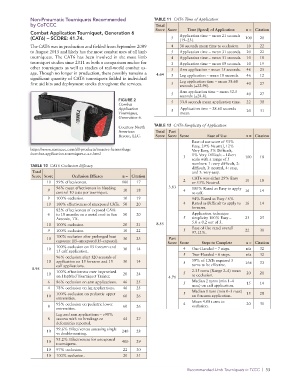
              Combat Application Tourniquet, Generation 6
              (CAT6) – SCORE: 41.74.                                    5  Application time – mean 21 seconds   100  20
                                                                           (19–23).
              The CAT6 was in production and fielded from September 2009   4  30 seconds mean time to occlusion.  10  22
              to August 2015 and likely has the most combat uses of all limb   5  Application time – mean 31 seconds.  20  22
              tourniquets. The CAT6  has  been  involved  in the  most  limb   4  Application time – mean 31 seconds.  10  18
              tourniquet studies since 2011 as both a comparison anchor for   3  Application time – mean 69 seconds.  10  19
              other tourniquets as well as studies of real-world combat us-  5  Arm application – mean 15 seconds.  46  25
              age. Though no longer in production, there possibly remains a   4.64
              significant quantity of CAT6 tourniquets fielded in individual   5  Leg application – mean 18 seconds.  46  12
              first aid kits and deployment stocks throughout the services.  5  Leg application time – mean 58.68   40  27
                                                                           seconds (±22.96).
                                                                           Arm application time – mean 52.5
                                                                        5                              40   27
                                                                           seconds (±28.8).
                                                  FIGURE 2              5  33.8 seconds mean application time.  22  30
                                                  Combat
                                                  Application           5  Application time – 28.60 seconds   20  31
                                                  Tourniquet,              mean.
                                                  Generation 6.
                                                  Courtesy North   TABLE 12  CAT6 Simplicity of Application
                                                  American       Total  Part
                                                  Rescue, LLC.   Score Score Score     Ease of Use     n =  Citation
                                                                                Ease of use score of 53%
                                                                                Easy, 29% Neutral, 12%
              https://www.narescue.com/all-products/massive-hemorrhage          Very Easy, 5% Difficult,
              /combat-application-tourniquet-c-a-t.html                         1% Very Difficult – Likert
                                                                             3                        100   18
                                                                                scale with a range of 5
              TABLE 10  CAT6 Occlusion Efficacy                                 numbers: 1: very difficult, 2:
                                                                                difficult, 3: neutral, 4: easy,
              Total                                                             and 5: very easy.
              Score Score      Occlusion Efficacy   n =  Citation               CAT6 was either 29% Easy
                    10  99% effectiveness.         180   17                  2  or 53% Neutral.       10    18
                        96% mean effectiveness in bleeding             3.83     100% Rated as Easy to apply
                     9                              10   18                  4                        16    14
                        control 10 tests per tourniquet.                        to calf.
                     9  100% occlusion.             10   19                     94% Rated as Easy / 6%
                    10  100% effectiveness of unexposed CATs. 50  20         4  Rated as Difficult to apply to  16  14
                                                                                forearm.
                        82% effectiveness of exposed CATs
                     6  to 18 months on a metal roof in San   50  20            Application technique
                        Antonio, TX.                                         5  simplicity 100% Easy –    23  25
                    10  100% occlusion.             20   21       8.55          5.0 ± 0.2 out of 5.
                     9  100% occlusion.             10   22                  5  Ease of Use rated overall   22  30
                                                                                97.12%.
                        100% occlusion after prolonged heat
                    10                              30   23            Part
                        exposure (15–unexposed/15–exposed).           Score Score   Steps to Complete  n =  Citation
                        100% occlusion on 15 forearm and
                    10                              30   14                  4  One-Handed – 7 steps.  n/a  32
                        15 calf application.                                 5  Two-Handed – 6 steps.  n/a  32
                        96% occlusion after 120 seconds of
                    10  application on 15 forearm and 15   30  14            5  59% of CATs required 3   166  33
                        calf applications.                                      turns to be effective.
              8.95                                                              2.35 turns (Range 2–4) mean
                    10  100% effectiveness over improvised   20  24          5                         20   21
                        on HapMed Tourniquet Trainer.                  4.71     to occlusion.
                     6  86% occlusion on arm applications.  46  25           5  Median 2 turns (min 1–4   15  14
                     4  78% occlusion on leg applications.  46  25              max) on calf application.
                        100% occlusion on pediatric upper                    5  Median 1 turn (min 0–3 max)   15  28
                    10                              60   26                     on forearm application.
                        extremities.
                        93% occlusion on pediatric lower                     4  Mean 4.00 turns to     20   31
                     8                              60   26                     occlusion.
                        extremities.
                        Leg and arm applications – >90%
                     8  success with no breakage or   44  27
                        deformities reported.
                    10  99.6% Effectiveness assessing single   240  28
                        vs double-routing.
                        95.2% Effectiveness for unexposed
                    10                             400   29
                        tourniquets.
                    10  97% occlusion.              22   30
                    10  100% occlusion.             20   31

                                                                              Recommended Limb Tourniquets in TCCC  |  33

