


Page 33 - JSOM Winter 2019
P. 33
wet/dry and hot/cold conditions. To be included, a tourniquet   pressure has a wide range. At the 99th percentile for males,
              device was required to have established application instruc-  the predicted occlusion pressure is (30.47 inches/1.5 inches)
              tions by the manufacturer.                         × 16.67 + 67 ≅ 405mmHg for the proximal thigh. The pre-
                                                                 dicted occlusion pressure at the proximal thigh for females at
              Some studies included a user evaluation for ease, but the de-  99th percentile is 388mmHg. The male mean proximal thigh
              fined ratings for users to choose differed from study to study.   circumference was 24.61 inches for a predicted occlusion
              The working group chose to highlight study results that in-  pressure  of 340mmHg. The  mean  predicted  occlusion pres-
              cluded Easy or Very Easy and those rated as Difficult or   sure for females (proximal thigh) was 336mmHg. As might be
              Challenging.                                       expected, the predicted occlusion pressures were significantly
                                                                 lower at the upper arm in both sexes.
              Steps to complete scoring were based on both manufacturer’s
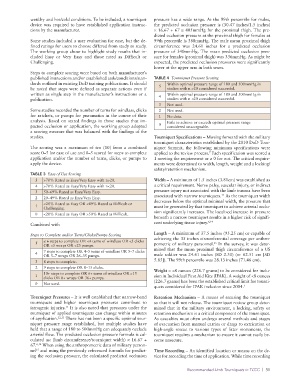
              published instructions and/or established task/conditions/stan-  TABLE 4  Tourniquet Pressure Scoring
              dards outlined in existing DoD training publications. It should   Within optimal pressure range of 180 and 500mmHg in
              be noted that steps were defined as separate actions even if   5  studies with n >20 considered successful.
              written as single step in the manufacturer’s instructions or a   Within optimal pressure range of 180 and 500mmHg in
              publication.                                         4  studies with n <20 considered successful.
                                                                   3  Not used.
              Some studies recorded the number of turns for windlass, clicks   2  Not used.
              for ratchets, or pumps for pneumatics in the course of their   1  No data.
              analysis. Based on stated findings in those studies that im-  Fails to achieve or exceeds optimal pressure range
              pacted occlusion or application, the working group adopted   0  considered unacceptable.
              a scoring measure that was balanced with the findings of the
              studies.                                           Tourniquet Specifications – Moving forward with the military
                                                                 tourniquet characteristics established by the 2010 DoD Tour-
              The scoring was a maximum of ten (10) from a combined   niquet Summit, the following minimum specifications were
              score 0–5 for ease of use and 0–5 scored for steps to complete   applied to the review process.  Each specification was scored a
                                                                                       7
              application and/or the number of turns, clicks, or pumps to   1 meeting the requirement or a 0 for not. The critical require-
              apply the device.                                  ments were determined to width, length, weight and a locking/
                                                                 safety/retention mechanism.
              TABLE 3  Ease of Use Scoring
                5  >70% Rated as Easy/Very Easy with n>20.       Width – A minimum of 1.5 inches (3.81cm) was established as
                4  >70% Rated as Easy/Very Easy with n<20.       a critical requirement. Nerve palsy, vascular injury, or indirect
                3  50–69% Rated as Easy/Very Easy.               pressure injury not associated with the limb trauma have been
                                                                                            11
                2  20–49% Rated as Easy/Very Easy.               associated with narrow tourniquets.  As the tourniquet width
                                                                 decreases below the optimal minimal width, the pressure that
                1  <20% Rated as Easy OR <49% Rated as Difficult or   must be generated by that tourniquet to achieve arterial occlu-
                   Challenging.
                0  <20% Rated as Easy OR >50% Rated as Difficult.  sion significantly increases. The localized increase in pressure
                                                                 beneath a narrow tourniquet results in a higher risk of signifi-
              Combined with                                      cant underlying tissue injury. 6,14

              Steps to Complete and/or Turns/Clicks/Pumps Scoring  Length – A minimum of 37.5 inches (95.25 cm) or capable of
                   ≤ 6 steps to complete OR <4 turns of windlass OR <5 clicks   achieving the 35 inches circumferential coverage per anthro-
                5                                                pometric of military personnel.  In the survey, it was deter-
                                                                                         15
                   OR <5 wraps OR <25 pumps.
                   7 steps to complete OR 4–5 turns of windlass OR 5–7 clicks   mined that the mean proximal thigh circumference of a US
                4                                                male soldier was 24.61 inches (SD 2.30) (or 62.51 cm [SD
                   OR 5–7 wraps OR 26–35 pumps.
                3  8 steps to complete.                          5.85]). The 99th percentile was 28.13 inches (71.46 cm).
                2  9 steps to complete OR 8–15 clicks.           Weight – <8 ounces (226.7 grams) to be considered for inclu-
                   10+ steps to complete OR 6+ turns of windlass OR >15
                1                                                sion in Individual First Aid Kits (IFAK). A weight of <8 ounces
                   clicks OR 8+ wraps OR 36+ pumps.
                0  Not used.                                     (226.7 grams) has been the established critical limit for tourni-
                                                                 quets considered for IFAK inclusion since 2004. 1
              Tourniquet Pressures – It is well established that narrow-band   Retention Mechanism – A means of securing the tourniquet
              tourniquets and higher tourniquet pressures contribute to   so that it will not release. The tourniquet review group deter-
              iatrogenic injuries.  It is also noted that pressures under the   mined that in the military environment, a locking, safety or
                            11
              tourniquet of applied tourniquets can change within minutes   retention mechanism is a critical component of the tourniquet.
              of application. 12,13  There has not been a specific optimal tour-  As casualties must often undergo several methods and stages
              niquet pressure range established, but multiple studies have   of evacuation from manual carries or drags to extrication or
              held that a range of 180 to 500mmHg can adequately occlude   high-angle  rescue  to  various  types  of  litter  movements,  the
              arterial flow. The predicted occlusion pressure formula is cal-  tourniquet requires a mechanism to ensure it cannot easily be-
              culated as: (limb circumference/tourniquet width) × 16.67 +   come unsecure.
              67. 6,14  When using the anthropometric data of military person-
              nel  and using the previously referenced formula for predict-  Time Recording – An identified location or means on the de-
                15
              ing the occlusion pressure, the calculated predicted occlusion   vice for recording the time of application. While time recording
                                                                              Recommended Limb Tourniquets in TCCC  |  31

