


Page 44 - JSOM Summer 2019
P. 44
comprised investigations of tourniquets as used by one com-  FIGURE 1  Handrail simulates an infant limb for deliberate practice
          petent user and one expert user. The expert designed the study   of tourniquet use.
          and also acted as a coach in deliberate practice of tourniquet
          use.

          The C-A-T, generation 7 was used, which has a band-and-rod
          design.  Each C-A-T is arranged in what is called the quick-
               7–9
          launch configuration, where the tourniquet’s self-adhering
          band is already routed through the tourniquet’s buckle to fas-
          ten to itself to form a loop. The loop is folded so that the tour-
          niquet is compact.  Individual tourniquets have instructions
                         10
          for use (IFU) inserted, and the tourniquet and instructions are
          packaged together in shrink wrap. The study tourniquets were
          unwrapped and IFU were removed. Individual users had their
          specific tourniquet for deliberate practice.
          The practice setup was designed to be demonstrably suitable
          for a public user to practice on an everyday object instead of
          on themselves or a manikin. The practice platform selected
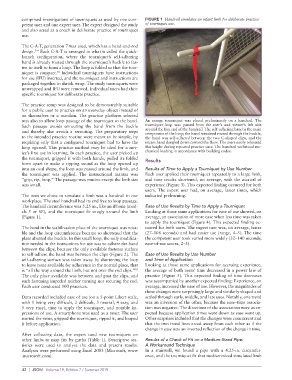
          was also to allow loop passage of the tourniquet so the band.   An orange tourniquet was placed preliminarily on a handrail. The
          Such passage avoids unrouting the band from the buckle   tourniquet loop was passed from the user’s and viewer’s left side
          and thereby also avoids a rerouting. The preparatory steps   around the free end of the handrail. The self-adhering band is the main
                                                             component of the loop; the band remained routed through the buckle,
          to the intended practice routine were meant to be simple, by   the band was self-adhered between the two C-shaped clips, and the
          requiring only that a configured tourniquet had to have the   excess band dangled down toward the floor. The users easily tolerated
          loop opened. This practice method may be ideal for a nov-  this height during repeated practice uses. The handrail withstood me-
          ice’s first use in learning. In each practice, the user picked up   chanical loading in accordance with building codes.
          the tourniquet, gripped it with both hands, pulled its folded   Results
          form apart to make a ripping sound as the loop opened up
          into an oval shape, the loop was passed around the limb, and   Results of Time to Apply a Tourniquet by Use Number
          the tourniquet was applied. The instructional mantra was   Each user applied their tourniquet repeatedly to a large limb,
          “grip, rip, loop.” The passage was routine except the limb size    and time results shortened, on average, with the accrual of
          was small.                                         experience (Figure 3). This expected finding occurred for both
                                                             users. The expert user had, on average, faster times, which
          The item we chose to simulate a limb was a handrail in our   indicated prelearning.
          workplace. The steel handrail had its end free to loop passage.
          The handrail circumference was 5.25 in., like an iPhone (mod-  Ease of Use Results by Time to Apply a Tourniquet
          els 5 or SE), and the tourniquet fit snugly around the limb   Looking at those same applications for ease of use showed, on
          (Figure 1).                                        average, an association of more ease when less time was taken
                                                             to apply the tourniquet (Figure 4). This expected finding oc-
          The bend in the stabilization plate of the tourniquet was nota-  curred for both users. The expert user was, on average, faster
          ble and the loop circumference became so shortened that the   (27–108 seconds) and had easier use (range, 4–5). The time
          plate abutted the buckle. In this small loop, the only modifica-  the competent user took varied more widely (32–140 seconds;
          tion needed in the instructions for use was to adhere the band   ease-of-use scores, 2–5).
          between the clips, because the only available fastener surface
          to self-adhere the band was between the clips (Figure 2). The   Ease of Use Results by Use Number
          self-adhering surface was taken away by shortening the loop   and Time of Application
          to leave none available for adherence in the normal place, that   Looking at those same applications for accruing experience,
          is “all the way around the limb, but not over the rod clips.”    the average of both users’ time decreased in a power law of
                                                         10
          The only place available was between and past the clips, and   practice (Figure  5). This expected finding of time decreases
          such fastening impeded neither turning nor securing the rod.   was accompanied by another expected finding: Experience, on
          Each user conducted 100 practices.                 average, increased the ease of use. However, the magnitudes of
                                                             those changes were surprisingly large and similarly shaped and
          Data recorded included ease of use (on a 5-point Likert scale,   scaled through early, middle, and late uses. Notably, one trend
          with 1 being very difficult, 2 difficult, 3 neutral, 4 easy, and   was an inversion of the other, because the ease–time associa-
          5 very easy), time to apply the tourniquet, and notable im-  tion was negative. The directions of the association were as ex-
          pressions of use. A smartphone was used as a timer. The user   pected because application times went down as ease went up.
          started the timer, gripped the tourniquet, ripped it, and looped   Other surprises included that the changes were concurrent and
          it before application.                             that the two trend lines arced away from each other as if the
                                                             change in ease was an inverted reflection of the change in time.
          After collecting  data, the expert used  new tourniquets on
          other limbs to map fits by girths (Table 1). Descriptive sta-  Results of a Check of Fit on a Medium-Sized Pipe:
          tistics were used to analyze the data and present results.   A Workaround Technique
          Analyses were performed using Excel 2003 (Microsoft, www   In a stairwell, we found a pipe with a 4.25-in. circumfer-
          .microsoft.com).                                   ence, and the tourniquet fit that medium-sized simulated limb


          42  |  JSOM   Volume 19, Edition 2 / Summer 2019

