


Page 16 - JSOM Summer 2019
P. 16
Mottled, Blanching Skin Changes After Aggressive Diving


                                                                       2
                                            1
                        Amanda M. Lau, MD *; Mickaila J. Johnston, MD ; Shayna C. Rivard, MD   3


          ABSTRACT
          The initial livedo skin changes of cutis marmorata, also known
          as cutaneous decompression sickness (DCS), are transient in
          nature. Accordingly, early images of violaceous skin changes
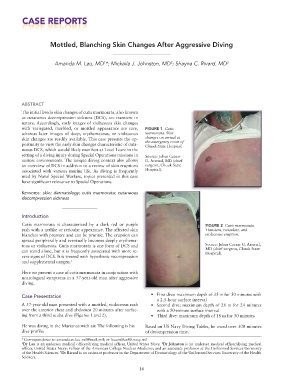
          with variegated, marbled, or mottled appearance are rare,   FIGURE 1  Cutis
          whereas later images of deep, erythematous, or violaceous   marmorata. Skin
          skin changes are readily available. This case presents the op-  changes on arrival at
          portunity to view the early skin changes characteristic of cuta-  the emergency room of
                                                             Chuuk State Hospital.
          neous DCS, which would likely manifest at Level I care in the
          setting of a diving injury during Special Operations missions in   Source: Julius Caesar
          austere environments. The unique diving context also allows   G. Arsenal, MD (chief
          an overview of DCS in addition to a review of skin eruptions   surgeon, Chuuk State
          associated with various marine life. As diving is frequently   Hospital).
          used by Naval Special Warfare, topics presented in this case
          have significant relevance to Special Operations.

          Keywords:  skin; dermatology; cutis marmorata; cutaneous
          decompression sickness


          Introduction
          Cutis marmorata is characterized by a dark red or purple                    FIGURE 2  Cutis marmorata.
          rash with a netlike or reticular appearance. The affected skin              Transient, reticulate, and
          blanches with pressure and can be pruritic. The eruption can                violaceous eruption.
          spread peripherally and eventually becomes deeply erythema-
          tous or violaceous. Cutis marmorata is one form of DCS and                  Source: Julius Caesar G. Arsenal,
          can stand alone, but it is frequently associated with more se-              MD (chief surgeon, Chuuk State
                                                                                      Hospital).
          vere signs of DCS. It is treated with hyperbaric recompression
          and supplemental oxygen. 1

          Here we present a case of cutis marmorata in conjunction with
          neurological symptoms in a 57-year-old man after aggressive
          diving.


          Case Presentation                                    •  First dive: maximum depth of 35 m for 50 minutes with
                                                                  a 2.5-hour surface interval
          A 57-year-old man presented with a mottled, violaceous rash   •  Second dive: maximum depth of 28 m for 24 minutes
          over the anterior chest and abdomen 20 minutes after surfac-  with a 50-minute surface interval
          ing from a third scuba dive (Figures 1 and 2).       •  Third dive: maximum depth of 18 m for 30 minutes

          He was diving in the Marianas with air. The following is his   Based on US Navy Diving Tables, he owed over 300 minutes
          dive profile:                                      of decompression time.
          *Correspondence to amanda.m.lau.mil@mail.mil; or lauam@as40.navy.mil
          1 Dr Lau is an undersea medical officer/diving medical officer, United States Navy.  Dr Johnston is an undersea medical officer/diving medical
                                                                    2
          officer, United States Navy; Fellow of the American College Nuclear Medicine; and an associate professor at the Uniformed Services University
          of the Health Sciences.  Dr Rivard is an assistant professor in the Department of Dermatology of the Uniformed Services University of the Health
                          3
          Sciences.
                                                           14

