


Page 111 - JSOM Winter 2018
P. 111
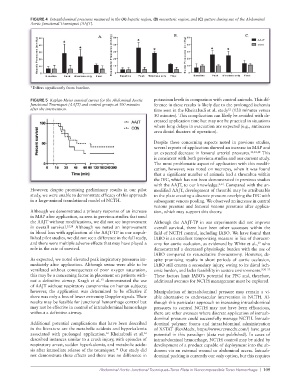
FIGURE 4  Intraabdominal pressures measured in the (A) hepatic region, (B) mesenteric region, and (C) gutters during use of the Abdominal
              Aortic Junctional Tourniquet (AAJT).


              *Differs significantly from baseline.

              FIGURE 5  Kaplan-Meier survival curves for the Abdominal Aortic   potassium levels in comparison with control animals. This dif-
              Junctional Tourniquet (AAJT) and control groups at 300 minutes   ference in these results is likely due to the prolonged ischemia
              after the intervention.                            time seen in the Kheirabadi et al. study  (120 minutes versus
                                                                                               12
                                                                 30 minutes). This complication can likely be avoided with de-
                                                                 creased application time but may not be practical in situations
                                                                 where long delays in evacuation are expected (e.g., antiaccess
                                                                 area denial theaters of operation).

                                                                 Despite these concerning aspects noted in previous studies,
                                                                 several reports of application showed an increase in MAP and
                                                                 an expected decrease in femoral arterial pressures. 11,12,18  This
                                                                 is consistent with both previous studies and our current study.
                                                                 The most problematic aspect of application with this modifi-
                                                                 cation, however, was noted on necropsy, when it was found
                                                                 that a significant number of animals had a thrombus within
                                                                 the IVC, which has not been demonstrated in previous studies
                                                                 with the AAJT, to our knowledge. 2,17,  Compared with the un-
              However, despite promising preliminary results in our pilot   modified AAJT, development of thrombi may be attributable
              study, we were unable to demonstrate efficacy of this approach   to the plate creating a discrete pressure overlying the IVC with
              in a large-animal translational model of NCTH.     subsequent venous pooling. We observed an increase in central
                                                                 venous pressure and femoral venous pressures after applica-
              Although we demonstrated a primary response of an increase   tion, which may support this theory.
              in MAP after application, as seen in previous studies that used
              the AAJT without modifications, we did not see improvement   Although the AAJT-TP in our experiments did not improve
              in overall survival. 12,18  Although we noted an improvement   overall survival, there have been other successes within the
              in blood loss with application of the AAJT-TP in our unpub-  field of NCTH control, including IABO. We have found that
              lished pilot studies, we did not see a difference in the full study,   IABO is an excellent temporizing measure in lieu of thoracot-
              and there were multiple adverse effects that may have played a   omy for aortic occlusion, as evidenced by White et al.,  who
                                                                                                           19
              role in the rate of survival.                      demonstrated a decreased physiologic burden with the use of
                                                                 IABO compared to resuscitative thoracotomy. However, de-
              As expected, we noted elevated peak inspiratory pressures im-  spite promising results in short periods of aortic occlusion,
              mediately after application. Although swine were able to be   IABO still creates a secondary injury, owing to its distal isch-
              ventilated without consequences of poor oxygen saturation,   emic burden, and lacks feasibility in austere environments. 9,20–22
              this may be a concerning factor in placement on patients with-  These factors limit IABO’s potential for PFC and, therefore,
              out a definitive airway. Kragh et al.  demonstrated the use   additional avenues for NCTH management must be explored.
                                           13
              of AAJT without respiratory compromise on human subjects;
              however, the application was determined to be effective if   Manipulation of intraabdominal pressure may remain a vi-
              there was only a loss of lower extremity Doppler signals. Their   able alternative to endovascular intervention in NCTH. Al-
              results may be feasible for junctional hemorrhage control but   though this particular approach to increasing intraabdominal
              may not be effective in control of intraabdominal hemorrhage   pressures  to  control  NCTH  may  not  have  been  efficacious,
              without a definitive airway.                       there are other avenues where discrete application of intraab-
                                                                 dominal pressure could successfully manage NCTH. Intraab-
              Additional potential complications that have been described   dominal polymer foams and intraabdominal administration
              in the literature are the metabolic acidosis and hyperkalemia   of XSTAT (RevMedx, https://www.revmedx.com/) have great
              associated with prolonged application.  Kheirabadi et al.    potential in this paradigm (data not published). In cases of
                                             12
                                                            12
              described instances similar to a crush injury, with episodes of   intraabdominal hemorrhage, NCTH control may be aided by
              respiratory arrest, sudden hyperkalemia, and metabolic acido-  development of a product capable of deployment into the ab-
              sis after immediate release of the tourniquet.  Our study did   domen via an external wound or abdominal access. Intraab-
                                                 12
              not demonstrate these effects and there was no difference in   dominal packing is currently our only option, but this requires
                                          Abdominal Aortic Junctional Tourniquet–Torso Plate in Noncompressible Torso Hemorrhage  |  109

