


Page 170 - JSOM Spring 2018
P. 170
Committee on Tactical Combat Casualty Care

                                                 Meeting Minutes


                                   6–7 September, 2017; San Antonio, TX


                                          Dr Frank Butler; Dr Stephen Giebner


          Wednesday, 6 September 2017                        despite the potential for additional IEDs and rescued SGT
          Chairman’s Welcome: Dr Frank Butler, Chairman of the   Hartswick and another wounded Soldier and transported
          CoTCCC, called the meeting to order and had attendees in-  them to a Role 3 medical treatment facility.
          troduce themselves. Dr Butler briefly reviewed the Commit-  Now, 3 years and 21 surgeries later, thankful for his sec-
          tee’s progress in prehospital combat trauma care since 2001,   ond chance that he has been given, SGT Hartswick works tire-
          its current knowledge products, and performance improve-  lessly to train others in TCCC through his role as a TCCC
          ment methodology. He then reviewed the agenda and asked   instructor with Techline Trauma, training mostly law enforce-
          for disclosures from the attendees. Several disclosures were   ment officers and SWAT teams—over 7000 individuals in 15
          noted. Dr John Holcomb has a financial interest in the Junc-  months. In his words: “I’ve seen it save lives.”
          tional Emergency Treatment Tool, one of the three CoTCCC-  In the question and answer period, SGT Hartswick re-
          recommended junctional tourniquets. Dr Russ Kotwal and Mr   marked that he did not have any significant pain during his
          Harold Montgomery consult for LynnTech, a company that   helicopter evacuation, despite the gravity of his wounds. He
          manufactures blood analysis technology.            attributes this  to the adrenaline produced  by his wounding
              Mr Harold Montgomery received a special award from   scenario.
          the Knowesis contracting company presented by Mr Scott   He was very grateful that the first sergeant in his unit had
          Cooper. The award noted Mr Montgomery’s remarkable con-  insisted that unit members wear “Combat Diapers”—a pro-
          tributions to the CoTCCC and the JTS during the short time   tective garment that covered his urogenital area and prevented
          that that he has been on the team. The award consisted of a   any damage to that region.
          Knowesis coin, a Certificate of Excellence, and a cash bonus.  He also noted that his unit received outstanding TCCC
                                                             training from their Medical Simulation Training Center
          2. Combat Medic Presentation: SGT Adam Hartswick started   (MSTC) and emphasized TCCC training, especially tourniquet
          his presentation by saying: “I am here to tell you about the   application, during the unit’s down time in theater. SGT Harts-
          worst day of my life and to let you know that I am alive today   wick received a sustained standing ovation from the group.
          because of TCCC.” His injuries were sustained in Afghanistan
          on 14 May 2013. There was a dismounted IED (dIED) attack
          outside of his base in Zhari province. He was the company
          senior medic and responded to an attack on the company’s
          Second Platoon. He was not on the mission, but when he
          heard that his some of his unit’s members had been injured, he
          jumped into the back of a responding Quick Response Force
          (QRF) vehicle and rushed to aid his teammates.
              When he got to the point where the IED had detonated,
          he found the junior platoon medic and two other unit mem-
          bers dead. The company’s EOD team leader arrived on scene,
          spoke a few words of reassurance to SGT Hartswick, and then
          was killed a few seconds later as he approached another IED.
          SGT Hartswick suffered minor injuries from that explosion
          but continued his duties as a medic, until another IED ex-
          ploded shortly thereafter, causing devastating injuries to both
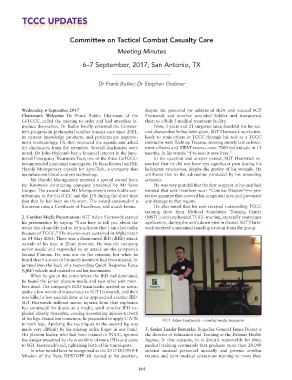
          of his legs. Dazed but conscious, he proceeded to apply C-A-Ts   SGT Adam Hartswick – combat medic presenter
          to both legs. Applying the tourniquet to the second leg was
          made very difficult by his missing index finger in one hand.   3. Senior Leader Remarks: Brigadier General James Dienst is
          His platoon leader, who had been trained in TCCC, ignored   the director of Education and Training at the Defense Health
          the danger presented by the possibility of more IEDs and came   Agency. In that capacity, he is directly responsible for three
          to SGT Hartswick’s aid, tightening both of his tourniquets.  medical training commands that graduate more than 20,000
              In what would later be recognized as the 2013 DUSTOFF   enlisted  medical  personnel  annually  and  provide  combat
          Mission of the Year,  DUSTOFF 68 landed at his position,   trauma and joint medical operations training to more than

                                                          164

