


Page 174 - JSOM Spring 2018
P. 174
concern about the potential for exacerbation of hemorrhage at
                                                             bleeding sites proximal to the site of aortic occlusion with the
                                                             AAJT. Similar concerns apply to Zone III REBOA.

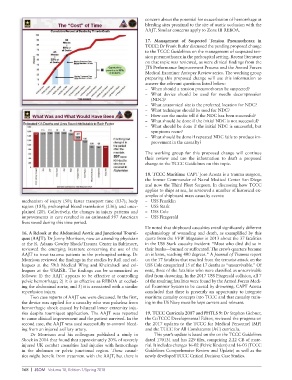
                                                             17. Management of Suspected Tension Pneumothorax in
                                                             TCCC: Dr Frank Butler discussed the pending proposed change
                                                             to the TCCC Guidelines on the management of suspected ten-
                                                             sion pneumothorax in the prehospital setting. Recent literature
                                                             on that topic was reviewed, as were clinical findings from the
                                                             JTS Performance Improvement Process and the Armed Forces
                                                             Medical Examiner Autopsy Review series. The working group
                                                             preparing this proposed change will use this information to
                                                             answer the relevant questions listed below:
                                                                – When should a tension pneumothorax be suspected?
                                                                – What device should be used for needle decompression
                                                               (NDC)?
                                                                – What anatomical site is the preferred location for NDC?
                                                                – What technique should be used for NDC?
                                                                – How can the medic tell if the NDC has been successful?
                                                                – What should be done if the initial NDC is not successful?
                                                                – What should be done if the initial NDC is successful, but
                                                               symptoms recur?
                                                                – What should be done if repeated NDC fails to produce im-
                                                               provement in the casualty?

                                                             The  working  group  for  this  proposed  change  will  continue
                                                             their review and use the information to draft a proposed
                                                             change to the TCCC Guidelines on this topic.

                                                             18. TCCC Maritime: CAPT Jose Acosta is a trauma surgeon,
                                                             the former Commander of Naval Medical Center San Diego
                                                             and now the Third Fleet Surgeon. In discussing how TCCC
                                                             applies to ships at sea, he reviewed a number of historical ex-
                                                             amples of shipboard mass casualty events:
          mechanism of injury (50); faster transport time (137); body     – USS Franklin
          region (185); prehospital blood transfusion (236); and unex-    – USS Stark
          plained (20). Collectively, the changes in injury patterns and     – USS Cole
          improvements in care resulted in an estimated 597 American     – USS Fitzgerald
          lives saved during this time period.
                                                             He noted that shipboard casualties entail significantly different
          16. A Relook at the Abdominal Aortic and Junctional Tourni-  epidemiology of wounding and death, as exemplified by this
          quet (AAJT): Dr Jonny Morrison, now an attending physician   quote from the VFW Magazine in 2013 about the 37 fatalities
          at the R. Adams Cowley Shock/Trauma Center in Baltimore,   in the USS Stark casualty incident: “Most who died did so in
          reviewed the emerging literature concerning the use of the   their bunks—burned or suffocated. The crew’s quarters became
          AAJT to treat trauma patients in the prehospital setting. Dr   an inferno, reaching 400 degrees.” A Journal of Trauma report
          Morrison reviewed the findings in the studies by Rall and col-  on the 17 fatalities that resulted from the terrorist attack on the
          leagues at the 59th Medical Wing and Kheirabadi and col-  USS Cole categorized 15 of the 17 deaths as “unsurvivable.” Of
          leagues at the USAISR. The findings can be summarized as   note, three of the fatalities who were classified as unsurvivable
          follows: 1) the AAJT appears to be effective at controlling   died from drowning. In the 2017 USS Fitzgerald collision, all 7
          pelvic hemorrhage; 2) it is as effective as REBOA at occlud-  of the resulting fatalities were found by the Armed Forces Medi-
          ing the abdominal aorta; and 3) it is associated with a similar   cal Examiner System to be caused by drowning. CAPT Acosta
          reperfusion injury.                                concluded that there is presently an opportunity to integrate
              Two case reports of AAJT use were discussed. In the first,   maritime casualty concepts into TCCC and that casualty train-
          the device was applied for a casualty who was pulseless from   ing in the US Navy must be kept current and relevant.
          hemorrhagic shock caused by bilateral lower extremity inju-
          ries  despite tourniquet application. The  AAJT was  reported   19. TCCC Curricula 2017 and PHTLS 9: Dr Stephen Giebner,
          to cause clinical improvement and the patient survived. In the   the CoTCCC Developmental Editor, reviewed the progress on
          second case, the AAJT was used successfully to control bleed-  the 2017 updates to the TCCC for Medical Personnel (MP)
          ing from an injured axillary artery.               and the TCCC for All Combatants (AC) curricula.
              Dr Morrison and his colleagues published a study in   This year’s update is based on the on the TCCC Guidelines
          Shock in 2014 that found that approximately 20% of severely   dated 170131 and has 229 files, comprising 2.22 GB of mate-
          injured UK combat casualties had injuries with hemorrhage   rial. It includes changes 16-02 (Pelvic Binders) and 16-03 (TCCC
          in  the  abdomen  or  pelvic  junctional  region.  These  casual-  Guidelines Comprehensive Review and Update) as well as the
          ties might benefit from treatment with the AAJT, but there is   newly developed TCCC Critical Decision Case Studies.


          168  |  JSOM   Volume 18, Edition 1/Spring 2018

