


Page 127 - JSOM Spring 2018
P. 127
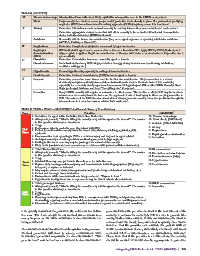
TABLE 4  (MARCHE) 2
              M 2    Massive hemorrhage Massive blood loss is the most likely rapid killer of casualties even in the CBRN environment.
                     Mask           Help casualty don mask or ensure proper seal if protective mask already in place. If a powered air purifying
                                    respirator (PAPR) or self-contained breathing apparatus (SCBA) in place, ensure it is functional.
              A 2    Airway         Determine if it makes sense to unmask casualty for airway intervention in a contaminated environment.
                                    Determine appropriate airway device that will allow casualty to be re-masked if indicated. Is resuscitator
                                    device individual chemical (RDIC) indicated?
                     Antidotes      If casualty will die before decontamination (i.e., nerve agent exposure or cyanide), administer antidotes
                                                          ®
                                    (ATNAA, CANA, or Cyanokit ).
              R 2    Respirations   Determine if respiratory symptoms are caused by agent or trauma.
                     Rapid spot     RSD indicated if agent can be seen on skin or there is a breach in PPE. Apply RSDL, M295, Sorbent, tech
                     decontamination   wipe, or plain irrigation. Rapid decontamination of the eyes with water or normal saline is imperative due to
                     (RSD)          eye sensitivity.
              C 2    Circulation    Determine if circulation issues are caused by agent or trauma.
                     Countermeasures  Nebulized medications, IV/IO drips, chelation therapy, airway maintenance (suctioning, intubation,
                                    ventilator settings, etc.)
              H 2    Hypothermia    Prevent hypothermia, especially in setting of decontamination.
                     Head wounds    Determine if altered mental status (AMS) is due to agent or trauma.
              E 2    Evacuate       Determine evacuation asset. Assess need for further decontamination. Dirty evacuation to a robust
                                    doctrinally complete and fully manned decontamination site may be the best choice if it is available,
                                    especially for extremely deadly agents such as nerve or biological agent. Fill out the CBRN Casualty Card.
                                    Begin prolonged field care and treat “Everything else” if required.
                     Extraction     Every CBRN casualty will require an extraction to effect rescue. The hot line or dirty CCP may be hundreds
                                    of meters or more away from the hot zone. Be cognizant of risk of heat injury to those carrying casualties in
                                    PPE. The nature of the CBRN environment almost always presents casualty extraction problems through the
                                    phases of care (e.g., confined space, vehicle, high angle, etc.).

              TABLE 5  TCCC + CBRN = (MARCHE)² Priorities and Phases of Care Summary
              Zone                                  Priorities                                   (MARCHE) 2
                    •  Sometimes the agent is like the bullet, think Care Under Fire.     M: Massive hemorrhage
                    •  Always ask yourself, “What is killing the casualty now, is it the agent or the wound?” The answer   M: Mask check, (PAPR/tank)
                      to this question dictates your treatments.                          A: Antidote (ATNAA/CANA)
                    •  Triage
                    •  Only expose what is needed to save life, follow with RSD.          A: Airway
              Hot   •  Protect yourself and the casualty from the threat: time, distance, shielding; upwind, uphill,   R: Respirations
              Zone    upstream.                                                           R: Rapid spot decontamination
                    •  Heat casualties from operating in PPE is a common injury and may not be agent related.  E: Extraction
                    •  Anticipate casualty extraction problem: confined space, vehicle, high angle, etc.
                    •  Getting to the warm zone may require prolonged movement of the casualty.
                    •  Dirty medic (contaminated and cannot cross to cold zone with patient until decontaminated).
                    •  Think Tactical Field Care                                          MAR reassessment
                    •  Always ask yourself, “What is killing the casualty now, is it the agent or the wound?” The answer   C: Circulation and shock status
                      to this question dictates your treatments.                          C: Countermeasures (drips)
                    •  Triage
                    •  Minimal lifesaving care, get them to the cold zone for definitive care.  H: Hypothermia
              Warm                                                                        H: Head wounds
              Zone  •  Replace dirty dressings and tourniquets, and decontaminate indwelling equipment (IV ports, ET
                      tubes, etc.) or replace as indicated.
                    •  May require advanced airway management (cricothyroidotomy, endotracheal intubation, etc.).
                    •  Cutout and thorough decontamination.
                    •  Do treatments while decontamination is being conducted. “Expose to treat.”
                    •  Hypothermia is a big threat due to exposure during the time it takes to decontaminate.
                    •  Think prolonged field care                                         MARCH reassessment
                    •  Always ask yourself, “What is killing the casualty now, is it the agent or the wound?” The answer   E: Evacuation
                      to this question dictates your treatments.
              Cold   •  Triage
              Zone  •  Hypothermia
                    •  Receiving medical personnel may have little to no experience with CBRN, anticipate fear, misun-
                      derstanding, requiring another unneeded decontamination process and/or an unwillingness to treat.
                    •  Clean medic (remains on cold zone side of hot line and not exposed to contaminated casualties).

              is to quickly transition the patient to the cold zone for defini-  personnel when the provider deems it in the best interest of the
              tive care. The focus should be on medical interventions nec-  casualty to remove the casualty’s PPE in order to provide life-
              essary to preserve life while simultaneous decontamination is   saving medical intervention. In this circumstance, the mask is
              being conducted.                                   removed and the head, face, and chest is quickly decontami-
                                                                 nated so that the provider can ventilate the patient with an
              Decontamination and treatment can be synchronous processes.   RDIC  (resuscitation  device,  individual,  chemical)  and  insert
              Medical  personnel will  need  to clearly  communicate  with   a sternal IO if countermeasures are immediately indicated.
              nonmedical personnel responsible for decontamination. “Ex-  Please note that if the provider is on filtered air, the casualty
              pose to treat” can be used as a command to decontamination   should be as well. It would also be appropriate to prioritize

                                                                       Integrating CBRN Protocols Into TCCC: (MARCHE)   |  121
                                                                                                           2

