


Page 9 - Journal of Special Operations Medicine - Fall 2017
P. 9
The Special Talk: An Interview this issue is with COL (Ret)   This issue’s Book Reviews are Front Line Surgery: A Practical
              Lutz: “We Cannot Afford to Lose the Lessons We Have   Approach, reviewed by Farr, and War Reminiscences by the
              Learned:  Bob  Lutz’s  Reflections  on  a  20-Year  SOF  Medical   Surgeon of Mosby’s Command, reviewed by Neal.
              Career,” as interviewed by Pennardt.

              The World of Special Operations Medicine  brings us “Re-
              mote Dental Surgery as a Medical Civilian Assistance Program
              (MEDCAP):  Helping  Iraqi,  Kurdish,  and  U.S.  Forces  Win
              Hearts and Minds in the Fight Against Daesh,” by Ferreira.


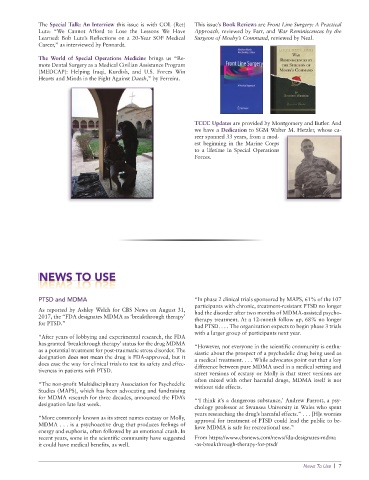
                                                                 TCCC Updates are provided by Montgomery and Butler. And
                                                                 we have a Dedication to SGM Walter M. Hetzler, whose ca-
                                                                 reer spanned 33 years, from a mod-
                                                                 est beginning in the Marine Corps
                                                                 to a lifetime in Special Operations
                                                                 Forces.


              PTSD and MDMA                                      “In phase 2 clinical trials sponsored by MAPS, 61% of the 107
                                                                 participants with chronic, treatment-resistant PTSD no longer
              As reported by Ashley Welch for CBS News on August 31,   had the disorder after two months of MDMA-assisted psycho-
              2017, the “FDA designates MDMA as ‘breakthrough therapy’   therapy treatment. At a 12-month follow up, 68% no longer
              for PTSD.”
                                                                 had PTSD. . . . The organization expects to begin phase 3 trials
                                                                 with a larger group of participants next year.
              “After years of lobbying and experimental research, the FDA
              has granted ‘breakthrough therapy’ status for the drug MDMA   “However, not everyone in the scientific community is enthu-
              as a potential treatment for post-traumatic stress disorder. The   siastic about the prospect of a psychedelic drug being used as
              designation does not mean the drug is FDA-approved, but it   a medical treatment. . . . While advocates point out that a key
              does ease the way for clinical trials to test its safety and effec-  difference between pure MDMA used in a medical setting and
              tiveness in patients with PTSD.
                                                                 street versions of ecstasy or Molly is that street versions are
                                                                 often mixed with other harmful drugs, MDMA itself is not
              “The non-profit Multidisciplinary Association for Psychedelic   without side effects.
              Studies (MAPS), which has been advocating and fundraising
              for MDMA research for three decades, announced the FDA’s   “‘I think it’s a dangerous substance,’ Andrew Parrott, a psy-
              designation late last week.
                                                                 chology professor at Swansea University in Wales who spent
                                                                 years researching the drug’s harmful effects.” . . . [H]e worries
              “More commonly known as its street names ecstasy or Molly,   approval for treatment of PTSD could lead the public to be-
              MDMA . . . is a psychoactive drug that produces feelings of   lieve MDMA is safe for recreational use.”
              energy and euphoria, often followed by an emotional crash. In
              recent years, some in the scientific community have suggested   From https://www.cbsnews.com/news/fda-designates-mdma
              it could have medical benefits, as well.           -as-breakthrough-therapy-for-ptsd/


                                                                                                    News To Use  |  7

