


Page 8 - Journal of Special Operations Medicine - Fall 2017
P. 8
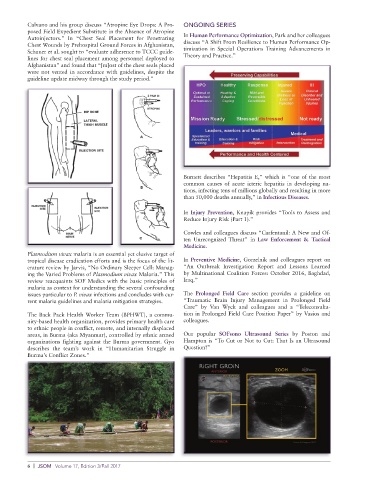
Calvano and his group discuss “Atropine Eye Drops: A Pro-  ONGOING SERIES
          posed Field Expedient Substitute in the Absence of Atropine
          Autoinjectors.”  In  “Chest  Seal  Placement  for  Penetrating   In Human Performance Optimization, Park and her colleagues
          Chest Wounds by Prehospital Ground Forces in Afghanistan,   discuss “A Shift From Resilience to Human Performance Op-
          Schauer et al. sought to “evaluate adherence to TCCC guide-  timization in Special Operations Training Advancements in
          lines for chest seal placement among personnel deployed to   Theory and Practice.”
          Afghanistan” and found that “[m]ost of the chest seals placed
          were not vented in accordance with guidelines, despite the
          guideline update midway through the study period.”


                                                             Burnett describes “Hepatitis E,” which is “one of the most
                                                             common causes of acute icteric hepatitis in developing na-
                                                             tions, infecting tens of millions globally and resulting in more
                                                             than 50,000 deaths annually,” in Infectious Diseases.

                                                             In Injury Prevention, Knapik provides “Tools to Assess and
                                                             Reduce Injury Risk (Part 1).”

                                                             Cowles and colleagues discuss “Carfentanil: A New and Of-
                                                             ten Unrecognized Threat” in  Law Enforcement & Tactical
                                                             Medicine.
          Plasmodium vivax malaria is an essential yet elusive target of
          tropical disease eradication efforts and is the focus of the lit-  In Preventive Medicine, Gorzelnik and colleagues report on
          erature review by Jarvis, “No Ordinary Sleeper Cell: Manag-  “An Outbreak Investigation Report and Lessons Learned
          ing the Varied Problems of Plasmodium vivax Malaria.” This   by Multinational Coalition Forces: October 2016, Baghdad,
          review reacquaints SOF Medics with the basic principles of   Iraq.”
          malaria as context for understanding the several confounding
          issues particular to P. vivax infections and concludes with cur-  The  Prolonged Field Care section provides a guideline on
          rent malaria guidelines and malaria mitigation strategies.  “Traumatic Brain Injury Management in Prolonged Field
                                                             Care” by Van Wyck and colleagues and a “Teleconsulta-
          The Back Pack Health Worker Team (BPHWT), a commu-  tion in Prolonged Field Care Position Paper” by Vasios and
          nity-based health organization, provides primary health care   colleagues.
          to ethnic people in conflict, remote, and internally displaced
          areas, in Burma (aka Myanmar), controlled by ethnic armed   Our popular  SOFsono Ultrasound Series  by Poston and
          organizations fighting against the Burma government. Gyo   Hampton is “To Cut or Not to Cut: That Is an Ultrasound
          describes the team’s work in “Humanitarian Struggle in   Question!”
            Burma’s Conflict Zones.”


          6  |  JSOM   Volume 17, Edition 3/Fall 2017

