


Page 7 - Journal of Special Operations Medicine - Fall 2017
P. 7
by Allison Esposito, Managing Editor


              CASE REPORTS                                       Surgical Treatment Team Operational Concept: Experience
                                                                 of the 102nd Forward Surgical Team in Operation Freedom’s
              In the first case report in this issue, Boni and Amann report the   Sentinel 2015–2016,” Benavides et al. report the experience of
              case of a 27-year-old male U.S. Marine who sustained a heat-  the 102nd FST during deployment to Afghanistan in support
              related illness resulting in fulminant liver failure and perma-  of Operation  Freedom’s  Sentinel/Resolute  Support Mission,
              nent disability in “Exertional Heat Illness Resulting in Acute   which provided small, ultramobile surgical teams supporting
              Liver Failure and Liver Transplantation.” Schauer et al. report   SOF teams conducting train, advise, and assist operations.
              that four cases of prehospital surgical airway cannulation on
              the battlefield demonstrated three successful uses of prehospi-  “Estimation of Dog-Bite Risk and Related Morbidity Among
              tal cricothyrotomy kits, in “Prehospital Cricothyrotomy Kits   Personnel Working With Military Dogs,” by Schermann, re-
              Used in Combat: A Case Series.” And Levri and colleagues   ports on military dog bites among soldiers serving in the Israel
              discuss the “Use of Acetylsalicylic Acid in the Prehospital Set-  Defense Force Military Working Dogs Unit. In “Prehospital
              ting for Suspected Acute Ischemic Stroke.”         Administration of Tranexamic Acid by Ground Forces in
                                                                 Afghanistan: The Prehospital Trauma Registry Experience,”
              FEATURE ARTICLES                                   Schauer and colleagues describe the prehospital administra-
                                                                 tion of TXA by ground forces in the Afghanistan combat
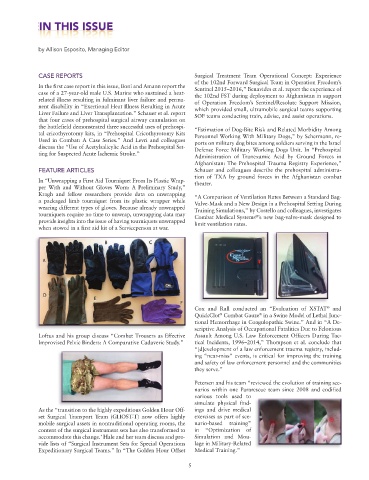
              In “Unwrapping a First Aid Tourniquet From Its Plastic Wrap-  theater.
              per With and Without Gloves Worn: A Preliminary Study,”
              Kragh and fellow researchers provide data on unwrapping   “A Comparison of Ventilation Rates Between a Standard Bag-
              a packaged limb tourniquet from its plastic wrapper while   Valve-Mask and a New Design in a Prehospital Setting During
              wearing different types of gloves. Because already unwrapped   Training Simulations,” by Costello and colleagues, investigates
              tourniquets require no time to unwrap, unwrapping data may   Combat Medical Systems ’s new bag-valve-mask designed to
                                                                                     ®
              provide insights into the issue of having tourniquets unwrapped   limit ventilation rates.
              when stowed in a first aid kit of a Serviceperson at war.


                                                                                                            ®
                                                                 Cox and Rall conducted an “Evaluation of XSTAT  and
                                                                                      ®
                                                                 QuickClot  Combat Gauze  in a Swine Model of Lethal Junc-
                                                                         ®
                                                                 tional Hemorrhage in Coagulopathic Swine.” And in “A De-
                                                                 scriptive Analysis of Occupational  Fatalities Due to Felonious
              Loftus and his group discuss “Combat Trousers as Effective   Assault Among U.S. Law Enforcement  Officers During Tac-
              Improvised Pelvic Binders: A Comparative Cadaveric Study.”  tical Incidents, 1996–2014,” Thompson et al. conclude that
                                                                 “[d]evelopment of a law enforcement trauma registry, includ-
                                                                 ing “near-miss” events, is critical for improving the training
                                                                 and safety of law enforcement personnel and the communities
                                                                 they serve.”
                                                                 Petersen and his team “reviewed the evolution of training sce-
                                                                 narios within one Pararescue team since 2008 and codified
                                                                 various tools  used to
                                                                 simulate physical find-
              As the “transition to the highly expeditious Golden Hour Off-  ings and drive  medical
              set  Surgical  Transport  Team  (GHOST-T)  now  offers  highly   exercises as part of sce-
              mobile surgical assets in nontraditional operating rooms, the   nario-based training”
              content of the surgical instrument sets has also transformed to   in “Optimization of
              accommodate this change.’ Hale and her team discuss and pro-  Simulation and Mou-
              vide lists of “Surgical Instrument Sets for Special Operations   lage in Military-Related
              Expeditionary Surgical Teams.” In “The Golden Hour Offset   Medical Training.”

                                                               5

