


Page 135 - Journal of Special Operations Medicine - Fall 2017
P. 135
hypoxia,  hypocarbia or hypercarbia, hypoglycemia, and signs   measurement of ONSD take priority over a neurologic
              of elevated intracranial pressure (ICP) is essential.  examination, and all results must be considered in the
                                                                     context of the neurologic examination and overall pa-
                 Telemedicine – Management of TBI is complex. Establish   tient status. See Appendix B for further details on using
              a telemedicine consultation as soon as possible.       ultrasound to obtain and interpret ONSDs.

              Neurologic Assessment                                  ONSD should NOT be attempted in any patient who

              ➤ ➤ Goal: Rapidly identify the clinical signs and symptoms of   has sustained an open globe injury where any pressure on
                TBI and associated traumatic injuries and assess TBI sever-  the globe is contraindicated. As many as 30% of head inju-
                ity. Track the progression of brain injury over time and be   ries in combat may also have an eye injury. 6
                vigilant for the early signs of rising ICP: worsening head-
                ache, focal neurologic deficits and declining neurologic   Monitoring
                examination.
                ■ ➤ Primary survey: Perform a rapid trauma survey to assess   ➤ ➤ Goal: Prevent secondary brain injury by maintaining ad-
                  all injuries. Determine and record the Glasgow Coma   equate oxygenation and ventilation, avoiding hypotension,
                  Scale  (GCS)  score  (Table  1).  Assess  pupils  and  motor   observing for signs and symptoms of elevated ICP, and
                  function in all four extremities.                trending the response to resuscitation. Detect changes in
                ■ ➤ Secondary survey: After stabilizing any immediate life-  vital signs and neurologic examination as early as possible.
                  threatening injuries, assess for TBI red flags that may   ■ ➤ Best: Portable monitor providing continuous vital-signs
                  indicate moderate to severe head injury (Table 2), and   display, Foley catheter to monitor urine output. If an
                  perform an initial detailed neurologic examination. See   advanced airway is in place, monitor end-tidal carbon
                  Appendix A for further details on performing a neu-  dioxide CO  (Etco ) with capnography. Check pupillary
                                                                              2
                                                                                    2
                  rologic examination. Annotate findings on the PFC   response and GCS score every hour. Document vital
                  flowsheet.                                         signs, GCS, and urine output on the PFC Casualty Card
                                                      4
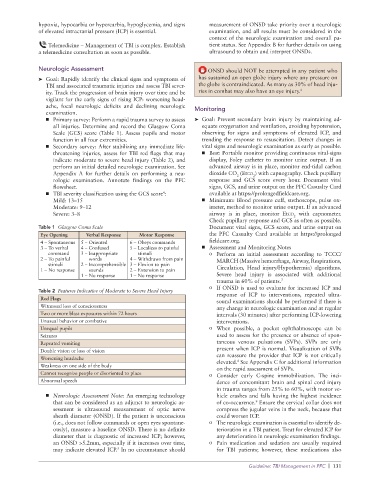
                ■ ➤ TBI severity classification using the GCS score :  available at https://prolongedfieldcare.org.
                  Mild: 13–15                                      ■ ➤ Minimum: Blood pressure cuff, stethoscope, pulse ox-
                  Moderate: 9–12                                     imeter, method to monitor urine output. If an advanced
                  Severe: 3–8                                        airway is in place, monitor Etco  with capnometer.
                                                                                                 2
                                                                     Check pupillary response and GCS as often as possible.
              Table 1  Glasgow Coma Scale                            Document vital signs, GCS score, and urine output on
              Eye Opening    Verbal Response   Motor Response        the PFC Casualty Card available at  https://prolonged
              4 – Spontaneous  5 – Oriented  6 – Obeys commands      fieldcare.org.
              3 –  To verbal   4 – Confused  5 –  Localizes to painful   ■ ➤ Assessment and Monitoring Notes
                 command   3 –  Inappropriate   stimuli               ➤ o Perform an initial assessment according to TCCC/
              2 –  To painful   words      4 –  Withdraws from pain     MARCH (Massive hemorrhage, Airway, Respira tions,
                 stimuli   2 –  Incomprehensible  3 – Flexion to pain
              1 – No response  sounds      2 – Extension to pain        Circulation, Head injury/Hypothermia) algorithms.
                           1 – No response  1 – No response             Severe head injury is associated with additional
                                                                        trauma in 60% of patients. 7
                                                                      ➤ o If ONSD is used to evaluate for increased ICP and
              Table 2  Features Indicative of Moderate to Severe Head Injury  response of ICP to interventions, repeated ultra-
              Red Flags                                                 sound examinations should be performed if there is
              Witnessed loss of consciousness                           any change in neurologic examination and at regular
              Two or more blast exposures within 72 hours               intervals (30 minutes) after performing ICP-lowering
              Unusual behavior or combative                             interventions.
              Unequal pupils                                          ➤ o When possible, a pocket ophthalmoscope can be
              Seizures                                                  used to assess for the presence or absence of spon-
              Repeated vomiting                                         taneous venous pulsations (SVPs). SVPs are only
              Double vision or loss of vision                           present when ICP is normal. Visualization of SVPs
              Worsening headache                                        can  reassure  the  provider  that  ICP  is  not  critically
                                                                        elevated.  See Appendix C for additional information
                                                                               8
              Weakness on one side of the body                          on the rapid assessment of SVPs.
              Cannot recognize people or disoriented to place         ➤ o Consider early C-spine immobilization. The inci-
              Abnormal speech                                           dence of concomitant brain and spinal cord injury
                                                                        in trauma ranges from 25% to 60%, with motor ve-
                ■ ➤ Neurologic Assessment Note: An emerging technology   hicle crashes and falls having the highest incidence
                                                                                     9
                  that can be considered as an adjunct to neurologic as-  of co-occurence.  Ensure the cervical collar does not
                  sessment is ultrasound measurement of optic nerve     compress the jugular veins in the neck, because that
                  sheath diameter (ONSD). If the patient is unconscious   could worsen ICP.
                  (i.e., does not follow commands or open eyes spontane-  ➤ o The neurologic examination is essential to identify de-
                  ously), measure a baseline ONSD. There is no definite   terioration in a TBI patient. Treat for elevated ICP for
                  diameter that is diagnostic of increased ICP; however,   any deterioration in neurologic examination findings.
                  an ONSD >5.2mm, especially if it increases over time,   ➤ o Pain medication and sedation are usually required
                  may indicate elevated ICP.  In no circumstance should   for TBI patients; however, these medications also
                                       5
                                                                                  Guideline: TBI Management in PFC  |  131

