


Page 132 - Journal of Special Operations Medicine - Fall 2017
P. 132
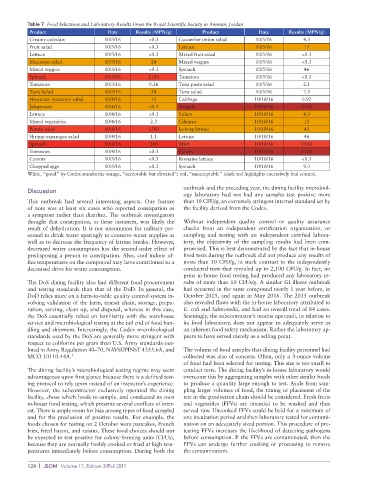
Table 7  Food Selections and Laboratory Results From the Royal Scientific Society in Amman, Jordan
           Product                  Date     Results (MPN/g)       Product            Date     Results (MPN/g)
           Creamy coleslaw         10/3/16        <0.3     Cucumber onion salad      10/5/16        4.3
           Fruit salad             10/3/16        <0.3     Lettuce                   10/5/16        15
           Lettuce                 10/3/16        <0.3     Mixed fruit salad         10/5/16        <0.3
           Macaroni salad          10/3/16        24       Mixed veggies             10/5/16        <0.3
           Mixed veggies           10/3/16        <0.3     Spinach                   10/5/16        46
           Spinach                 10/3/16       2100      Tomatoes                  10/5/16        <0.3
           Tomatoes                10/3/16        0.36     Tuna pasta salad          10/5/16        2.1
           Tuna Salad              10/3/16        24       Tuna salad                10/5/16        7.5
           Hawaiian macaroni salad  10/4/16       15       Cabbage                  10/10/16        0.92
           Jalepenoes              10/4/16        <0.3     Arugula                  10/10/16       1100
           Lettuce                 10/4/16        <0.3     Celery                   10/10/16        4.3
           Mixed vegetables        10/4/16        2.3      Cilantro                 10/10/16        15
           Potato salad            10/4/16       1500      Iceberg lettuce          10/10/16        43
           Shrimp asparagus salad  10/4/16        1.1      Lettuce                  10/10/16        46
           Spinach                 10/4/16        240      Mint                     10/10/16       1500
           Tomatoes                10/4/16        <0.3     Parsley                  10/10/16       1100
           Carrots                 10/5/16        <0.3     Romaine lettuce          10/10/16        <0.3
           Chopped eggs            10/5/16        <0.3     Spinach                  10/10/16        9.3
          White, “good” by Codex standards; orange, “acceptable but elevated”; red, “unacceptable” (dark red highlights excessively bad counts).

                                                             outbreak and the preceding year, the dining facility microbiol-
          Discussion
                                                             ogy laboratory had not had any samples test positive more
          This outbreak had several interesting aspects. One feature   than 10 CFU/g, an extremely stringent internal standard set by
          of note was at least six cases who reported constipation as   the facility derived from the Codex.
          a symptom rather than diarrhea. The outbreak investigators
          thought that constipation, in these instances, was likely the   Without independent  quality control or quality assurance
          result of dehydration. It is not uncommon for military per-  checks from an independent certification organization, or
          sonnel to drink water sparingly to conserve water supplies as   sampling and testing with an independent certified labora-
          well as to decrease the frequency of latrine breaks. However,   tory, the objectivity of the sampling results had been com-
          decreased water consumption has the second-order effect of   promised. This is best demonstrated by the fact that in-house
          predisposing a person to constipation. Also, cool indoor of-  food tests during the outbreak did not produce any results of
          fice temperatures on the compound may have contributed to a   more than 10 CFU/g, in stark contrast to the independently
          decreased drive for water consumption.             conducted tests that revealed up to 2,100 CFU/g. In fact, no
                                                             prior in-house food testing had produced any laboratory re-
          The DoS dining facility also had different food procurement   sults of more than 10 CFUs/g. A similar GI illness outbreak
          and testing standards than that of the DoD. In general, the   had occurred in the same compound nearly 1 year before, in
          DoD relies more on a farm-to-table quality control system in-  October 2015, and again in May 2016. The 2015 outbreak
          volving validation of the farm, transit chain, storage, prepa-  also revealed flaws with the in-house laboratory attributed to
          ration, serving, clean up, and disposal, whereas in this case,   E. coli and Salmonella, and had an overall total of 84 cases.
          the DoS essentially relied on familiarity with the warehouse   Seemingly, the subcontractor’s modus operandi, in relation to
          service and microbiological testing at the tail end of food han-  its food laboratory, does not appear to adequately serve as
          dling and shipment. Interestingly, the Codex microbiological   an inherent food safety mechanism. Rather the laboratory ap-
          standards used by the DoS are generally more stringent with   pears to have served merely as a selling point.
          respect to coliforms per gram than U.S. Army standards out-
          lined in Army Regulation 40–70, NAVSUPINST 4355.6A, and   The volume of food samples that dining facility personnel had
          MCO 10110.44A. 3                                   collected was also of concern. Often, only a 3-ounce volume
                                                             of food had been selected for testing. This size is too small to
          The dining facility’s microbiological testing regime may seem   conduct tests. The dining facility’s in-house laboratory would
          advantageous upon first glance because there is a defined test-  overcome this by aggregating samples with other similar foods
          ing protocol to rely upon instead of an inspector’s experience.   to produce a quantity large enough to test. Aside from sam-
          However, the subcontractor exclusively operated the dining   pling larger volumes of food, the timing or placement of the
          facility, chose which foods to sample, and conducted its own   test in the production chain should be considered. Fresh fruits
          in-house food testing, which presents several conflicts of inter-  and vegetables (FFVs) are intended to be washed and then
          est. There is ample room for bias among types of food sampled   served raw. Uncooked FFVs could be held for a minimum of
          and for the preclusion of positive results. For example, the   one incubation period and then laboratory tested for contami-
          foods chosen for testing on 2 October were pancakes, French   nation on an adequately sized portion. This procedure of pre-
          fries, fried bacon, and raisins. These food choices should not   testing FFVs increases the likelihood of detecting pathogens
          be expected to test positive for colony-forming units (CFUs),   before consumption. If the FFVs are contaminated, then the
          because they are normally freshly cooked or fried at high tem-  FFVs can undergo further cooking or processing to remove
          peratures immediately before consumption. During both the   the contamination.

          128  |  JSOM   Volume 17, Edition 3/Fall 2017

