


Page 85 - Journal of Special Operations Medicine - Spring 2017
P. 85
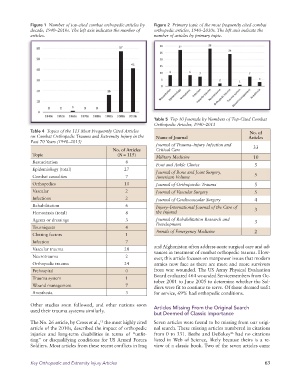
Figure 1  Number of top-cited combat orthopedic articles by   Figure 2  Primary topic of the most frequently cited combat
              decade, 1940–2010s. The left axis indicates the number of   orthopedic articles, 1940–2010s. The left axis indicate the
              articles.                                          number of articles by primary topic.


                                                                 Table 5  Top 10 Journals by Numbers of Top-Cited Combat
                                                                 Orthopedic Articles, 1940–2013
              Table 4  Topics of the 115 Most Frequently Cited Articles                                 No. of
              on Combat Orthopedic Trauma and Extremity Injury in the   Name of Journal                 Articles
              Past 70 Years (1940–2013)
                                                                 Journal of Trauma–Injury Infection and
                                                No. of Articles    Critical Care                          33
              Topic                               (N = 115)      Military Medicine                        10
              Resuscitation                          8
                                                                 Foot and Ankle Clinics                   5
              Epidemiology (total)                  27
                                                                 Journal of Bone and Joint Surgery,
              Combat casualties                      7           American Volume                          5
              Orthopedics                           10           Journal of Orthopaedic Trauma            5
              Vascular                               2           Journal of Vascular Surgery              5
              Infections                             2           Journal of Cardiovascular Surgery        4
              Rehabilitation                         6           Injury–International Journal of the Care of
              Hemostasis (total)                     8           the Injured                              3
              Agents or dressings                    3           Journal of Rehabilitation Research and   3
                                                                 Development
              Tourniquets                            4
                                                                 Annals of Emergency Medicine             2
              Clotting factors                       1
              Infection                              7
                                                                 and  Afghanistan often address acute surgical care and ad-
              Vascular trauma                       28
                                                                 vances in treatment of combat orthopedic trauma. How-
              Neurotrauma                            2           ever, this article focuses on manpower issues that modern
              Orthopedic trauma                     24           armies now face as there are more and more survivors
              Prehospital                            0           from war wounded. The US Army Physical Evaluation
                                                                 Board evaluated 464 wounded Servicemembers from Oc-
              Trauma system                          1
                                                                 tober 2001 to June 2005 to determine whether the Sol-
              Wound management                       7           diers were fit to continue to serve. Of those deemed unfit
              Anesthesia                             3           for service, 69% had orthopedic conditions.

              Other studies soon followed, and other nations soon   Articles Missing From the Original Search
              used their trauma systems similarly.
                                                                 but Deemed of Classic Importance
              The No. 26 article, by Cross et al.,  the most highly cited   Seven articles were found to be missing from our origi-
                                          15
              article of the 2010s, described the impact of orthopedic   nal search. These missing articles numbered in citations
                                                                                                26
              injuries  and  long-term  disabilities  in  terms  of  “unfit-  from 0 to 331. Beebe and DeBakey  had no citations
              ting” or disqualifying conditions for US Armed Forces   listed in Web of Science, likely because theirs  is a re-
              Soldiers. Most articles from these recent conflicts in Iraq   view of a classic book. Two of the seven articles came


              Key Orthopedic and Extremity Injury Articles                                                    63

