


Page 81 - Journal of Special Operations Medicine - Spring 2017
P. 81
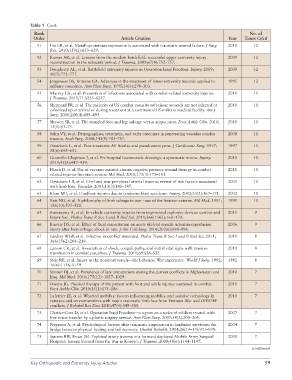
Table 1  Cont.
               Rank                                                                                     No. of
               Order                               Article Citation                            Year   Times Cited
                51    Utz ER, et al. Metalloproteinase expression is associated with traumatic wound failure. J Surg   2010  12
                      Res. 2010;159(2):633–639.
                52    Kumar AR, et al. Lessons from the modern battlefield: successful upper extremity injury   2009  12
                      reconstruction in the subacute period. J Trauma. 2009;67(4):752–757.
                53    Dougherty AL, et al. Battlefield extremity injuries in Operation Iraqi Freedom. Injury. 2009;   2009  12
                      40(7):772–777.
                54    Jorgenson DS, Antoine GA. Advances in the treatment of lower-extremity wounds applied to   1995  12
                      military casualties. Ann Plast Surg. 1995;34(3):298–303.
                55    Murray CK, et al. Prevention of infections associated with combat-related extremity injuries.    2011  11
                      J Trauma. 2011;71:S235–S257.
                56    Sheppard FR, et al. The majority of US combat casualty soft-tissue wounds are not infected or   2010  11
                      colonized upon arrival or during treatment at a continental US military medical facility. Am J
                      Surg. 2010;200(4):489–495.
                57    Shawen SB, et al. The mangled foot and leg: salvage versus amputation. Foot Ankle Clin. 2010;   2010  11
                      15(1):63–75.
                58    Sohn VY, et al. Demographics, treatment, and early outcomes in penetrating vascular combat   2008  11
                      trauma. Arch Surg. 2008;143(8):783–787.
                59    Davidovic L, et al. Post-traumatic AV fistulas and pseudoaneurysms. J Cardiovasc Surg. 1997;   1997  11
                      38(6):645–651.
                60    Granville-Chapman J, et al. Pre-hospital haemostatic dressings: a systematic review. Injury.   2011  10
                      2011;42(5):447–459.
                61    Hinck D, et al. Use of vacuum-assisted closure negative pressure wound therapy in combat-  2010  10
                      related injuries-literature review. Mil Med. 2010;175(3):173–181.
                62    Davidovic LB, et al. Civil and war peripheral arterial trauma: review of risk factors associated   2005  10
                      with limb loss. Vascular. 2005;13(3):141–147.
                63    Khan MT, et al. Hindfoot injuries due to landmine blast accidents. Injury. 2002;33(2):167–171.  2002  10
                64    Reis ND, et al. A philosophy of limb salvage in war - use of the fixateur externe. Mil Med. 1991;   1991  10
                      156(10):505–520.
                65    Ramasamy A, et al. In-vehicle extremity injuries from improvised explosive devices: current and   2011  9
                      future foci. Philos Trans R Soc Lond B Biol Sci. 2011;366(1562):160–170.
                66    Kauvar DS, et al. Effect of fluid resuscitation on acute skeletal muscle ischemia-reperfusion   2006  9
                      injury after hemorrhagic shock in rats. J Am Coll Surg. 2006;202(6):888–896.
                67    Eardley WGP, et al. Infection in conflict wounded. Philos Trans R Soc Lond B Biol Sci. 2011;   2011  8
                      366(1562):204–218.
                68    Larson CR, et al. Association of shock, coagulopathy, and initial vital signs with massive   2010  8
                      transfusion in combat casualties. J Trauma. 2010;69:S26–S32.
                69    Sfeir RE, et al. Injury to the popliteal vessels—the Lebanese War experience. World J Surg. 1992;   1992  8
                      16(6):1156–1159.
                70    Stinner DJ, et al. Prevalence of late amputations during the current conflicts in Afghanistan and   2010  7
                      Iraq. Mil Med. 2010;175(12): 1027–1029.
                71    Owens JG. Physical therapy of the patient with foot and ankle injuries sustained in combat.   2010  7
                      Foot Ankle Clin. 2010;15(1):175–186.
                72    Laferrier JZ, et al. Wheeled mobility: factors influencing mobility and assistive technology in   2010  7
                      veterans and servicemembers with major traumatic limb loss from Vietnam War and OIF/OEF
                      conflicts. J Rehabil Res Dev. 2010;47(4):349–360.
                73    Chatter-Cora D, et al. Operation Iraqi Freedom—a report on a series of soldiers treated with   2007  7
                      free tissue transfer by a plastic surgery service. Ann Plast Surg. 2007;58(2):200–206.
                74    Ferguson A, et al. Psychological factors after traumatic amputation in landmine survivors: the   2004  7
                      bridge between physical healing and full recovery. Disabil Rehabil. 2004;26(14–15):931–938.
                75    Starnes BW, Bruce JM. Popliteal artery trauma in a forward deployed Mobile Army Surgical   2000  7
                      Hospital: lessons learned from the war in Kosovo. J Trauma. 2000;48(6):1144–1147.
                                                                                                         (continues)


              Key Orthopedic and Extremity Injury Articles                                                    59

