


Page 24 - Journal of Special Operations Medicine - Spring 2017
P. 24
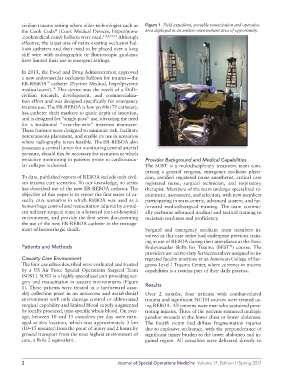
civilian trauma setting where older technologies such as   Figure 1  Field expedient, portable resuscitation and operative
          the Cook Coda  (Cook Medical Devices, https://www   area deployed in an austere environment area of opportunity.
                        ®
          .cookmedical.com/) balloon were used. 1,2,4,18,19  Although
          effective, the larger size of many existing occlusion bal-
          loon catheters and their need to be placed over a long
          stiff wire with radiographic or fluoroscopic guidance
          have limited their use in emergent settings.

          In 2015, the Food and Drug Administration approved
          a new endovascular occlusion balloon for trauma—the
          ER-REBOA  catheter (Prytime Medical, http://prytime
                    ™
          medical.com/).  This device was the result of a DoD–
                       18
          civilian  research,  development,  and commercializa-
          tion effort and was designed specifically for emergency
          trauma use. The ER-REBOA is low profile (7F catheter),
          has catheter shaft markers to guide depth of insertion,
          and is designed for “single-pass” use, obviating the need
          for a traditional “over-the-wire” insertion maneuver.
          These features were designed to minimize risk, facilitate
          percutaneous placement, and enable its use in scenarios
          where radiography is not feasible. The ER-REBOA also
          possesses a central lumen for monitoring central arterial
          pressure, should this be necessary for scenarios in which
          proactive monitoring in patients prone to cardiovascu-  Provider Background and Medical Capabilities
          lar collapse is desired.                           The SOST is a multidisciplinary treatment team com-
                                                             prising a general surgeon, emergency medicine physi-
          To date, published reports of REBOA include only civil-  cian, certified registered nurse anesthetist, critical care
          ian trauma care scenarios. To our knowledge, no series   registered nurse, surgical technician, and respiratory
          has described use of the new ER-REBOA catheter. The   therapist. Members of the team undergo specialized re-
          objective of this paper is to report the first series of ca-  cruitment, assessment, and selection, with new members
          sualty care scenarios in which REBOA was used as a   participating in team-centric, advanced austere, and far-
          hemorrhage control and resuscitation adjunct by a mod-  forward medical/surgical training. The team continu-
          ern military surgical team in a forward (out-of-hospital)   ally performs advanced medical and tactical training to
          environment, and provide the first series documenting   maintain readiness and proficiency.
          the use of the new ER-REBOA catheter in the manage-
          ment of hemorrhagic shock.                         Surgical and emergency medicine team members in-
                                                             volved in this case series had undergone previous train-
                                                             ing in use of REBOA during their attendance at the Basic
          Patients and Methods                               Endovascular Skills for Trauma (BEST ) course. The
                                                                                                ™
                                                             providers are active-duty Servicemembers assigned to in-
          Casualty Care Environment                          tegrated faculty positions at an American College of Sur-
          The four casualties described were evaluated and treated   geons Level I Trauma Center, where currency in trauma
          by a US Air Force Special Operations Surgical Team   capabilities is a routine part of their daily practice.
          (SOST). SOST is a highly specialized unit providing sur-
          gery and resuscitation in austere environments (Figure
          1). These patients were treated in a far-forward casu-  Results
          alty collection point in an antiaccess and aerial-denial   Over 2 months, four patients with combat-related
          environment with only damage control or abbreviated   trauma and significant NCTH sources were treated us-
          surgical capability and limited blood supply augmented   ing REBOA. All patients were men who sustained pene-
          by locally procured, type-specific whole blood. On aver-  trating injuries. Three of the patients sustained multiple
          age, between 10 and 15 casualties per day were man-  gunshot wounds to the lower chest or lower abdomen.
          aged at this location, which was approximately 3 km   The fourth victim had diffuse fragmentation injuries
          (10–15 minutes) from the point of injury and 2 hours by   due to explosive ordinance, with the preponderance of
          ground transport from the next highest environment of   significant injury burden to the lower abdomen and in-
          care, a Role 2 equivalent.                         guinal region. All casualties were delivered directly to


          2                                       Journal of Special Operations Medicine  Volume 17, Edition 1/Spring 2017

