


Page 121 - Journal of Special Operations Medicine - Spring 2017
P. 121
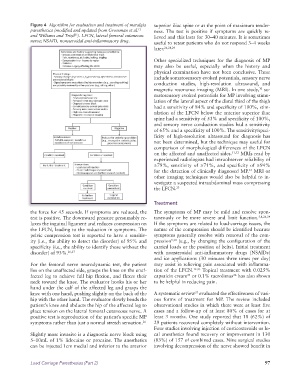
Figure 4  Algorithm for evaluation and treatment of meralgia   superior iliac spine or at the point of maximum tender-
                                                          12
              paresthetica (modified and updated from Grossman et al.    ness. The test is positive if symptoms are quickly re-
                                25
              and Williams and Trizil ). LFCN, lateral femoral cutaneous   lieved and this lasts for 30–40 minutes. It is sometimes
              nerve; NSAID, nonsteroidal anti-inflammatory drug.  useful to retest patients who do not respond 3–4 weeks
                                                                 later. 26,28,29

                                                                 Other specialized techniques for the diagnosis of MP
                                                                 may  also  be  useful,  especially  when  the  history  and
                                                                 physical examination have not been conclusive. These
                                                                 include somatosensory evoked potentials, sensory nerve
                                                                 conduction studies, high-resolution ultrasound, and
                                                                 magnetic resonance imaging (MRI). In one study,  so-
                                                                                                            30
                                                                 matosensory evoked potentials for MP involving stimu-
                                                                 lation of the lateral aspect of the distal third of the thigh
                                                                 had a sensitivity of 84% and specificity of 100%, stim-
                                                                 ulation of the LFCN below the anterior superior iliac
                                                                 spine had a sensitivity of 53% and specificity of 100%,
                                                                 and sensory nerve conduction studies had a sensitivity
                                                                 of 65% and a specificity of 100%. The sensitivity/speci-
                                                                 ficity of high-resolution ultrasound for diagnosis has
                                                                 not been determined, but the technique may useful for
                                                                 comparison of morphological differences of the LFCN
                                                                 on the affected and unaffected sides. 31,32  MRIs read by
                                                                 experienced radiologists had intraobserver reliability of
                                                                 ≥79%, sensitivity of  ≥71%, and specificity of  ≥94%
                                                                 for the detection of clinically diagnosed MP.  MRI or
                                                                                                        33
                                                                 other imaging techniques would also be helpful to in-
                                                                 vestigate a suspected intraabdominal mass compressing
                                                                 the LFCN. 23


                                                                 Treatment
              the force for 45 seconds. If symptoms are reduced, the   The symptoms of MP may be mild and resolve spon-
              test is positive. The downward pressure presumably re-  taneously or be more severe and limit function. 5,8,26,34
              laxes the inguinal ligament and reduces compression on   If the symptoms are related to load-carriage issues, the
              the LFCN, leading to the reduction in symptoms. The   nature of the compression should be identified because
              pelvic compression test is reported to have a sensitiv-  symptoms generally resolve with removal of the com-
              ity (i.e., the ability to detect the disorder) of 95% and   pression 5,10  (e.g., by changing the configuration of the
              specificity (i.e., the ability to identify those without the   carried loads or the position of belts). Initial treatment
              disorder) of 93%. 26,27                            with nonsteroidal anti-inflammatory drugs (NSAIDs)
                                                                 and ice applications (30 minutes three times per day)
              For  the  femoral  nerve  neurodynamic  test,  the  patient   may assist in relieving pain associated with inflamma-
              lies on the unaffected side, grasps the knee on the unaf-  tion of the LFCN. 12,25  Topical treatment with 0.025%
                                                                                                 36
                                                                              35
              fected leg to achieve full hip flexion, and flexes their   capsaicin cream  or 0.1% tacrolimus  has also shown
              neck toward the knee. The evaluator hooks his or her   to be helpful in reducing pain.
              hand under the calf of the affected leg and grasps the
                                                                                  37
              knee with one hand, pushing slightly on the back of the   A systematic review  evaluated the effectiveness of vari-
              hip with the other hand. The evaluator slowly bends the   ous forms of treatment  for MP. The review included
              patient’s knee and abducts the hip of the affected leg to   observational studies in which there were at least five
              place tension on the lateral femoral cutaneous nerve. A   cases and a follow-up of at least 80% of cases for at
              positive test is reproduction of the patient’s specific MP   least 3 months. One study reported that 18 (62%) of
              symptoms rather than just a normal stretch sensation. 26  29 patients recovered completely without intervention.
                                                                 Four studies involving injection of corticosteroids or lo-
              Slightly more invasive is a diagnostic nerve block using   cal anesthetics found recovery or improvement in 130
              5–10mL of 1% lidocaine or procaine. The anesthetics   (83%) of 157 of combined cases. Nine surgical studies
              can be injected 1cm medial and inferior to the anterior   involving decompression of the nerve showed benefit in


              Load Carriage Paresthesias (Part 2)                                                             97

