


Page 76 - Journal of Special Operations Medicine - Winter 2016
P. 76
when such measures are implemented across large popu-  because it has also been shown to augment muscle mass
          lations of deployed troops. LOB-IT candidates must also   and strength  and inhibit exercise-induced muscle dam-
                                                                        15
          be specifically tailored to level of risk. Relative probabil-  age.  Nutritional strategies could also be implemented
                                                                16
          ity of injury is both personnel and mission specific, and   to improve immune function “in the field.” 17
          such calculations are already commonplace in the plan-
          ning of deliberate operations by military commanders.   Physiologic preconditioning
          LOB-IT candidates, therefore, may be stratified accord-  The general principle for physiologic preconditioning
          ing to their relative assessment of benefit according to   would be to increase the physiologic reserve and car-
          specific tasks and risks. Special Forces personnel would   diovascular  reactivity  for  optimum  response  to  injury,
          be some of the most likely to benefit from such interven-  hemorrhage, and subsequent hypovolemia and acidosis.
          tions because of the high-risk environment in which they   Outcomes for critically ill trauma patients are worse when
          operate and challenges in accessing timely medical care.   they are smokers ; therefore, a useful pretrauma inter-
                                                                            18
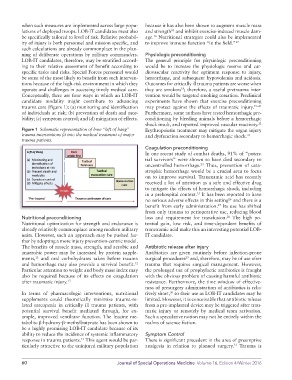
          Conceptually, there are four ways in which an LOB-IT    vention would be targeted smoking cessation. Preclinical
          candidate modality might contribute to advancing   experiments have shown that exercise preconditioning
          trauma care (Figure 1): (a) monitoring and identification   may protect against the effects of traumatic injury. 19–21
          of individuals at risk; (b) prevention of death and mor-  Furthermore, some authors have tested hemorrhagic pre-
          bidity; (c) symptom control; and (d) mitigation of effects.  conditioning by bleeding animals before a hemorrhagic
                                                             shock insult, and reported improved vascular reactivity.
                                                                                                            22
          Figure 1  Schematic representation of how “left of bang”   Erythropoietin treatment may mitigate the organ injury
          trauma interventions fit into the medical treatment of major   and dysfunction secondary to hemorrhagic shock. 23
          trauma patients.
                                                             Coagulation preconditioning
                                                             In one recent study of combat deaths, 91% of “poten-
                                                             tial survivors” were shown to have died secondary to
                                                             uncontrolled hemorrhage.  Thus, prevention of cata-
                                                                                    24
                                                             strophic hemorrhage would be a crucial area to focus
                                                             on to improve survival. Tranexamic acid has recently
                                                             received a lot of attention as a safe and effective drug
                                                             to mitigate the effects of hemorrhagic shock, including
                                                             in a prehospital context.  It has been reported to have
                                                                                  25
                                                             no serious adverse effects in this setting  and there is a
                                                                                               26
                                                             benefit from early administration.  Its use has shifted
                                                                                           27
                                                             from only trauma to perioperative use, reducing blood
          Nutritional preconditioning                        loss and requirement for transfusion.  The high po-
                                                                                               28
          Nutritional optimization for strength and endurance is   tential gain, low risk, and time-dependent benefits of
          already relatively commonplace among modern military   tranexamic acid make this an interesting potential LOB-
          units. However, such an approach may be pushed fur-  IT candidate.
          ther by adopting a more injury prevention-centric model.
          The benefits of muscle mass, strength, and aerobic and   Antibiotic release after injury
          anaerobic power may be increased by protein supple-  Antibiotics are given routinely before infection-prone
          ments,  and oral carbohydrates taken before trauma   surgical procedures  and, therefore, may be of use after
                                                                              29
                11
          and hemorrhage may also provide a survival benefit.    trauma that requires surgical management. However,
                                                         12
          Particular attention to weight and body mass index may   the prolonged use of prophylactic antibiotics is fraught
          also be required because of its effects on coagulation   with the obvious problem of causing harmful antibiotic
          after traumatic injury. 13                         resistance. Furthermore, the time window of effective-
                                                             ness of presurgery administration of antibiotics is rela-
          In terms of pharmacologic interventions, nutritional   tively short,  so their use as LOB-IT candidates may be
                                                                       30
          supplements could theoretically minimize trauma-re-  limited. However, it is conceivable that antibiotic release
          lated sarcopenia in critically ill trauma patients, with   from a pre-implanted device may be triggered after trau-
          potential survival benefit mediated through, for ex-  matic injury or remotely by medical team activation.
          ample, improved ventilator function. The leucine me-  Such a speculative notion may not be entirely within the
          tabolite β-hydroxy-β-methylbutyrate has been shown to   realms of science fiction.
          be a highly promising LOB-IT candidate because of its
          ability to reduce the incidence of systemic inflammatory   Symptom Control
          response in trauma patients.  This agent would be par-  There is significant precedent in the area of preemptive
                                  14
          ticularly attractive to the uninjured military population   analgesia in relation to planned surgery.  Trauma is
                                                                                                  31

          60                                     Journal of Special Operations Medicine  Volume 16, Edition 4/Winter 2016

