


Page 73 - Journal of Special Operations Medicine - Winter 2016
P. 73
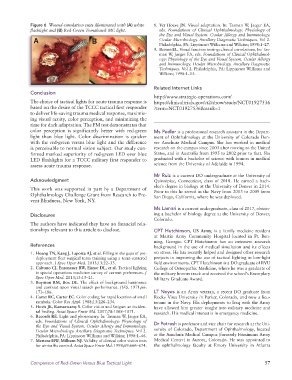
Figure 6  Wound-simulation suits illuminated with (A) white   8.  Ver Hoeve JN. Visual adaptation. In: Tasman W, Jaeger EA,
              flashlight and (B) Red-Green Tomahawk MC light.      eds.  Foundations  of Clinical  Ophthalmology:  Physiology of
                                                                   the Eye and Visual System. Ocular Allergy and Immunology.
                                                                   Ocular Microbiology. Ancillary Diagnostic Techniques. Vol 2.
                                                                   Philadelphia, PA: Lippincott Williams and Wilkins; 1998:1–27.
                                                                 9.  Berson EL. Visual function testing: clinical correlations. In: Tas-
                                                                   man W, Jaeger EA, eds. Foundations of Clinical Ophthalmol-
                                                                   ogy: Physiology of the Eye and Visual System. Ocular Allergy
                                                                   and Immunology. Ocular Microbiology. Ancillary Diagnostic
                                                                   Techniques. Vol 2. Philadelphia, PA: Lippincott Williams and
                                                                   Wilkins; 1998:1–15.


                                                                 Related Internet Links
              Conclusion
                                                                 http://www.strategic-operations.com/
              The choice of tactical lights for acute trauma response is   https://clinicaltrials.gov/ct2/show/study/NCT01927536
              based on the desire of the TCCC tactical first responder   ?term=NCT01927536&rank=1
              to deliver life-saving trauma medical response, maximiz-
              ing visual acuity, color perception, and minimizing the
              time for dark adaptation. The FM test demonstrates that
              color perception is significantly better with red-green   Ms Pedler is a professional research assistant in the Depart-
              light than blue light. Color discrimination is quicker   ment of Ophthalmology at the University of Colorado Den-
              with the red-green versus blue light and the difference   ver  Anschutz  Medical  Campus.  She  has  worked  in  medical
              is perceivable to normal vision subject. Our study con-  research on the campus since 2003 after moving to the United
              firmed marked superiority of red-green LED over blue   States, and in Australia from 1995 to 2002 prior to that. She
              LED flashlights for a TCCC military first responder to   graduated with a bachelor of science with honors in medical
              assess acute trauma response.                      science from the University of Adelaide in 1994.
                                                                 Mr Ruiz is a current DO undergraduate at the University of
              Acknowledgment                                     Quinnipiac, Connecticut, class of 2018. He earned a bach-
                                                                 elor’s degree in biology at the University of Denver in 2014.
              This work was supported in part by a Department of   Prior to this he served in the Navy from 2003 to 2009 from
              Ophthalmology Challenge Grant from Research to Pre-  San Diego, California, where he was deployed.
              vent Blindness, New York, NY.
                                                                 Ms Lamari is a current undergraduate, class of 2017, obtain-
              Disclosures                                        ing a bachelor of biology degree at the University of Denver,
                                                                 Colorado.
              The authors have indicated they have no financial rela-
              tionships relevant to this article to disclose.    CPT Hutchinson, US Army, is a family medicine resident
                                                                 at Martin Army Community Hospital located in Ft. Ben-
                                                                 ning, Georgia. CPT Hutchinson has an extensive research
              References                                         background in the use of medical simulation and its effects
              1.  Hoang TN, Kang J, Laporta AJ, et al. Filling in the gaps of pre-  on stress. He has recently helped and designed other research
                deployment fleet surgical team training using a team-centered   projects in improving the use of tactical lighting in low-light
                approach. J Spec Oper Med. 2013;13:22–33.        field environments. CPT Hutchinson is a DO graduate of RVU
              2.  Calvano CJ, Enzenauer RW, Eisnor DL, et al. Tactical lighting   College of Osteopathic Medicine, where he was a graduate of
                in special operations medicine: survey of current preferences. J   the military honors track and received the school’s Exemplary
                Spec Oper Med. 2013;13:15–21.                    Military Graduate Award.
              3.  Boynton RM, Box DE. The effect of background luminance
                and contrast upon visual search performance. JIES. 1971;66:
                173–186.                                         LT Noyes is an Army veteran, a recent DO graduate from
              4.  Carter RC, Carter EC. Color coding for rapid location of small   Rocky Vista University in Parker, Colorado, and now a lieu-
                symbols. Color Res Appl. 1988;13:226–234.        tenant in the Navy. His deployments to Iraq with the Army
              5.  Hovis JK, Ramaswamy S. Color vision and fatigue: an inciden-  have allowed him greater insight into military medicine and
                tal finding. Aviat Space Envir Md. 2007;78:1068–1071.  research. His medical interest is in emergency medicine.
              6.  Records RE. Light and photometry. In: Tasman W, Jaeger EA,
                eds.  Foundations  of Clinical  Ophthalmology:  Physiology of   Dr Petrash is professor and vice chair for research at the Uni-
                the Eye and Visual System. Ocular Allergy and Immunology.
                Ocular Microbiology. Ancillary Diagnostic Techniques. Vol 2.   versity of Colorado, Department of Ophthalmology, located
                Philadelphia, PA: Lippincott Williams and Wilkins; 1998:1–46.  at the Anschutz Medical Campus (formerly Fitzsimons Army
              7.  Mertens HW, Milburn NJ. Validity of clinical color vision tests   Medical Center) in Aurora, Colorado. He was appointed to
                for air traffic control. Aviat Space Envir Md. 1998;69:666–674.  the ophthalmology faculty at Emory University in Atlanta


              Comparison of Red-Green Versus Blue Tactical Light                                              57

