


Page 7 - Journal of Special Operations Medicine - Winter 2016
P. 7
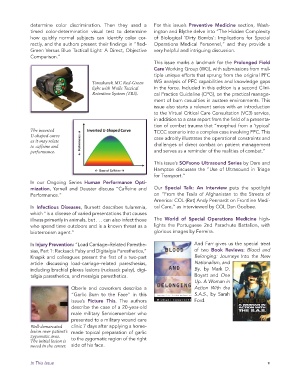
determine color discrimination. Then they used a   For this issue’s  Preventive  Medicine section, Wash-
              timed color-determination visual test to determine   ington and Blythe delve into “The Hidden  Complexity
              how quickly normal subjects can identify color cor-  of Biological ‘Dirty Bombs’: Implications for Special
              rectly, and the authors present their findings in “Red-  Operations  Medical  Personnel,”  and  they  provide  a
              Green Versus Blue Tactical Light: A Direct, Objective   very helpful and intriguing discussion.
              Comparison.”
                                                                 This issue marks a landmark for the Prolonged Field
                                                                 Care Working Group (WG), with submissions from mul-
                                                                 tiple unique efforts that sprung from the original PFC
                                       Tomahawk MC Red-Green     WG analysis of PFC capabilities and knowledge gaps
                                       light with Molle Tactical   in the force. Included in this edition is a second Clini-
                                       Retention System (TRS).   cal Practice Guideline (CPG), on the practical manage-
                                                                 ment of burn casualties in austere environments. This
                                                                 issue also starts a relevant series with an introduction
                                                                 to the Virtual Critical Care Consultation (VC3) service,
                                                                 in addition to a case report from the field of a presenta-
                                                                 tion of combat trauma that “morphed from a ‘typical‘
              The inverted                                       TCCC scenario into a complex case involving PFC. This
              U-shaped curve                                     case adroitly illustrates the operational constraints and
              as it may relate
              to caffeine and                                    challenges of direct combat on patient management
              performance.                                       and serves as a reminder of the realities of combat.”

                                                                 This issue’s SOFsono Ultrasound Series by Dare and
                                                                 Hampton discusses the “Use of Ultrasound in Triage
                                                                 for Transport.”
              In our Ongoing Series  Human Performance Opti-
              mization, Yarnell and Deuster discuss “Caffeine and   Our  Special Talk: An Interview  puts the spotlight
              Performance.”                                      on “From the Trails of Afghanistan to the Streets of
                                                                 America: COL (Ret) Andy Pennardt on Frontline Medi-
              In  Infectious  Diseases,  Burnett describes tularemia,   cal Care,” as interviewed by COL Dan Godbee.
              which “is a disease of varied presentations that causes
              illness primarily in animals, but . . . can also infect those   The  World of Special Operations Medicine  high-
              who spend time outdoors and is a known threat as a   lights the Portuguese 2nd Parachute Battalion, with
              bioterrorism agent.”                               glorious images by Ferreira.

              In Injury Prevention: “Load Carriage–Related Paresthe-             And Farr gives us the special treat
              sias, Part 1: Rucksack Palsy and Digitalgia Paresthetica,”         of two  Book Reviews:  Blood and
              Knapik and colleagues present the first of a two-part              Belonging: Journeys Into the New
              article discussing load-carriage–related paresthesias,             Nationalism, and
              including brachial plexus lesions (rucksack palsy), digi-          By, by Mark D.
              talgia paresthetica, and meralgia paresthetica.                    Boyatt and  One
                                                                                 Up. A Woman in
                              Oberle and coworkers describe a                    Action With  the
                              “Garlic Burn to the Face” in this                  S.A.S.,  by  Sarah
                              issue’s  Picture This. The authors                 Ford.
                              describe the case of a 20-year-old
                              male military Servicemember who
                              presented to a military wound care
              Well-demarcated   clinic 7 days after applying a home-
              lesion over patient’s   made topical preparation of garlic
              zygomatic area.   to the zygomatic region of the right
              The initial lesion is
              noted in the center.  side of his face.


              In This Issue                                                                                     v

