


Page 6 - Journal of Special Operations Medicine - Winter 2016
P. 6
by Allison Esposito, Managing Editor


           n a  Case Report  titled “Secondary Hypertension,   not guarantee maintenance of arterial occlusion.
         IErythrocytosis, and Unilateral Renal Cystic Disease in   Given the opportunity, tourniquet applications should
          a Submariner,” Forbes and Yeo describe the case of an   be reassessed for continued arterial occlusion 5 or 10
          active duty Servicemember who presented with a chief   minutes after application.”
          complaint of headache symptoms directly attributable
          to erythrocytosis in the setting of negative JAK2 muta-
          tion and normal EPO levels.                        Temporary
                                                             indentation
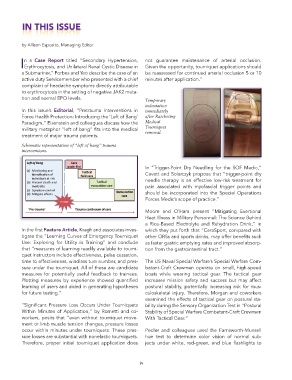
          In  this  issue’s  Editorial,  “Pretrauma  Interventions  in   immediately
          Force Health Protection: Introducing the ‘Left of Bang’   after Ratcheting
          Paradigm,” Eisenstein and colleagues discuss how the   Medical
          military metaphor “left of bang” fits into the medical   Tourniquet
                                                             removal.
          treatment of major trauma patients.

          Schematic representation of “left of bang” trauma
          interventions.


                                                             In “Trigger-Point Dry Needling for the SOF Medic,”
                                                             Cavett and Solarczyk propose that “trigger-point dry
                                                             needle therapy is an effective low-risk treatment for
                                                             pain associated with myofascial trigger points and
                                                             should be incorporated into the Special Operations
                                                             Forces Medic’s scope of practice.”


                                                             Moore and O’Hara  present  “Mitigating Exertional
                                                             Heat Illness in Military Personnel: The Science Behind
                                                             a Rice-Based Electrolyte and Rehydration Drink,” in
          In the first Feature Article, Kragh and associates inves-  which they put forth that “CeraSport, compared with
          tigate the “Learning Curves of Emergency Tourniquet   other ORSs and sports drinks, may offer benefits such
          Use: Exploring for Utility in Training” and conclude   as faster gastric emptying rates and improved absorp-
          that “measures of learning readily available to tourni-  tion from the gastrointestinal tract.”
          quet instructors include effectiveness, pulse cessation,
          time to effectiveness, windlass turn number, and pres-  The US Naval Special Warfare’s Special Warfare Com-
          sure under the tourniquet. All of these are candidate   batant-Craft Crewmen operate on small, high-speed
          measures for potentially useful feedback to trainees.   boats  while wearing  tactical gear. The tactical  gear
          Plotting measures by experience showed quantified   increases mission  safety  and  success but  may  affect
          learning of users and aided in generating hypotheses   postural stability, potentially increasing risk for mus-
          for future testing.”                               culoskeletal injury. Therefore, Morgan and coworkers
                                                             examined the effects of tactical gear on postural sta-
          “Significant Pressure Loss Occurs Under Tourniquets   bility during the Sensory Organization Test in “Postural
          Within Minutes of Application,” by Rometti and co-  Stability of Special Warfare Combatant-Craft Crewmen
          workers, posits that “even without tourniquet move-  With Tactical Gear.”
          ment or limb muscle tension changes, pressure losses
          occur within minutes under tourniquets. These pres-  Pedler and colleagues used the Farnsworth-Munsell
          sure losses are substantial with nonelastic tourniquets.   hue test to determine color vision of normal sub-
          Therefore, proper initial tourniquet application does   jects under white, red-green, and blue flashlights to


                                                           iv

