


Page 60 - Journal of Special Operations Medicine - Winter 2016
P. 60
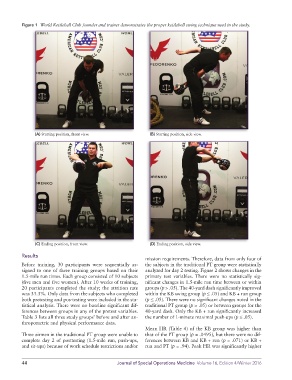
Figure 1  World Kettlebell Club founder and trainer demonstrates the proper kettlebell swing technique used in the study.


               (A) Starting position, front view.              (B) Starting position, side view.


               (C) Ending position, front view.                (D) Ending position, side view.

          Results
                                                             mission requirements. Therefore, data from only four of
          Before training, 30 participants were sequentially as-  the subjects in the traditional PT group were statistically
          signed  to one of  three  training groups  based on their   analyzed for day 2 testing. Figure 2 shows changes in the
          1.5-mile run times. Each group consisted of 10 subjects   primary  test  variables.  There  were  no  statistically  sig-
          (five men and five women). After 10 weeks of training,   nificant changes in 1.5-mile run time between or within
          20 participants completed the study; the attrition rate   groups (p > .05). The 40-yard dash significantly improved
          was 33.3%. Only data from the subjects who completed   within the KB swing group (p ≤ .05) and KB + run group
          both pretesting and pos-testing were included in the sta-  (p ≤ .05). There were no significant changes noted in the
          tistical analysis. There were no baseline significant dif-  traditional PT group (p > .05) or between groups for the
          ferences between groups in any of the pretest variables.   40-yard dash. Only the KB + run significantly increased
          Table 3 lists all three study groups’ before and after an-  the number of 1-minute maximal push-ups (p ≤ .05).
          thropometric and physical performance data.
                                                             Mean HR (Table 4) of the KB group was higher than
          Three airmen in the traditional PT group were unable to   that of the PT group (p = .0495), but there were no dif-
          complete  day  2  of  posttesting  (1.5-mile  run,  push-ups,   ferences between KB and KB + run (p = .071) or KB +
          and sit-ups) because of work schedule restrictions and/or   run and PT (p = .94). Peak HR was significantly higher


          44                                     Journal of Special Operations Medicine  Volume 16, Edition 4/Winter 2016

