


Page 59 - Journal of Special Operations Medicine - Winter 2016
P. 59
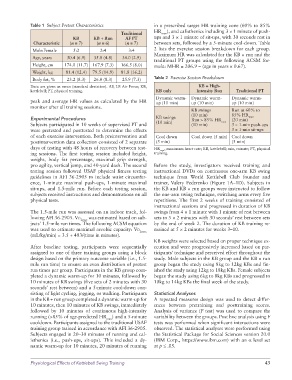
Table 1  Subject Pretest Characteristics           in a  prescribed target HR training zone (60% to 85%
                                                   Traditional   HR max ), and calisthenics including 3 × 1 minute of push-
                               KB       KB + Run     AF PT       ups and 3 × 1 minute of sit-ups, with 30 seconds rest in
               Characteristic  (n = 7)   (n = 6)     (n = 7)     between sets, followed by a 5-minute cool-down. Table
              Male:Female      5:2        2:4         3:4        2 lists the exercise session breakdown for each group.
              Age, years     30.4 (6.9)  35.8 (4.8)  34.0 (2.9)  Maximum HR was calculated for the KB + run and the
                                                                 traditional PT groups using the following ACSM for-
              Height, cm    174.0 (11.7)  167.9 (7.3)  166.5 (8.0)  mula: MHR = 206.9 − (age in years × 0.67).
              Weight, kg    81.4 (12.4)  79.5 (14.9)  81.8 (16.2)
              Body fat, %    23.2 (8.3)  26.0 (8.3)  25.9 (7.3)  Table 2  Exercise Session Breakdown
              Data are given as mean (standard deviation). AF, US Air Force; KB,   KB + High-
              kettlebell; PT, physical training.                 KB only          Intensity Run   Traditional PT
                                                                 Dynamic warm-  Dynamic warm-    Dynamic warm-
              peak and average HR values as calculated by the HR   up (10 min)  up (10 min)      up (10 min)
              monitor after all training sessions.
                                                                                KB swings        Run at 60% to
                                                                                (10 min)         85% HR
              Experimental Procedures                            KB swings      Run > 85% HR    (20 min)  max
              Subjects participated in 10 weeks of supervised PT and   (10 min)  (10 min)   max  3 × 1-min push-ups
              were pretested and posttested to determine the effects                             3 × 1-min sit-ups
              of each exercise intervention. Both preintervention and   Cool down    Cool down (5 min) Cool down
              postintervention data collection consisted of 2 separate   (5 min)                 (5 min)
              days of testing with 48 hours of recovery between test-  HR max , maximum heart rate; KB, kettlebell; min, minute; PT, physical
              ing sessions. The first testing session included height,   training.
              weight, body fat percentage, maximal grip strength,
              pro agility, vertical jump, and 40-yard dash. The second   Before the study, investigators received training and
              testing session followed USAF physical fitness testing   instructional DVDs on continuous one-arm KB swing
              guidelines in AFI 36-2905 to include waist circumfer-  technique from World Kettlebell Club founder and
              ence, 1-minute maximal push-ups, 1-minute maximal   trainer, Valery Federenko (Figure 1A–1D). Subjects in
              sit-ups, and 1.5-mile run. Before each testing session,   the KB and KB + run groups were instructed to follow
              subjects received instructions and demonstrations on all   the one-arm swing technique, switching arms every five
              physical tests.                                    repetitions. The first 2 weeks of training consisted of
                                                                 instructional sessions and progressed in duration of KB
              The 1.5-mile run was assessed on an indoor track, fol-  swings from 4 × 1 minute with 1 minute of rest between
              lowing AFI 36-2905. Vo 2max  was estimated based on sub-  sets to 5 × 2 minutes with 30 seconds’ rest between sets
              jects’ 1.5-mile run times. The following ACSM equation   by the end of week 2. The duration of KB training re-
              was used to estimate maximal aerobic capacity: Vo 2max    mained at 5 × 2 minutes for weeks 3–10.
              (mL/kg/min) = 3.5 + 483/(time in minutes).
                                                                 KB weights were selected based on proper technique ex-
              After baseline testing, participants were sequentially   ecution and were progressively increased based on par-
              assigned to one of three training groups using a block   ticipants’ technique and perceived effort throughout the
              design based on the primary outcome variable (i.e., 1.5-  study. Male subjects in the KB group and the KB + run
              mile run time) to ensure an even distribution of pretest   group began the study using 8kg to 12kg KBs and fin-
              run times per group. Participants in the KB group com-  ished the study using 12kg to 18kg KBs. Female subjects
              pleted a dynamic warm-up for 10 minutes, followed by   began the study using 6kg to 8kg KBs and progressed to
              10 minutes of KB swings (five sets of 2 minutes with 30   10kg to 14kg KBs the final week of the study.
              seconds’ rest between) and a 5-minute cool-down con-
              sisting of light cycling, jogging, or walking. Participants   Statistical Analyses
              in the KB + run group completed a dynamic warm-up for   A repeated measures design was used to detect differ-
              10 minutes, then 10 minutes of KB swings, immediately   ences between pretraining and posttraining scores.
              followed by 10 minutes of continuous high-intensity   Analysis of variance (F test) was used to compare the
              running (>85% of age-predicted HR max ) and a 5-minute   variability between the groups. Post hoc analysis using F
              cooldown. Participants assigned to the traditional USAF   tests was performed when significant interactions were
              training group trained in accordance with AFI 36-2905.   observed. The statistical analyses were performed using
              Subjects engaged in 20–30 minutes of running and cal-  the Statistical Package for Social Sciences version 20.0
              isthenics  (i.e.,  push-ups,  sit-ups).  This  included  a  dy-  (IBM Corp., https://www.ibm.com) with an α level set
              namic warm-up for 10 minutes, 20 minutes of running   at p ≤ .05.


              Physiological Effects of Kettlebell Swing Training                                              43

