


Page 27 - Journal of Special Operations Medicine - Winter 2016
P. 27
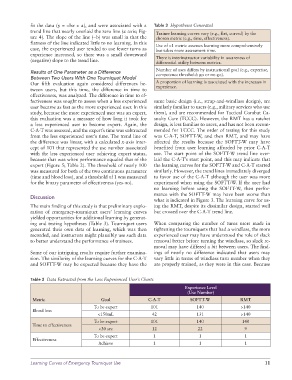
fit the data (y = −bx + a), and were associated with a   Table 3  Hypotheses Generated
              trend line that nearly overlaid the zero line (x axis; Fig-  Trainee learning curves vary (e.g., flat, curved) by the
              ure 4). The slope of the line (−b) was small in that the   chosen metric (e.g., time, effectiveness).
              flatness of the line indicated little to no learning. In this   Use of >1 metric assesses learning more comprehensively
              case, the experienced user tended to use fewer turns as   but takes more assessment time.
              experience increased, so there was a small downward   There is interinstructor variability in awareness of
              (negative) slope to the trend line.                differential utility between metrics.

              Results of One Parameter as a Difference           Number of uses differs by instructional goal (e.g., expertise,
                                                                 competence threshold: go or no-go).
              Between Two Users With One Tourniquet Model
              Our fifth evaluation again considered differences be-  A proportion of learning is associated with the increases in
                                                                 experience.
              tween users, but this time, the difference in time to
              effectiveness, was analyzed. The difference in time to ef-
              fectiveness was sought to assess when a less experienced   same basic design (i.e., strap-and-windlass design), are
              user became as fast as the more experienced user. In this   similarly familiar to users (e.g., military services who use
              study, because the more experienced user was an expert,   them), and are recommended for Tactical Combat Ca-
              this evaluation was a measure of how long it took for   sualty Care (TCCC). However, the RMT has a ratchet
              a less experienced user to become expert. Again, the    design, is less familiar to users, and has not been recom-
              C-A-T was assessed, and the expert’s time was subtracted   mended for TCCC. The order of testing for this study
              from the less experienced user’s time. The trend line of   was C-A-T, SOFTT-W, and then RMT, and may have
              the difference was linear, with a calculated x-axis inter-  affected  the results  because  the SOFTT-W may  have
              cept of 101 that represented the use number associated   benefited from user learning afforded by prior C-A-T
              with the less experienced user achieving expert status,   use. The start point of the SOFTT-W trend line over-
              because that was when performance equaled that of the   laid the C-A-T’s start point, and this may indicate that
              expert (Figure 5; Table 2). The threshold of nearly 100   the learning curves for the SOFTT-W and C-A-T started
              was measured for both of the two continuous parameter   similarly. However, the trend lines immediately diverged
              (time and blood loss), and a threshold of 1 was measured   to favor use of the C-A-T although the user was more
              for the binary parameter of effectiveness (yes-no).  experienced when using the SOFTT-W. If the user had
                                                                 no learning before using the SOFTT-W, then perfor-
                                                                 mance with the SOFTT-W may have been worse than
              Discussion
                                                                 what is indicated in Figure 3. The learning curve for us-
              The main finding of this study is that preliminary explo-  ing the RMT, despite its dissimilar design, started well
              ration of emergency-tourniquet  users’ learning curves   but crossed over the C-A-T trend line.
              yielded opportunities for additional learning by generat-
              ing and testing hypotheses (Table 3). Tourniquet users   When comparing the number of turns users made in
              generated their own data of learning, which was then   tightening the tourniquets that had a windlass, the more
              recorded, and instructors might plausibly use such data   experienced user may have understood the role of slack
              to better understand the performance of trainees.  removal better before turning the windlass, so slack re-
                                                                 moval may have differed a bit between users. The find-
              Some of our intriguing results require further examina-  ings of nearly no difference indicated that users may
              tion. The similarity of the learning curves for the C-A-T   vary little in terms of windlass turn number when they
              and SOFTT-W may be expected because they have the   are properly trained, as they were in this case. Because


              Table 2  Data Extracted from the Less Experienced User’s Charts
                                                                             Experience Level
                                                                              (Use Number)
              Metric                       Goal               C-A-T             SOFTT-W             RMT
                                        To be expert           101                140               >140
              Blood loss
                                         <150mL                 42                131               >140
                                        To be expert           101                140                140
              Time to effectiveness
                                          <30 sec               12                 22                 9
                                        To be expert            1                  1                  1
              Effectiveness
                                          Achieve               1                  1                  1


              Learning Curves of Emergency Tourniquet Use                                                     11

