


Page 26 - Journal of Special Operations Medicine - Winter 2016
P. 26
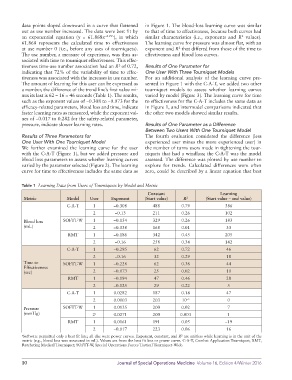
data points sloped downward in a curve that flattened   in Figure 1. The blood-loss learning curve was similar
          out as use number increased. The data were best fit by   to that of time to effectiveness, because both curves had
          an exponential equation (y = 61.868x −0.295 ), in which   similar characteristics (i.e., exponents and  R  values).
                                                                                                     2
          61.868 represents the calculated time to effectiveness   The learning curve for pressure was almost flat, with an
          at use number 0 (i.e., before any uses of tourniquets).   exponent and R  that differed from those of the time to
                                                                           2
          The use number, a measure of experience, was thus as-  effectiveness and blood loss curves.
          sociated with time to tourniquet effectiveness. This effec-
          tiveness time-use number association had an R  of 0.72,   Results of One Parameter for
                                                  2
          indicating that 72% of the variability of time to effec-  One User With Three Tourniquet Models
          tiveness was associated with the increases in use number.   For an additional analysis of the learning curve pre-
          The amount of learning for this user can be expressed as   sented in Figure 1 with the C-A-T, we added two other
          a number, the difference of the trend line’s first value mi-  tourniquet models to assess whether learning curves
          nus its last is 62 – 16 = 46 seconds (Table 1). The results,   varied by model (Figure 3). The learning curve for time
          such as the exponent values of −0.308 to −0.073 for the   to effectiveness for the C-A-T includes the same data as
          efficacy-related parameters, blood loss and time, indicate   in Figure 1, and intermodel comparisons indicated that
          faster learning rates as  measured, while the  exponent val-  the other two models showed similar results.
          ues of −0.017 to 0.282 for the safety-related parameter,
          pressure, indicate slower learning rates.          Results of One Parameter as a Difference
                                                             Between Two Users With One Tourniquet Model
          Results of Three Parameters for                    The  fourth evaluation  considered  the  difference  (less
          One User With One Tourniquet Model                 experienced user minus the more experienced user) in
          We  further  examined  the  learning  curve  for  the  user   the number of turns users made in tightening the tour-
          with the C-A-T (Figure 1), but we added pressure and   niquets that had a windlass; the C-A-T was the model
          blood loss parameters to assess whether learning curves   assessed. The difference was plotted by use number to
          varied by the parameter selected (Figure 2). The learning   explore for trends. Calculated differences were often
          curve for time to effectiveness includes the same data as   zero, could be described by a linear equation that best


          Table 1  Learning Data from Users of Tourniquets by Model and Metric
                                                              Constant                      Learning
           Metric            Model    User     Exponent      (Start value)   R 2      (Start value − end value)
                             C-A-T      1       −0.308          488         0.79              386
                                        2       −0.13           211         0.26              102
           Blood loss      SOFTT-W      1       −0.154          329         0.26              183
           (mL)                         2       −0.038          168         0.01              33
                             RMT        1       −0.186          342         0.45              205
                                        2       −0.16           258         0.34              142
                             C-A-T      1       −0.295           62         0.72              46
                                        2       −0.16            32         0.29              18
           Time to         SOFTT-W      1       −0.228           62         0.36              44
           Effectiveness
           (sec)                        2       −0.073           25         0.02              10
                             RMT        1       −0.194           47         0.46              28
                                        2       −0.125           29         0.22               5
                             C-A-T      1       0.0282          187         0.18              47
                                        2       0.0003          203         10 −5              0
           Pressure        SOFTT-W      1       0.0135          200         0.02               7
           (mmHg)                      2 a      0.0271          200        0.003               1
                             RMT        1       0.0161          191         0.05              −19
                                        2       −0.017          223         0.06              16
          a Software permitted only a best fit line; all else were power curves. Exponent, constant, and R  are unitless while learning is in the unit of the
                                                                            2
          metric (e.g., blood loss was measured in mL). Values are from the best fit line or power curve. C-A-T, Combat Application Tourniquet; RMT,
          Ratcheting Medical Tourniquet; SOFTT-W, Special Operations Forces Tactical Tourniquet-Wide.


          10                                     Journal of Special Operations Medicine  Volume 16, Edition 4/Winter 2016

