


Page 137 - Journal of Special Operations Medicine - Summer 2016
P. 137
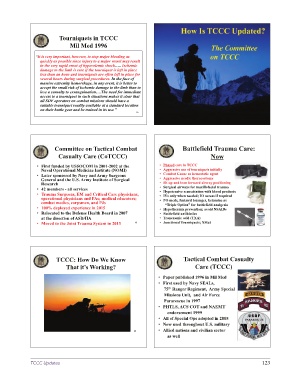
Tourniquets in TCCC
                              Mil Med 1996

                “It is very important, however, to stop major bleeding as
                  quickly as possible since injury to a major vessel may result
                  in the very rapid onset of hypovolemic shock….. Ischemic
                  damage to the limb is rare if the tourniquet is left in place
                  less than an hour and tourniquets are often left in place for
                  several hours during surgical procedures. In the face of
                  massive extremity hemorrhage, in any event, it is better to
                  accept the small risk of ischemic damage to the limb than to
                  lose a casualty to exsanguination….The need for immediate
                  access to a tourniquet in such situations makes it clear that
                  all SOF operators on combat missions should have a
                  suitable tourniquet readily available at a standard location
                  on their battle gear and be trained in its use.”
                                                         16


                         Committee on Tactical Combat                        Battlefield Trauma Care:
                         Casualty Care (CoTCCC)                                         Now

                •  First funded by USSOCOM in 2001-2002 at the     •  Phased care in TCCC
                  Naval Operational Medicine Institute (NOMI)      •  Aggressive use of tourniquets initially
                •  Later sponsored by Navy and Army Surgeons       •  Combat Gauze as hemostatic agent
                  General and the U.S. Army Institute of Surgical   •  Aggressive needle thoracostomy
                  Research                                         •  Sit up and lean forward airway positioning
                •  42 members - all services                       •  Surgical airways for maxillofacial trauma
                                                                   •  Hypotensive resuscitation with blood products
                •  Trauma Surgeons, EM and Critical Care physicians,    •  IVs only when needed; IO access if required
                  operational physicians and PAs; medical educators;   •  PO meds, fentanyl lozenges, ketamine as
                  combat medics, corpsmen, and PJs                       “Triple Option” for battlefield analgesia
                •  100% deployed experience in 2015                •  Hypothermia prevention; avoid NSAIDs
                •  Relocated to the Defense Health Board in 2007   •  Battlefield antibiotics
                    at the direction of ASD/HA                     •  Tranexamic acid (TXA)
                •  Moved to the Joint Trauma System in 2013   18   •  Junctional Tourniquets; XStat         19
                                                         18


                        TCCC: How Do We Know                                    Tactical Combat Casualty
                            That it’s Working?                                    Care (TCCC)

                                                                  •  Paper published 1996 in Mil Med
                                                                  •  First used by Navy SEALs,
                                                                       75  Ranger Regiment,  Army Special
                                                                       th
                                                                       Missions Unit,  and Air Force
                                                                       Pararescue in 1997
                                                                  •  PHTLS, ACS COT and NAEMT
                                                                          endorsement 1999
                                                                  •  All of Special Ops adopted in 2005
                                                                  •  Now used throughout U.S. military
                                                                  •  Allied nations and civilian sector
                                                        20
                                                                          as well                            21


              TCCC Updates                                                                                   123

