


Page 80 - Journal of Special Operations Medicine - Spring 2016
P. 80
Center. The result was to have organic BN Surgeons and   Table 1  Factors Contributing to SOLCUS Success
          PAs who could instruct and supervise the 18Ds, with the   The pros and cons of teaching ultrasound at the
          fellowship cadre providing any additional or advanced   operator level were openly discussed. The second-
          training as required.
                                                              and third-order effects were determined and a plan
                                                              for expansion was developed before embarking on
          Conclusion                                          the project.
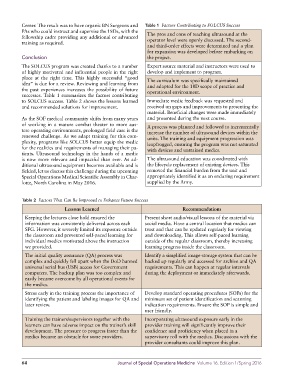
          The SOLCUS program was created thanks to a number   Expert source material and instructors were used to
          of highly motivated and influential people in the right   develop and implement to program.
          place at the right time. This highly successful “good   The curriculum was specifically maintained
          idea” is due for a review. Reviewing and learning from   and adapted for the 18D scope of practice and
          the past experiences increases the possibility of future   operational environment.
          successes. Table 1 summarizes the factors contributing
          to SOLCUS success. Table 2 shows the lessons learned   Immediate medic feedback was requested and
          and recommended solutions for improvement.          received on gaps and improvements to presenting the
                                                              material. Beneficial changes were made immediately
          As the SOF medical community shifts from many years   and presented during the next course.
          of working in a mature combat theater to more aus-  A process was planned and followed to incrementally
          tere operating environments, prolonged field care is the   increase the number of ultrasound devices within the
          renewed challenge. As we adapt training for this com-  units. The training and equipment progression was
          plexity, programs like SOLCUS better equip the medic   leapfrogged, ensuring the program was not saturated
          for the realities and requirements of managing their pa-  with devices and untrained medics.
          tients. Ultrasound technology in the hands of a medic
          is now more relevant and impactful than ever. As ad-  The ultrasound education was coordinated with
          ditional ultrasound equipment becomes available and is   the lifecycle replacement of existing devices. This
          fielded, let us discuss this challenge during the upcoming   removed the financial burden from the unit and
          Special Operations Medical Scientific Assembly in Char-  appropriately identified it as an enduring requirement
          lotte, North Carolina in May 2016.                  supplied by the Army.


          Table 2  Factors That Can Be Improved to Enhance Future Success
                            Lessons Learned                                 Recommendations
           Keeping the lectures close hold ensured the       Present short audio/visual lessons of the material via
           information was consistently delivered across each   social media. Have a central location that medics can
           SFG. However, it severely limited its exposure outside   trust and that can be updated regularly for viewing
           the classroom and prevented self-paced learning for   and downloading. This allows self-paced learning
           individual medics motivated above the instruction    outside of the regular classroom, thereby increasing
           we provided.                                      learning progress inside the classroom.
           The initial quality assurance (QA) process was    Identify a simplified image-storage system that can be
           complex and quickly fell apart when the DoD banned   backed up regularly and accessed for archive and QA
           universal serial bus (USB) access for Government   requirements. This can happen at regular intervals
           computers. The backup plan was too complex and    during the deployment or immediately afterwards.
           easily became overcome by all operational events for
           the medics.

           Stress early in the training process the importance of   Develop standard operating procedures (SOPs) for the
           identifying the patient and labeling images for QA and  minimum set of patient identification and scanning
           later review.                                     indication requirements. Ensure the SOP is simple and
                                                             user friendly.
           Training the trainers/supervisors together with the   Incorporating ultrasound exposure early in the
           learners can have adverse impact on the trainer’s skill   provider training will significantly improve their
           development. The pressure to progress faster than the   confidence and proficiency when placed in a
           medics became an obstacle for some providers.     supervisory roll with the medics. Discussions with the
                                                             provider consultants could improve this plan.


          64                                      Journal of Special Operations Medicine  Volume 16, Edition 1/Spring 2016

