


Page 62 - Journal of Special Operations Medicine - Spring 2016
P. 62
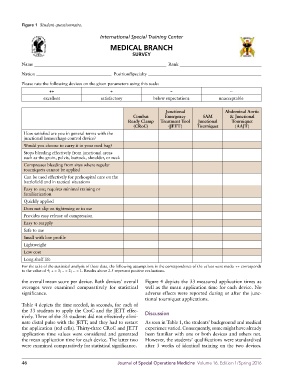
Figure 1  Student questionnaire.

                                          International Special Training Center
                                               MEDICAL BRANCH
                                                        SURVEY

          Name _______________________________________________________________  Rank _______________________________________
          Nation ____________________________________  Position/Specialty ______________________________________________________

          Please rate the following devices on the given parameters using this scale:
                     ++                        +                       −                        --
                   excellent               satisfactory         below expectations         unacceptable

                                                                     Junctional               Abdominal Aortic
                                                        Combat       Emergency       SAM        & Junctional
                                                      Ready Clamp    Treatment Tool   Junctional   Tourniquet
                                                        (CRoC)         (JETT)     Tourniquet      (AAJT)
           How satisfied are you in general terms with the
           junctional hemorrhage control device?
           Would you choose to carry it in your med bag?
           Stops bleeding effectively from junctional areas
           such as the groin, pelvis, buttock, shoulder, or neck
           Compresses bleeding from sites where regular
           tourniquets cannot be applied
           Can be used effectively for prehospital care on the
           battlefield and in tactical situations
           Easy to use; requires minimal training or
           familiarization
           Quickly applied
           Does not slip on tightening or in use
           Provides easy release of compression
           Easy to reapply
           Safe to use
           Small with low profile
           Lightweight
           Low cost
           Long shelf life
          For the sake of the statistical analysis of these data, the following assumptions in the correspondence of the values were made: ++ corresponds
          to the value of 4; + = 3; − = 2; -- = 1. Results above 2.5 represent positive evaluations.

          the overall mean score per device. Both devices’ overall   Figure 4 depicts the 33 measured application times as
          averages were examined comparatively for statistical   well as the mean application time for each device. No
          significance.                                      adverse effects were reported during or after the junc-
                                                             tional tourniquet applications.
          Table 4 depicts the time needed, in seconds, for each of
          the 33 students to apply the CroC and the JETT effec-  Discussion
          tively. Three of the 33 students did not effectively elimi-
          nate distal pulse with the JETT, and they had to restart   As seen in Table 1, the students’ background and medical
          the application (red cells). Thirty-three CRoC and JETT   experience varied. Consequently, some might have already
          application time values were considered and generated   been familiar with one or both devices and others not.
          the mean application time for each device. The latter two   However, the students’ qualifications were  standardized
          were examined comparatively for statistical significance.  after 3 weeks of identical training on the two  devices.


          46                                      Journal of Special Operations Medicine  Volume 16, Edition 1/Spring 2016

