


Page 61 - Journal of Special Operations Medicine - Spring 2016
P. 61
2
              arterial flow in the iliac artery.  It is necessary to provide   Table 1  Attendees’ Backgrounds
              a suitable tool to ensure proper care for casualties. New                    Basic
              devices were developed to address this problem: the                  SOF    Medical
                                                      ™
              Junctional Emergency Treatment Tool (JETT ; North   Nationality  SOF  Enablers  Background  Paramedic  Nurse
              American Rescue, http://www.narescue.com), the Com-  NOR       6     28       21       12      1
                                    ™
              bat Ready Clamp (CRoC ; Combat Medical Systems,
              http://www.combatmedicalsystems.com),  the  Abdomi-  NLD       2     22       16        8
              nal Aortic and Junctional Tourniquet (AAJT ; Chinook   ITA     7              7
                                                    ™
              Gear Inc., http://www.chinookmed.com), and the SAM   USA       1      6       3         4
              Junctional Tourniquet (SAM Medical Products, http://  BEL      3      2       4         1
              www.sammedical.com/products) are some examples.
                                                                 ROU         6              2         4
              International Special Training Center (ISTC)  Medi-  DNK              1                 1
              cal Branch Special Operations Forces Advanced Medi-  GBR              1                        1
              cal First Responder (SOF AMFR) course attendees are   HRV      1      1       2
              trained in accordance with Tactical Combat Casualty   LVA             1       1
              Care  guidelines;  severe  external  hemorrhage  control,
              by any means, is their first priority, as taught using the   Data are given as number of attendees. SOF, Special Operations Forces;
                                                                 BEL, Belgium; DNK, Denmark; GBR, Great Britain; HRV, Croatia;
              MARCH ON drill. Our objective was to examine the   ITA, Italy; LVA, Latvia; NOR, Norway; NLD, The Netherlands; ROU,
              application time of the CRoC and the JETT tourniquets   Romania; USA, United States of America.
              and to assess the opinions of our students regarding the
              efficacy of these tools, and then to examine how these   simulated casualty’s groin at least four times in training
              two parameters correlated. Our study analyzes both ob-  combat scenarios over a period of 1 week and under the
              jective and subjective criteria. The objective data were   supervision of Medical Branch instructors. After that,
              obtained by recording the effective application time   each of the students, having been through a prescheduled
              of  these  two  junctional  tourniquets  in  training  com-  event of intense physical stress, had to apply both devices
              bat scenarios. The subjective data were obtained from   on another student’s groin and effectively eliminate the
              a relevant questionnaire that addressed several factors,   distal pulse unilaterally with each device. The time for
              including ease of use and practicality. 3          this application was measured by the instructors. The ap-
                                                                 plication technique consisted of positioning oneself next
                                                                 to the simulated casualty and applying one of the devices
              Methods
                                                                 over the common femoral artery until the pulse from ei-
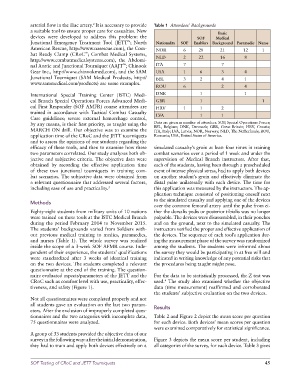
              Eighty-eight students from military units of 10 nations   ther the dorsalis pedis or posterior tibialis was no longer
              were trained on these tools at the ISTC Medical Branch   palpable. The devices were disassembled, in their pouches
              during the period February 2014 to November 2015.   and on the ground, next to the simulated casualty. The
              The students’ backgrounds varied from Soldiers with-  instructors verified the proper and effective application of
              out  previous  medical training  to  medics,  paramedics,   the devices. The sequence of each tool’s application dur-
              and nurses (Table 1). The whole survey was realized   ing the measurement phase of the survey was randomized
              inside the scope of a 3-week SOF AFMR course. Inde-  among the students. The students were informed about
              pendent of their experience, the students’ qualifications   the survey they would be participating in at free will and
              were standardized after 3 weeks of identical training   indicated in writing knowledge of any potential risks that
              on the two devices. The students completed a relevant   the procedures being taught might pose.
              questionnaire at the end of the training. The question-
              naire evaluated aspects/parameters of the JETT and the   For the data to be statistically processed, the Z test was
                                                                     4
              CRoC such as comfort level with use, practicality, effec-  used.  The study also examined whether the objective
              tiveness, and safety (Figure 1).                   data (time measurement) reaffirmed and corroborated
                                                                 the students’ subjective evaluation on the two devices.
              Not all questionnaires were completed properly and not
              all students gave an evaluation on the last two param-  Results
              eters. After the exclusion of improperly completed ques-
              tionnaires and the two categories with incomplete data,   Table 2 and Figure 2 depict the mean score per question
              75 questionnaires were analyzed.                   for each device. Both devices’ mean scores per question
                                                                 were examined comparatively for statistical significance.
              A group of 33 students provided the objective data of our
              survey in the following way: after the initial  demonstration,   Figure 3 depicts the mean score per student, including
              they had to train and apply both devices effectively on a   all categories of the survey, for each device. Table 3 gives


              SOF Testing of CRoC and JETT Tourniquets                                                        45

