


Page 48 - Journal of Special Operations Medicine - Spring 2016
P. 48
reported.  For  pairwise  comparison  of  models,  a  non-  Table 2  Distal Pulse Cessation Results by Tourniquet Model*
          parametric Wilcoxon method was used. For pairwise                           Pulse Cessation,**
          comparison of model means, the Tukey method was                            Occurrence,  No. (%)
                                                                                              †
          used. Significance for results was established when p <   Tourniquet Model  No            Yes
          .05. All statistical analysis was conducted using SAS soft-
          ware (SAS Institute; https://www.sas.com) and MS Excel   C-A-T (n = 20)   0 (0)         20 (100)
          2003 (Microsoft Corp.; http://www.microsoft.com).   RATS (n = 20)         0 (0)         20 (100)
                                                              TMT (n = 20)          1 (5)         19 (95)
                                                              Total (N = 60)        1 (2)         59 (98)
          Results
                                                             *Chi-square analysis found no differences  among tourniquets (p >
                                                             .05). **Pulse cessation was defined by absence of measurable pulse
          Tourniquet Model Comparisons                       (no/yes).  Percentage was calculated by dividing occurrences for each
                                                                   †
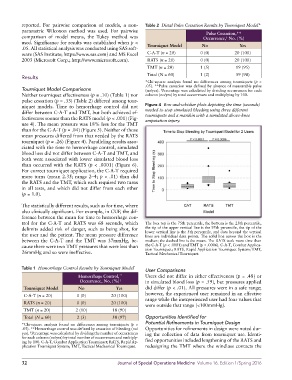
          Neither tourniquet effectiveness (p = .10) (Table 1) nor   column (no/yes) by total occurrences and multiplying by 100.
          pulse cessation (p = .33) (Table 2) differed among tour-
          niquet models. Time to hemorrhage control did not   Figure 4  Box-and-whisker plots depicting the time (seconds)
          differ between C-A-T and TMT, but both achieved ef-  needed to stop simulated bleeding using three different
                                                             tourniquets and a manikin with a simulated above-knee
          fectiveness sooner than the RATS model (p < .001) (Fig-  amputation injury.
          ure 4). The mean pressure was 18% less for the TMT
          than for the C-A-T (p = .04) (Figure 5). Neither of those
          mean pressures differed from that needed by the RATS
          tourniquet (p ≥ .26) (Figure 4). Paralleling results asso-
          ciated with the time to hemorrhage control, simulated
          blood loss did not differ between C-A-T and TMT, and
          both were associated with lower simulated blood loss
          than occurred with the RATS (p < .0001) (Figure 6).
          For correct tourniquet application, the C-A-T required
          more turns (mean 2.35; range 2–4; p < .01) than did
          the RATS and the TMT, which each required two turns
          in all tests, and which did not differ from each other
          (p = 1.0).

          The statistically different results, such as for time, where
          also clinically significant. For example, in CUF, the dif-
          ference between the mean for time to hemorrhage con-
          trol for the C-A-T and RATS was 68 seconds, which   The box top is the 75th percentile, the bottom is the 25th percentile,
          delimits added risk of danger, such as being shot, for   the tip of the upper vertical line is the 95th percentile, the tip of the
          the user and the patient. The mean pressure difference   lower vertical line is the 5th percentile, and dots beyond the vertical
                                                             lines are individual data points. The solid line across the box is the
          between the C-A-T and the TMT was 37mmHg, be-      median; the dashed line is the mean. The RATS took more time than
          cause there were two TMT pressures that were less than   the C-A-T (p < .0001) and TMT (p = .0006). C-A-T, Combat Applica-
          26mmHg and so were ineffective.                    tion Tourniquet; RATS, Rapid Application Tourniquet System; TMT,
                                                             Tactical Mechanical Tourniquet.

          Table 1  Hemorrhage Control Results by Tourniquet Model *
                                                             User Comparisons
                                 Hemorrhage Control, **      Users did not differ in either effectiveness (p = .48) or
                                  Occurrence, No. (%) †      in simulated blood loss (p = .59), but pressures applied
           Tourniquet Model      No              Yes         did differ (p < .01). All pressures were in a safe range;
           C-A-T (n = 20)        0 (0)         20 (100)      however, the experienced user remained in an effective
                                                             range while the inexperienced user had four values that
           RATS (n = 20)         0 (0)         20 (100)
                                                             were outside that range (<100mmHg).
           TMT (n = 20)         2 (10)         18 (90)
           Total (N = 60)        2 (3)         58 (97)       Opportunities Identified for
          *Chi-square analysis found no differences  among tourniquets (p >   Potential Refinements in Tourniquet Design
          .05). **Hemorrhage control was defined by cessation of bleeding (no/  Opportunities for refinements in design were noted dur-
          yes).  Percentage was calculated by dividing the number of occurrences   ing the collection of data from tourniquet use. Identi-
              †
          for each column (no/yes) by total number of occurrences and multiply-
          ing by 100. C-A-T, Combat Application Tourniquet; RATS, Rapid Ap-  fied opportunities included lengthening of the RATS and
          plication Tourniquet System; TMT, Tactical Mechanical Tourniquet.  redesigning the TMT where the windlass contacts the


          32                                      Journal of Special Operations Medicine  Volume 16, Edition 1/Spring 2016

