


Page 139 - Journal of Special Operations Medicine - Spring 2016
P. 139
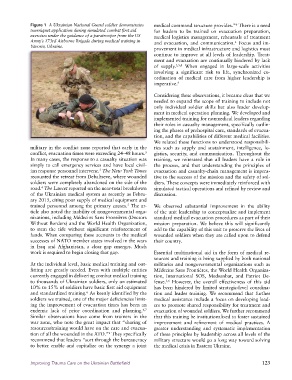
Figure 1  A Ukrainian National Guard soldier demonstrates     medical  command structure provides.”  There is a need
                                                                                                  6
              tourniquet application during simulated combat first aid   for leaders to be trained on evacuation preparation,
              exercises under the guidance of a paratrooper from the US   medical logistics management, rehearsals of treatment
              Army’s 173rd Airborne Brigade during medical training in   and evacuation, and communication.  Focus and im-
                                                                                                  6
              Yavoriv, Ukraine.
                                                                 provement in medical infrastructure and logistics must
                                                                 continue to improve at all levels of leadership. Treat-
                                                                 ment and evacuation are continually hindered by lack
                                                                 of supply. 3,5,8  When engaged in large-scale activities
                                                                 involving a significant risk to life, synchronized co-
                                                                 ordination of medical care from higher leadership is
                                                                 imperative. 9

                                                                 Considering these observations, it became clear that we
                                                                 needed to expand the scope of training to include not
                                                                 only individual soldier skills but also leader develop-
                                                                 ment in medical operation planning. We developed and
                                                                 implemented training for nonmedical leaders regarding
                                                                 their roles in casualty management, specifically outlin-
                                                                 ing the phases of prehospital care, standards of evacua-
                                                                 tion, and the capabilities of different medical facilities.
                                                                 We related these functions to understood responsibili-
              military in the conflict zone reported that early in the   ties such as supply and sustainment, intelligence, lo-
              conflict, evacuation times were exceeding 24–48 hours.    gistics, security, and communication. Throughout the
                                                             3
              In many cases, the response to a casualty situation was   training, we reiterated that all leaders have a role in
              simply to call emergency services and have local civil-  the  process,  and  that  understanding  the  principles  of
              ian response personnel intervene.  The New York Times   evacuation and casualty-chain management is impera-
                                          3
              recounted the retreat from Debaltseve, where wounded   tive to the success of the mission and the safety of sol-
              soldiers were completely abandoned on the side of the   diers. These concepts were immediately reinforced with
                  4
              road.  The Lancet reported on the near-total breakdown   simulated tactical operations and refined by review and
              of the Ukrainian medical system as recently as Febru-  discussion.
              ary 2015, citing poor supply of medical equipment and
                                                      5
              trained personnel among the primary causes.  The ar-  We observed substantial improvement in the ability
              ticle also noted the inability of nongovernmental orga-  of the unit leadership to conceptualize and implement
              nizations, including Médecins Sans Frontières (Doctors   standard medical evacuation procedures as part of their
              Without Borders) and the World Health Organization,   mission preparation. We believe this will significantly
              to  stem  the  tide  without  significant  reinforcement  of   add to the capability of this unit to preserve the lives of
              funds. When comparing these accounts to the medical   wounded soldiers when they are called upon to defend
              successes of NATO member states involved in the wars   their country.
              in Iraq and Afghanistan, a clear gap emerges. Much
              work is required to begin closing that gap.        Essential multinational aid in the form of medical re-
                                                                 sources and training is being supplied by both national
              At the individual level, basic medical training and out-  militaries and nongovernmental organizations such as
              fitting are greatly needed. Even with multiple entities   Médecins Sans Frontières, the World Health Organiza-
              currently engaged in delivering combat medical training   tion, International SOS, Medsanbat, and Patriot De-
              to thousands of Ukrainian soldiers, only an estimated   fense.  However, the overall effectiveness  of this aid
                                                                     5,6
              10% to 15% of soldiers have basic first aid equipment   has been hindered by limited strategic-level coordina-
                                     6
              and standardized training.  As keenly identified by the   tion and leader training. We recommend that further
              soldiers we trained, one of the major deficiencies limit-  medical assistance include a focus on developing lead-
              ing the improvement of evacuation times has been an   ers to promote shared responsibility for treatment and
                                                            6,7
              endemic  lack  of  prior  coordination  and  planning.    evacuation of wounded soldiers. We further recommend
              Similar observations have come from trainers in the   that this training be institutionalized to foster sustained
              war zone, who note the great impact that “sharing of   improvement and refinement of medical practices. A
              resources/training would have on the care and evacua-  greater  understanding  and systematic  implementation
              tion of all the wounded in the ATO.”  They specifically   of these principles by leadership across all levels of the
                                              6
              recommend that leaders “sort through the bureaucracy   military structure would go a long way toward solving
              to better enable and capitalize on the synergy a joint   the medical crisis in Eastern Ukraine.


              Improving Trauma Care on the Ukrainian Battlefield                                             123

