


Page 109 - Journal of Special Operations Medicine - Spring 2016
P. 109
rates are related to running injuries. This lack of clar-  A study from Brigham Young University, by Ridge et
                                                                   35
              ity results from the limitations of the cited retrospective   al.,  compared bone stress injuries in runners using
              studies, the mixed results from these retrospective inves-  conventional versus minimalist shoes. Runners who
              tigations, and the fact that the only prospective study   participated  in this study had never used  minimalist
              found that runners with higher loading rates were less   shoes, were injury free, and ran an average of 15–30
                               29
              likely to be injured.  However, it is notable that higher   miles/week in the 6 months before the study. Investi-
              impact forces are associated with greater bone mineral   gators randomized subjects into two groups: one that
              content and density, 30–32  and this finding is consistent   continued running in conventional shoes for 10 weeks
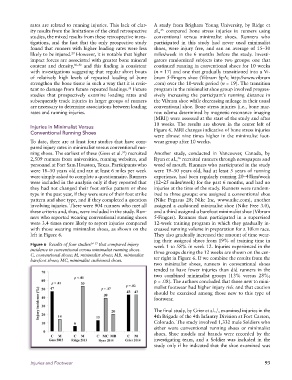
              with investigations suggesting that regular short bouts   (n = 17) and one that gradually transitioned into a Vi-
              of  relatively  high  levels  of  repeated  loading  of  bone   bram 5-Fingers shoe (Vibram SpA; http://www.vibram
              strengthen the bone tissue in such a way that it is resis-  .com) over the 10-week period (n = 19). The transition
                                                      33
              tant to damage from future repeated loadings.  Future   program in the minimalist shoe group involved progres-
              studies  that  prospectively  examine  loading  rates  and   sively increasing the participant’s running distance in
              subsequently track injuries in larger groups of runners   the Vibram shoe while decreasing mileage in their usual
              are necessary to determine associations between loading   conventional shoe. Bone stress injuries (i.e., bone mar-
              rates and running injuries.                        row edema determined by magnetic resonance imaging
                                                                 [MRI]) were assessed at the start of the study and after
                                                                 10 weeks. The results are shown in the center left of
              Injuries in Minimalist Versus                      Figure 6. MRI changes indicative of bone stress injuries
              Conventional Running Shoes
                                                                 were almost nine times higher in the minimalist foot-
              To date, there are at least four studies that have com-  wear group after 10 weeks.
              pared injury rates in minimalist versus conventional run-
              ning shoes. The earliest of these (Goss et al. ) recruited   Another study, conducted in Vancouver, Canada, by
                                                   34
                                                                          36
              2,509 runners from universities, running websites, and   Ryan et al.,  recruited runners through newspapers and
              personnel at Fort Sam Houston, Texas. Participants who   word of mouth. Runners who participated in the study
              were 18–50 years old and ran at least 6 miles per week   were 19–50 years old, had at least 5 years of running
              were simply asked to complete a questionnaire. Runners   experience, had been regularly running 20–40km/week
              were included in the analysis only if they reported that   (12–25 miles/week) for the past 6 months, and had no
              they had not changed their foot strike pattern or shoe   injuries at the time of the study. Runners were random-
              type in the past year, if they were sure of their foot strike   ized to three groups: one assigned a conventional shoe
              pattern and shoe type, and if they completed a question   (Nike Pegasus 28; Nike Inc, www.nike.com), another
              involving injuries. There were 904 runners who met all   assigned a cushioned minimalist shoe (Nike Free 3.0),
              these criteria and, thus, were included in the study. Run-  and a third assigned a barefoot minimalist shoe (Vibram
              ners who reported wearing conventional running shoes   5-Fingers). Runners then participated in a supervised
              were 3.4 times more likely to report injuries compared   12-week training program in which they gradually in-
              with those wearing minimalist shoes, as shown on the   creased running volume in preparation for a 10km race.
              left in Figure 6.                                  They also gradually increased the amount of time wear-
                                                                 ing their assigned shoes from 19% of training time in
              Figure 6  Results of four studies 34–37  that compared injury   week 1 to 58% in week 12. Injuries experienced in the
              incidence in conventional versus minimalist running shoes.   three groups during the 12 weeks are shown on the cen-
              C, conventional shoes; M, minimalist shoes; MB, minimalist
              barefoot shoes; MC, minimalist cushioned shoes.    ter right in Figure 6. If we combine the results from the
                                                                 two minimalist shoes, runners in conventional shoes
                                                                 tended to have fewer injuries than did runners in the
                                                                 two combined minimalist groups (13% versus 28%;
                                                                 p = .08). The authors concluded that those new to mini-
                                                                 malist footwear had higher injury risk and that caution
                                                                 should be exercised among those new to this type of
                                                                 footwear.

                                                                                           3
                                                                 The final study, by Grier et al., , examined injuries in the
                                                                 4th Brigade of the 4th Infantry Division at Fort Carson,
                                                                 Colorado. The study involved 1,332 male Soldiers who
                                                                 either wore conventional running shoes or minimalist
                                                                 shoes. Shoe models and brands were recorded by the
                                                                 investigating team, and a Soldier was included in the
                                                                 study only if he indicated that the shoe examined was


              Injuries and Footwear                                                                           93

