


Page 107 - Journal of Special Operations Medicine - Spring 2016
P. 107
rearfoot strike pattern, whereas 57% were using a fore-    runners were filmed as they ran on either a treadmill or
              foot strike pattern.  These investigations indicate that   a track, and their foot strike patterns were assessed on
                              14
              over a relatively short time, most runners adapting to   viewing the film. There were 16 forefoot strikers (31%)
              minimalist shoes adopt a forefoot strike pattern.  and 36 rearfoot strikers (69%). Injuries were recorded
                                                                 by an athletic trainer/physical therapist with follow-up
              Figure 3 shows vertical ground reaction forces for fore-  consultations with physicians. A complex injury severity
              foot, midfoot, and rearfoot ground strikes. 1,16,17  Vertical   score was developed based primarily on the number of
              ground reaction forces are the vertical forces of impact   days of activity restriction and the types of restrictions.
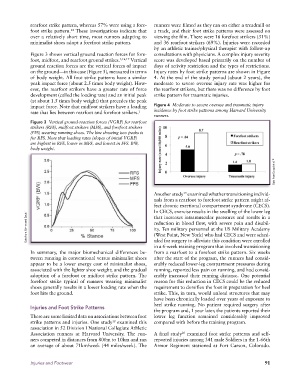
              on the ground—in this case (Figure 3), measured in terms   Injury rates by foot strike patterns are shown in Figure
              of body weight. All foot strike patterns have a similar   4. At the end of the study period (about 2 years), the
              peak impact force (about 2.5 times body weight). How-  moderate to severe overuse injury rate was higher for
              ever, the rearfoot strikers have a greater rate of force   the rearfoot strikers, but there was no difference by foot
              development (called the loading rate) and an initial peak   strike pattern for traumatic injuries.
              (at about 1.5 times body weight) that precedes the peak
              impact force. Note that midfoot strikers have a loading   Figure 4  Moderate to severe overuse and traumatic injury
              rate that lies between rearfoot and forefoot strikers. 1  incidence by foot strike patterns among Harvard University
                                                                 runners.
              Figure 3  Vertical ground-reaction forces (VGRF) for rearfoot
              strikers (RFS), midfoot strikers (MFS), and forefoot strikers
              (FFS) wearing running shoes. The line showing two peaks is
              for RFS. Note that loading rates (slopes of initial VGRF)
              are highest in RFS, lower in MFS, and lowest in FFS. BW,
              body weight.

                                                                                                                  Data from Daoud et al. 18


                                                                             19
                                                                 Another study  examined whether transitioning individ-
                                                                 uals from a rearfoot to forefoot strike pattern might af-
                                                                 fect chronic exertional compartment syndrome (CECS).
                                                                 In CECS, exercise results in the swelling of the lower leg
            Data from Altman and Davis. 1                        reduction in blood flow, with severe pain and disabil-
                                                                 that increases intramuscular pressures and results in a
                                                                 ity. Ten military personnel at the US Military Academy
                                                                 (West Point, New York) who had CECS and were sched-
                                                                 uled for surgery to alleviate this condition were enrolled
                                                                 in a 6-week training program that involved transitioning
              In summary, the major biomechanical differences be-  from a rearfoot to a forefoot strike pattern. Six weeks
              tween running in conventional versus minimalist shoes   after the start of the program, the runners had consid-
              appear to be a lower energy cost of minimalist shoes,   erably reduced lower-leg compartment pressures during
              associated with the lighter shoe weight; and the gradual   running, reported less pain on running, and had consid-
              adoption of a forefoot or midfoot strike pattern. The   erably increased their running distance. One potential
              forefoot strike typical of runners wearing minimalist   reason for this reduction in CECS could be the reduced
              shoes generally results in a lower loading rate when the   requirement to dorsiflex the foot in preparation for heel
              foot hits the ground.                              strike. This, in turn, would unload structures that may
                                                                 have been chronically loaded over years of exposure to
                                                                 heel strike running. No patient required surgery after
              Injuries and Foot Strike Patterns
                                                                 the program and, 1 year later, the patients reported their
              There are some limited data on associations between foot   lower leg function remained considerably improved
                                               18
              strike patterns and injuries. One study  examined this   compared with before the training program.
              association in 52 Division I National Collegiate Athletic
                                                                            20
              Association runners at Harvard University. The run-  A final study  examined foot strike patterns and self-
              ners competed in distances from 800m to 10km and ran   reported injuries among 341 male Soldiers in the 1-66th
              an average of about 71km/week (44 miles/week). The   Armor Regiment stationed at Fort Carson, Colorado.


              Injuries and Footwear                                                                           91

