


Page 123 - Journal of Special Operations Medicine - Winter 2015
P. 123
benefited from research efforts. Current research has   blood collection tubes, results are given in 30 seconds. In
              shown acidemia, hypothermia, and hemodilution are   real-world use in Africa, USSOCOM medical personnel
              causal factors in the coagulopathy of trauma patients.    were impressed with its overall ease of use. The device is
                                                             5
              Efforts to combat this “triad of coagulopathy” form the   portable and battery powered, has wireless capabilities,
              basis of many stabilization–resuscitation protocols in   and allows for room temperature smart card storage.
              the military. Similarly, studies on the clearance of lac-  Downsides of the users’ experience included no “emer-
              tate as well as hyperglycemia have shown them both to   gency” setting (170-second calibration, then more time
              be prognostic markers in trauma patients.  In malarial   to results) and the requirement for two different power
                                                  6,7
              patients, laboratory values also provide vital informa-  cords. Compared with the other two options detailed
              tion. The World Health Organization defines “severe   next, the EPOC’s most unique feature would be the abil-
              malaria” with several laboratory abnormalities includ-  ity to store the reagent smart cards at room temperature
              ing severe anemia and hypoglycemia. 8              for a 6-month shelf-life.

                                                                 Abaxis’ Piccolo costs US$12,100 and can evaluate more
              Comparison of POCT Devices
                                                                 comprehensive metabolic tests including a liver profile
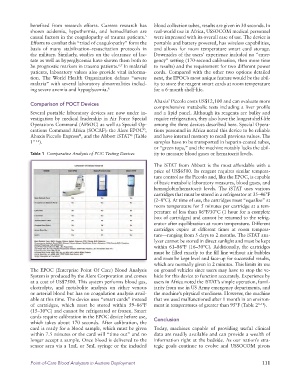
              Several portable laboratory devices are now under in-  and a lipid panel. Although its reagents are bulky and
              vestigation by medical leadership in Air Force Special   require refrigeration, they also have the longest shelf-life
              Operations Command (AFSOC) as well as Special Op-  among the three devices described here. Special Opera-
              erations Command Africa (SOCAF): the Alere EPOC ,   tions personnel in Africa noted this device to be reliable
                                                            ©
              Abaxis Piccolo Express , and the Abbott iSTAT  (Table   and have internal memory to recall previous values. The
                                                       ©
                                  ©
              1 9–11 ).                                          samples have to be transported in heparin-coated tubes,
                                                                 or “green tops,” and the machine notably lacks the abil-
              Table 1  Comparative Analysis of POC Testing Devices  ity to measure blood gases or hematocrit levels.
                                                                 The iSTAT from Abbott is the most affordable with a
                                                                 price of US$6500. Its reagent requires similar tempera-
                                                                 ture control as the Piccolo and, like the EPOC, is capable
                                                                 of basic metabolic laboratory measures, blood gases, and
                                                                 hemoglobin/hematocrit levels. The iSTAT uses various
                                                                 cartridges that must be stored in a refrigerator at 35–46°F
                                                                 (2–8°C). At time of use, the cartridges must “equalize” at
                                                                 room temperature for 5 minutes per cartridge at a tem-
                                                                 perature of less than 86°F/30°C (1 hour for a complete
                                                                 box of cartridges) and cannot be returned to the refrig-
                                                                 erator after equilibration at room temperature. Different
                                                                 cartridges expire at different times at room tempera-
                                                                 ture—ranging from 5 days to 2 months. The iSTAT ana-
                                                                 lyzer cannot be stored in direct sunlight and must be kept
                                                                 within 61–86°F (16–30°C). Additionally, the cartridges
                                                                 must be filled exactly to the fill line without air bubbles
                                                                 and must be kept level and face-up for successful results,
                                                                 which are normally given in 2 minutes. This limits its use
              The EPOC (Enterprise Point Of Care) Blood Analysis   on ground vehicles since users may have to stop the ve-
              System is produced by the Alere Corporation and comes   hicle for this device to function accurately. Experience by
              at a cost of US$7500. This system performs blood gas,   users in Africa noted the iSTAT’s simple operation, famil-
              electrolyte, and metabolite analysis on either venous   iarity from use in US Army emergency departments, and
              or arterial blood but has no coagulation analysis avail-  the machine’s physical sturdiness. However, the machine
              able at this time. The device uses “smart cards” instead   that we used malfunctioned after 1 month in an environ-
              of  cartridges,  which  must  be  stored  within  59–86°F   ment in temperatures of greater than 95°F (Table 2 9–11 ).
              (15–30°C) and cannot be refrigerated or frozen. Smart
              cards require calibration in the EPOC device before use,   Conclusion
              which takes about 170 seconds. After calibration, the
              card is ready for a blood sample, which must be given   Today, machines capable of providing useful clinical
              within 7.5 minutes or the card will “time out” and no   data are readily available and can provide a wealth of
              longer accept a sample. Once blood is delivered to the   information right at the bedside. As our nation’s stra-
              sensor area via a 1mL or 3mL syringe or the included   tegic goals continue to evolve and USSOCOM pivots


              Point-of-Care Blood Analyzers in Austere Deployment                                            111

