


Page 98 - Journal of Special Operations Medicine - Winter 2014
P. 98
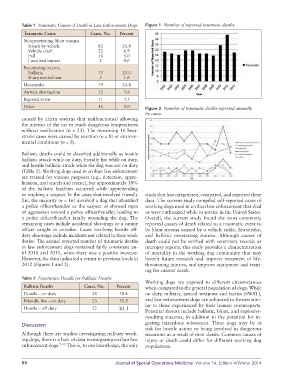
Table 1  Traumatic Causes of Death in Law Enforcement Dogs  Figure 1  Number of reported traumatic deaths.
           Traumatic Cause            Cases, No.  Percent
           Nonpenetrating blunt trauma
             Struck by vehicle            82        25.8
             Vehicle crash                22        6.9
             Fall                         16        5.0
             Localized impact             2         0.6
           Penetrating trauma
             Ballistic                    73        23.0
             Sharp nonballistic           5         1.6
           Heatstroke                     79        24.8
           Airway obstruction             12        3.8
           Ingested toxin                 11        3.5
           Other                          16        5.0      Figure 2  Number of traumatic deaths reported annually
                                                             by cause.
          caused by alarm systems that malfunctioned allowing
          the interior of the car to reach dangerous temperatures
          without notification (n = 23). The remaining 16 heat-
          stroke cases were caused by exertion (n = 8) or environ-
          mental conditions (n = 8).

          Ballistic deaths could be classified additionally as hostile
          ballistic attack while on duty, friendly fire while on duty,
          and hostile ballistic attack while the dog was not on duty
          (Table 2). Working dogs used in civilian law enforcement
          are trained for various purposes (e.g., detection, appre-
          hension, and search and rescue), but approximately 38%
          of  the  ballistic fatalities  occurred  while  apprehending
          or tracking a suspect. In the cases that involved friendly   study that has categorized, compared, and reported these
          fire, the majority (n = 16) involved a dog that identified   data. The current study compiled self-reported cases of
          a police officer/handler as the suspect or showed signs   working dogs used in civilian law enforcement that died
          of aggression toward a police officer/handler, leading to   or were euthanized while in service in the United States.
          a police officer/handler fatally wounding the dog. The   Overall, the  current study found the  most commonly
          remaining cases include accidental shootings or a canine     reported causes of death related to a traumatic event to
          officer caught in crossfire. Cases involving hostile off-  be blunt trauma caused by a vehicle strike, heatstroke,
          duty shootings include incidents not related to their work   and ballistic penetrating trauma. Although causes of
          duties. The annual reported number of traumatic deaths   death could not be verified with veterinary records or
          in law enforcement dogs remained fairly consistent un-  necropsy reports, this study provides a characterization
          til 2010 and 2011, when there was a positive increase.   of mortality in the working dog community that may
          However, the data indicated a return to previous levels in   benefit future research and improve treatment of life-
          2012 (Figures 1 and 2).                            threatening injuries, and improve equipment and train-
                                                             ing for current needs.
          Table 2  Descriptive Details for Ballistic Deaths
                                                             Working dogs are exposed to different circumstances
           Ballistic Deaths         Cases, No.   Percent     when compared to the general population of dogs. While
           Hostile – on duty           28         38.4       on duty, military, special weapons and tactics (SWAT),
           Friendly fire – on duty     23         31.5       and law enforcement dogs are subjected to threats simi-
                                                             lar to those experienced by their human counterparts.
           Hostile – off duty          22         30.1
                                                             Potential threats include ballistic, blunt, and explosive-
                                                             resulting traumas, in addition to the potential for in-
                                                             gesting hazardous substances. These dogs may be at
          Discussion
                                                             risk for hostile action or being involved in dangerous
          Although there are studies investigating military work-  situations as a result of their duties. Common causes of
          ing dogs, there is a lack of data investigating civilian law   injury or death could differ for different  working dog
          enforcement dogs. 7–12  This is, to our knowledge, the only   populations.


          88                                     Journal of Special Operations Medicine  Volume 14, Edition 4/Winter 2014

