


Page 93 - Journal of Special Operations Medicine - Winter 2014
P. 93
www.idexx.com),  according  to  manufacturer’s  recom-  Statistical Analysis
              mendations. Peptide-specific antibody to  A. phago-  Local prevalence for single disease status was calculated
              cytophilum, A. platys, E. canis, E. chaffeensis, or  B.   as the proportion of positive samples from the total of
              burgdorferi present in the patient sample binds to the   the samples tested. The odds ratios (ORs) for single dis-
              peptide-HRP conjugate. Immune complexes that form   eases among the three populations were compared by
              are bound to peptide conjugates adhered to the mem-  logistic regression analysis using the PROC LOGISTIC
              brane on the flow matrix. Unbound antibodies and   function of the Statistical Analysis System (SAS version
              peptide-HRP conjugates were washed and substrate   9.2; SAS Institute Inc., Cary, NC, USA; http://www.sas
              reagents were applied. Color development in the area   .com/).
              of the deposition species-specific peptides and immune
              complexes indicated a positive result.
                                                                 Results
              DNA Extraction and Real-Time                       Of the 218 serum samples tested, 62 (28.4%) had an-
              Polymerase Chain Reaction Amplification            tibodies only to E. canis and 15 (6.9%) had antibod-
              DNA was extracted from canine whole blood using a   ies only to  A. platys. However, 101 (46.3%) samples
              commercially  available  kit  (High  Pure  PCR  Template   had antibodies to both E. canis and A. platys. There-
              Preparation Kit, Roche Applied Science, Madison, WI,   fore, the total number of E. canis positive samples was
              USA; lifescience.roche.com) according to the manufac-  163 (74.4%) and the total number of A. platys positive
              turer’s instructions. Genomic DNA was stored at −20°C   samples was 116 (53.2%). Of the 218 DNA samples,
              until testing.                                     46 (21.1%) were positive for E. canis DNA, 19 (8.7%)
                                                                 were positive for A. platys DNA and 16 (7.3%) were
              Real-time polymerase chain reaction (PCR) hybridiza-  positive for both E. canis and A. platys DNA. There-
              tion probe assays were used that detect the disulfide   fore, 62 samples (28.4%) were positive for the presence
              oxidoreductase gene (GenBank AF403710) of E. canis   of E. canis DNA and 35 samples (16.1%) were positive
              and the p44 gene of A. platys. These two assays were   for the presence of A. platys DNA. Of the 163 dogs se-
              used based on the high seroprevalence of exposure to   ropositive for E. canis, 60 (36.8%) were also positive by
              these agents in the sample population. The real-time   PCR analysis. Two samples were PCR positive for E. ca-
              PCR assays were performed with the LightCycler 480   nis but seronegative. Of the 116 dogs seropositive for A.
              instrument (Roche Applied Science, Madison, WI, USA;   platys, 26 (22.4%) were also positive by PCR analysis.
              lifescience.roche.com). PCR was carried out in a total re-  Nine samples were PCR positive but seronegative. Of
              action volume of 20μL containing LightCycler 480 Ge-  the 101 samples that were seropositive for both E. canis
              notyping Master mix (Roche Applied Science, Madison,   and A. platys, 10 (10.0%) were also PCR positive for
              WI, USA; lifescience.roche.com), assay specific primers   both organisms. All 218 serum samples were seronega-
              and probes, and 5μL of template DNA. Cycling param-  tive for E. ewingii, E. chaffeensis, and B. burgdorferi.
              eters for the E. canis PCR consisted of a denaturation   Two samples were seropositive for A. phagocytophilum,
              cycle of 95°C for 10 minutes, followed by a 55- cycle   and both of these were PCR negative. These data are
              amplification  profile  (95°C  for  20  seconds,  60°C  for   outlined in Table 1. Exposure to tick-borne pathogens
              30 seconds with a single data acquisition, 72°C for 20   was  highest  in  shelter  animals  and  military  working
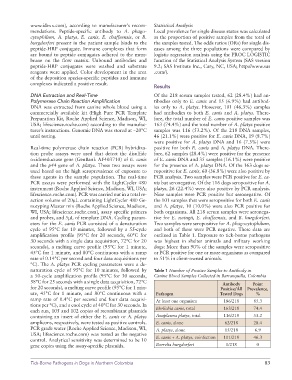
              seconds), a melting curve profile (95°C for 1 minute,   dogs: More than 90% of the samples were seropositive
              45°C for 1 minute, and 80°C continuous with a ramp   or PCR positive for one or more organisms as compared
              rate of 0.14°C per second and four data acquisitions per   to 51% in client-owned animals.
              °C). The A. platys PCR cycling parameters were a de-
              naturation cycle of 95°C for 10 minutes, followed by   Table 1 Number of Positive Samples to Antibody in
              a 50-cycle amplification profile (95°C for 30 seconds,   Canine Blood Samples Collected in Barranquilla, Colombia
              58°C for 25 seconds with a single data acquisition, 72°C                       Antibody    Point
              for 20 seconds), a melting curve profile (95°C for 1 min-                     Positive/All  Prevalence,
              ute,  45°C  for  1  minute,  and  80°C  continuous  with  a   Pathogen        Tested Dogs    %
              ramp rate of 0.4°C per second and four data acquisi-  At least one organism    186/218      85.3
              tions per °C), and a cool cycle of 40°C for 30 seconds. In
              each run, 105 and 102 copies of recombinant plasmids   Ehrlichia canis, total  163/218      74.4
              containing an insert of either the E. canis or A. platys   Anaplasma platys, total  116/218   53.2
              amplicons, respectively, were tested as positive controls.   E. canis, alone    62/218      28.4
              PCR grade water (Roche Applied Science, Madison, WI,   A. platys, alone         15/218      6.9
              USA; lifescience.roche.com) was tested as the negative   E. canis + A. platys, coinfection  101/218   46.3
              control. Analytical sensitivity was determined to be 10
              gene copies using the assay-specific plasmids.     Borrelia burgdorferi         0/218        0


              Tick-Borne Pathogens in Dogs in Northern Colombia                                               83

