


Page 94 - Journal of Special Operations Medicine - Winter 2014
P. 94
The overall canine tick-borne pathogen point prevalence   Ehrlichia spp. and a high sample prevalence of  Ana-
          (infection with one or more tick-borne pathogens) in Bar-  plasma spp.  A limitation of the 2011 study was that
                                                                       10
          ranquilla, Colombia, was 85.3% (186 of 218 samples).   the IDEXX SNAP  4Dx  Test was used, which could
                                                                             ®
                                                                                   ®
          Comparing the three populations, 98% (99 of 101) of   not differentiate between  A. phagocytophilum  and  A.
          the canines from the regional community shelters, 90%   platys. In this study, we used the research SNAP  Multi-
                                                                                                      ®
          (63 of 70) of the military working dogs, and 51% (24   analyte Prototype Test   combined with advanced lab-
                                                                                 17
          of 47) of client-owned canines were seropositive and/or   oratory methods to differentiate the two  Anaplasma
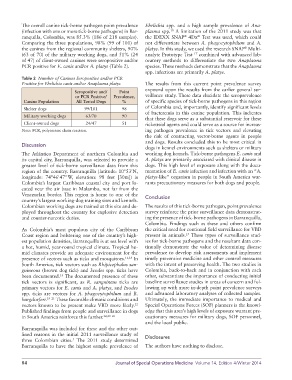
          PCR positive for E. canis and/or A. platys (Table 2).  species. These methods demonstrate that the Anaplasma
                                                             spp. infections are primarily A. platys.
          Table 2  Number of Canines Seropositive and/or PCR
          Positive for Ehrlichia canis and/or Anaplasma platys  The results from this current point prevalence survey
                                Seropositive and/  Point     expound upon the results from the earlier general sur-
                                or PCR Positive/  Prevalence,   veillance study. These data elucidate the seroprevalence
           Canine Population    All Tested Dogs    %         of specific species of tick-borne pathogens in this region
           Shelter dogs             99/101         98        of Colombia and, importantly, identify significant levels
                                                             of bacteremia in this canine population. This indicates
           Military working dogs    63/70          90
                                                             that these dogs serve as a substantial reservoir for these
           Client-owned dogs        24/47          51        rickettsial agents and could serve as a source for increas-
          Note: PCR, polymerase chain reaction.              ing pathogen prevalence in tick vectors and elevating
                                                             the risk of contracting vector-borne agents in people
                                                             and dogs. Results concluded this to be most critical in
          Discussion
                                                             dogs in kennel environments such as shelters or military
          The Atlántico Department of northern Colombia and   working dog kennels. Tick-borne pathogens E. canis and
          its capital city, Barranquilla, was selected to provide a   A. platys are primarily associated with clinical disease in
          greater level  of tick-borne surveillance  data from this   dogs. This high level of exposure along with the docu-
          region of the country. Barranquilla (latitude: 10°53'N,   mentation of E. canis infection and infection with an “A.
          longitude: 74°46'47"W, elevation: 98 feet [30m]) is   platys-like” organism in people in South America war-
          Colombia’s largest Caribbean coastal city and port lo-  rants precautionary measures for both dogs and people.
          cated near the air base in Malambo, not far from the
          Venezuelan border. This region is home to one of the
          country’s largest working-dog training sites and kennels.   Conclusion
          Colombian working dogs are trained at this site and de-  The results of this tick-borne pathogen, point prevalence
          ployed throughout the country for explosive detection   survey reinforce the prior surveillance data demonstrat-
          and counter-narcotic duties.                       ing the presence of tick-borne pathogens in Barranquilla,
                                                             Colombia. Findings such as these and others confirm
          As Colombia’s most populous city of the Caribbean   the critical need for continual field surveillance for VBD
                                                                              27
          Coast region and bolstering one of the country’s high-  present in animals.  These types of surveillance stud-
          est population densities, Barranquilla is at sea level with   ies for tick-borne pathogens and the resultant data con-
          a hot, humid, year-round tropical climate. Tropical hu-  tinually demonstrate the value of determining disease
          mid climates provide an adequate environment for the   prevalence to develop risk assessments and implement
          presence of vectors such as ticks and mosquitoes. 11,18  In   timely preventive medicine and other control measures
          South America, tick vectors such as Rhipicephalus san-  with the intent of preserving health. The two studies in
          guineous (brown dog tick) and Ixodes spp. ticks have   Colombia, back-to-back and in conjunction with each
          been documented.  The documented presence of these   other, substantiate the importance of conducting initial
                          13
          tick vectors is significant, as  R. sanguineus ticks are   baseline surveillance studies in areas of concern and fol-
          primary vectors for E. canis and A. platys, and Ixodes   lowing up with more in-depth point prevalence surveys
          spp. ticks are vectors for  A. phagocytophilum  and  B.   and advanced laboratory analyses of collected samples.
          burgdorferi. 19–21  These favorable climatic conditions and   Ultimately, the immediate importance to medical and
          vectors known to be present make VBD more likely.    Special Operations Forces (SOF) planners is the knowl-
                                                         22
          Published findings from people and surveillance in dogs   edge that this area’s high levels of exposure warrant pre-
          in South America reinforce this further. 12,23–26  cautionary measures for military dogs, SOF personnel,
                                                             and the local public.
          Barranquilla was included for these and the other out-
          lined reasons in the initial 2011 surveillance study of
                               3
          three Colombian cities.  The 2011 study determined   Disclosures
          Barranquilla to have the highest sample prevalence of   The authors have nothing to disclose.


          84                                     Journal of Special Operations Medicine  Volume 14, Edition 4/Winter 2014

