


Page 51 - Journal of Special Operations Medicine - Fall 2014
P. 51
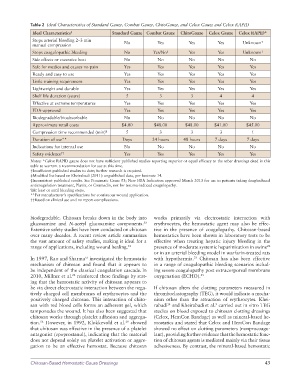
Table 2  Ideal Characteristics of Standard Gauze, Combat Gauze, ChitoGauze, and Celox Gauze and Celox RAPID
              Ideal Characteristics ‡          Standard Gauze Combat Gauze  ChitoGauze  Celox Gauze  Celox RAPID*
              Stops arterial bleeding 2–3 min       No            Yes          Yes         Yes       Unknown †
              manual compression
              Stops coagulopathic bleeding          No          Yes/No §       Yes         Yes       Unknown †
              Side effects or excessive heat        No            No           No          No           No
              Safe for medics and causes no pain    Yes           Yes          Yes         Yes          Yes
              Ready and easy to use                 Yes           Yes          Yes         Yes          Yes
              Little training requirement           Yes           Yes          Yes         Yes          Yes
              Lightweight and durable               Yes           Yes          Yes         Yes          Yes
              Shelf life duration (years)            5             3            3           4            4
              Effective at extreme temperatures     Yes           Yes          Yes         Yes          Yes
              FDA-approved                          Yes           Yes          Yes         Yes          Yes
              Biodegradable/bioabsorbable           No            No           No          No           No
              Approximate retail costs             $4.00         $48.00       $48.00      $41.00       $45.00
              Compression time recommended (min) ¶   5             3            3           3            1
              Duration of use**                     Days        24 hours     48 hours     7 days       7 days
              Indications for internal use          No            No           No          No           No
              Safety evidence ††                    Yes           Yes          Yes         Yes          Yes
              Notes: *Celox RAPID gauze does not have sufficient published studies reporting superior or equal efficacy to the other dressings cited in this
              table to warrant a recommendation for use at this time.
              †Insufficient published studies to date; further research is required.
              ‡Modified list based on Kheirabadi (2011): unpublished data, per footnote 14.
              §Inconsistent published results. See Proximate Cause #3; New FDA Indication approved March 2013 for use in patients taking drug/induced
              anticoagulation treatment, Plavix, or Coumadin, not for trauma-induced coagulopathy.
              ¶At least or until bleeding stops.
              **Per manufacturer’s specifications for continuous wound application.
              ††Based on clinical use and no report complications.


              biodegradable. Chitosan breaks down in the body into   works primarily via electrostatic interaction with
              glucosamine and  N-acetyl glucosamine components.    erythrocytes, the hemostatic agent may also be effec-
                                                            53
              Extensive safety studies have been conducted on chitosan   tive in the presence of coagulopathy. Chitosan-based
              over many decades. A recent review article summarizes   hemostatics have been shown in laboratory tests to be
              the vast amount of safety studies, making it ideal for a   effective when treating hepatic injury bleeding in the
              range of applications, including wound healing.    presence of moderate systemic heparinization in swine
                                                      54
                                                                                                               22
                                                                 or in an arterial bleeding model in warfarin-treated rats
                                    55
                                                                                 23
              In 1997, Rao and Sharma  investigated the hemostatic   with hypothermia.  Chitosan has also been effective
              mechanism of chitosan and found that it appears to   in a range of coagulopathic bleeding scenarios includ-
              be independent of the classical coagulation cascade. In   ing severe coagulopathy post extracorporeal membrane

              2010, Millner et al.  reinforced these findings by stat-  oxygenation (ECHO).
                                                                                    25
                               22
              ing that the hemostatic activity of chitosan appears to
              be via direct electrostatic interaction between the nega-  If chitosan alters the clotting parameters measured in
              tively charged cell membranes of erythrocytes and the   thromboelastography (TEG), it would indicate a mecha-
              positively charged chitosan. This interaction of chito-  nism  other  than  the  attraction  of  erythrocytes.  Khei-
                                                                      14

                                                                                          9
              san with red blood cells forms an adherent gel, which   rabadi  and Kheirabadi et al.  carried out in vitro TEG
              tamponades the wound. It has also been suggested that   studies on blood exposed to chitosan clotting dressings
              chitosan works through platelet adhesion and aggrega-  (Celox, HemCon Bandage) as well as mineral-based he-
              tion.  However, in 1992, Klokkevold et al.  showed   mostatics and stated that Celox and HemCon Bandage
                  56
                                                     19
              that chitosan was effective in the presence of a platelet   showed no effect on clotting parameters (nonprocoagu-
              antagonist (epoprostanol), indicating that the material   lant), providing further evidence that the hemostatic func-
              does not depend solely on platelet activation or aggre-  tion of chitosan agents is mediated mainly via their tissue
              gation to be an effective hemostat. Because   chitosan   adhesiveness. By contrast, the mineral-based hemostatic
              Chitosan-Based Hemostatic Gauze Dressings                                                       43

