


Page 12 - Journal of Special Operations Medicine - Fall 2014
P. 12
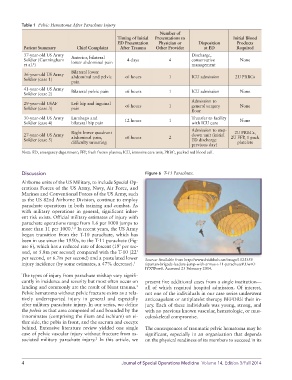
Table 1  Pelvic Hematoma After Parachute Injury
                                                                   Number of
                                                  Timing of Initial   Presentations to           Initial Blood
                                                  ED Presentation   Physician or    Disposition    Products
           Patient Summary       Chief Complaint   After Trauma  Other Provider      at ED         Required
           37-year-old US Army   Anterior, bilateral                            Discharge,
           Soldier (Cunningham   lower abdominal pain  4 days          4        conservative        None
           et al. )                                                             management
               2
                              Bilateral lower
           36-year-old US Army   abdominal and pelvic   <6 hours       1        ICU admission     2U PRBCs
           Soldier (case 1)
                              pain
           41-year-old US Army   Bilateral pelvic pain  <6 hours       1        ICU admission       None
           Soldier (case 2)
                                                                                Admission to
           29-year-old USAF   Left hip and inguinal   <6 hours         1        general surgery     None
           Soldier (case 3)   pain
                                                                                floor
           30-year-old US Army   Lumbago and         12 hours          1        Transfer to facility   None
           Soldier (case 4)   bilateral hip pain                                with ICU care
                                                                                Admission to step-
                              Right lower quadrant                                                2U PRBCs,
           27-year-old US Army   abdominal pain,     <6 hours          2        down unit (initial   2U FFP, 1 pack
           Soldier (case 5)                                                     ED discharge
                              difficulty urinating                                                 platelets
                                                                                previous day)
          Note: ED, emergency department; FFP, fresh frozen plasma; ICU, intensive care unit; PRBC, packed red blood cell.


          Discussion                                         Figure 6  T-11 Parachute.
          Airborne units of the US Military, to include Special Op-
          erations Forces of the US Army, Navy, Air Force, and
          Marines and Conventional Forces of the US Army, such
          as the US 82nd Airborne Division, continue to employ
          parachute operations in both training and combat. As
          with military operations in general, significant inher-
          ent risk exists. Official military estimates of injury with
          parachute operations range from 1.6 per 1000 jumps to
          more than 11 per 1000.  In recent years, the US Army
                               1,2
          began transition from the T-10 parachute, which has
          been in use since the 1950s, to the T-11 parachute (Fig-
          ure 6), which has a reduced rate of descent (19' per sec-
          ond, or 5.8m per second) compared with the T-10 (22'
          per second, or 6.7m per second) and a postulated lower   Source: Available from http://www.dvidshub.net/image/1025359
          injury incidence (by some estimates, a 47% decrease). 1  /spartan-brigade-leaders-jump-with-armys-t-11-parachute#.UwrO
                                                             lYXWow8. Accessed 23 February 2014.
          The types of injury from parachute mishap vary signifi-
          cantly in incidence and severity but most often occur on     present five additional cases from a single institution—
          landing and commonly are the result of blunt trauma.    all of which required hospital admission. Of interest,
                                                         3
          Pelvic hematoma without pelvic fracture exists as a rela-  not one of the individuals in our case series underwent
          tively underreported injury in general and especially   anticoagulant or antiplatelet therapy BEFORE their in-
          after military parachute injury. In our series, we define   jury. Each of these individuals was young, strong, and
          the pelvis as that area composed of and bounded by the   with no previous known vascular, hematologic, or mus-
          innominates (comprising the ilium and ischium) on ei-  culoskeletal compromise.
          ther side, the pubis in front, and the sacrum and coccyx
          behind. Extensive literature review yielded one single   The consequences of traumatic pelvic hematoma may be
          case of pelvic vascular injury without fracture from as-  significant,  especially  in  an  organization  that  depends
          sociated military parachute injury.  In this article, we   on the physical readiness of its members to succeed in its
                                         2


          4                                        Journal of Special Operations Medicine  Volume 14, Edition 3/Fall 2014

