


Page 88 - Journal of Special Operations Medicine - Summer 2014
P. 88
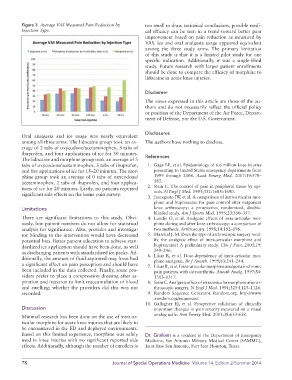
Figure 3  Average VAS Measured Pain Reduction by    too small to draw statistical conclusions, possible medi-
          Injection Type.                                    cal efficacy can be seen in a trend toward better pain
                                                             improvement based on pain reduction as measured by
                                                             VAS. Ice and oral analgesia usage appeared equivalent
                                                             among  the  three  study  arms.  The  primary  limitation
                                                             of this study is that it is a limited pilot study for one
                                                               specific  indication.  Additionally,  it  was  a  single-blind
                                                             study. Future research with larger patient enrollments
                                                             should be done to compare the efficacy of morphine to
                                                             lidocaine in acute knee injuries.


                                                             Disclaimer
                                                             The views expressed in this article are those of the au-
                                                             thors and do not necessarily reflect the official policy
                                                             or position of the Department of the Air Force, Depart-
                                                             ment of Defense, nor the U.S. Government.


          Oral analgesia and ice usage was nearly equivalent   Disclosures
          among all three arms. The lidocaine group took an av-  The authors have nothing to disclose.
          erage of 2 tabs of oxycodone/acetaminophen, 3 tabs of
          ibuprofen, and four applications of ice for 30 minutes.
          The lidocaine and morphine group took an average of 3   References
          tabs of oxycodone/acetaminophen, 3 tabs of ibuprofen,     1.  Gage BE, et al. Epidemiology of 6.6 million knee injuries
          and five applications of ice for 15–20 minutes. The mor-  presenting to United States emergency departments from
          phine group took an average of 0 tabs of oxycodone/    1999 through 2008.  Acad Emerg Med. 2007;19:378–
          acetaminophen, 2 tabs of ibuprofen, and four applica-  385.
          tions of ice for 20 minutes. Lastly, no patients reported     2.  Stein C. The control of pain in peripheral tissue by opi-
                                                                 oids. N Engl J Med. 1995;332:1685–1690.
          significant side effects on the home pain survey.
                                                               3.  Jaureguito JW, et al. A comparison of intra-articular mor-
                                                                 phine and bupivacaine for pain control after outpatient
          Limitations                                            knee arthroscopy: a prospective, randomized, double-
                                                                 blinded study. Am J Sports Med. 1995;23:350–357.
          There are significant limitations to this study. Obvi-    4.  Lundin O, et al. Analgesic effects of intra-articular mor-
          ously, low patient numbers do not allow for statistical   phine during and after knee arthroscopy: a comparison of
          analysis for significance. Also, provider and investiga-  two methods. Arthroscopy. 1998;14:192–196.
          tor blinding to the intervention would have decreased     5.  Marchal J. M. Does the type of arthroscopic surgery mod-
          potential bias. Better patient education to achieve stan-  ify the analgesic effect of intra-articular morphine and
          dardized ice application should have been done, as well   bupivacaine? A preliminary study. Clin J Pain. 2003;19:
                                                                 240–246.
          as discharging patients with standardized ice packs. Ad-    6.  Likar R, et al. Dose-dependency of intra-articular mor-
          ditionally, the amount of fluid aspirated may have had   phine analgesia. Br J Anesth. 1999;83:241–244.
          a significant effect on pain perception and should have     7.  Likar R, et al. Intra-articular morphine analgesia in chronic
          been included in the data collected. Finally, some pro-  pain patients with osteoarthritis. Anesth Analg. 1997;84:
          viders prefer to place a compression dressing after as-  1313–1317.
          piration and injection to limit reaccumulation of blood     8.  Stein C. Analgesic effect of intraarticular morphine after ar-
          and swelling; whether the providers did this was not   throscopic surgery. N Engl J Med. 1991;325:1123–1126.
          recorded.                                            9.  Random  Sequence  Generator.  Random.org. http://www
                                                                 .random.org/sequences/.
                                                             10.  Gallagher EJ, et al. Prospective validation of clinically
          Discussion                                             important changes in pain severity measured on a visual
          Minimal research has been done on the use of intra-ar-  analog scale. Ann Emerg Med. 2001;38:633-638.
          ticular morphine for acute knee injuries that are likely to
          be encountered in the ED and deployed environments.
          Based on this limited experience, morphine was safely   Dr. Graham is a resident in the Department of Emergency
          used in knee injuries with no significant reported side   Medicine, San Antonio Military Medical Center (SAMMC),
          effects. Additionally, although the number of enrollees is   Joint Base San Antonio, Fort Sam Houston, Texas.


          78                                   Journal of Special Operations Medicine  Volume 14, Edition 2/Summer 2014

