


Page 28 - Journal of Special Operations Medicine - Spring 2014
P. 28
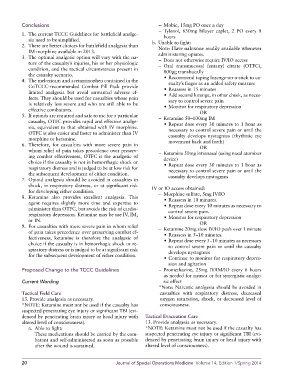
Conclusions                                              –  Mobic, 15mg PO once a day
                                                                   –   Tylenol, 650mg bilayer caplet, 2 PO every 8
          1.  The current TCCC Guidelines for battlefield analge-    hours
             sia need to be simplified.
          2.  There are better choices for battlefield analgesia than   b.  Unable to fight:
                                                                    Note: Have naloxone readily available whenever

             IM morphine available in 2013.
          3.  The optimal analgesic option will vary with the na-  administering opiates.
                                                                   –   Does not otherwise require IV/IO access
             ture of the casualty’s injuries, his or her physiologic   –   Oral transmucosal fentanyl citrate (OTFC),
             condition, and the tactical circumstances present in    800µg transbucally
             the casualty scenario.
          4.  The meloxicam and acetaminophen contained in the       •  Recommend taping lozenge-on-a-stick to ca-
                                                                       sualty’s finger as an added safety measure
             CoTCCC-recommended Combat Pill Pack provide             •  Reassess in 15 minutes
             limited analgesia but avoid unwanted adverse ef-        •  Add second lozenge, in other cheek, as neces-
             fects. They should be used for casualties whose pain      sary to control severe pain
             is relatively less severe and who are still able to be   •  Monitor for respiratory depression
             effective combatants.
                                                                                   OR
          5.  If opioids are required and safe to use for a particular   –  Ketamine 50–100mg IM
             casualty, OTFC provides rapid and effective analge-     •  Repeat dose every 30 minutes to 1 hour as
             sia, equivalent to that obtained with IV morphine.        necessary to control severe pain or until the
             OTFC is also easier and faster to administer than IV      casualty develops nystagmus (rhythmic eye
             morphine or ketamine.
          6.  Therefore, for casualties with more severe pain in       movement back and forth)
                                                                                   OR
             whom relief of pain takes precedence over preserv-    –   Ketamine 50mg intranasal (using nasal atomizer
             ing combat effectiveness, OTFC is the analgesic of      device)
             choice if the casualty is not in hemorrhagic shock or   •  Repeat dose every 30 minutes to 1 hour as
             respiratory distress and is judged to be at low risk for   necessary to control severe pain or until the
             the subsequent development of either condition.
          7.  Opioid analgesia should be avoided in casualties in      casualty develops nystagmus
             shock, in respiratory distress, or at significant risk   IV or IO access obtained:
             for developing either condition.
          8.  Ketamine also provides excellent analgesia. This     –   Morphine sulfate, 5mg IV/IO
                                                                     •  Reassess in 10 minutes.
             agent requires slightly more time and expertise to      •  Repeat dose every 10 minutes as necessary to
             administer than OTFC, but avoids the risk of cardio-      control severe pain.
             respiratory depression. Ketamine may be use IV, IM,     •  Monitor for respiratory depression
             or IN.
                                                                                   OR
          9.  For casualties with more severe pain in whom relief   –   Ketamine 20mg slow IV/IO push over 1 minute
             of pain takes precedence over preserving combat ef-     •  Reassess in 5–10 minutes.
             fectiveness,  ketamine  is  therefore  the  analgesic of   •  Repeat dose every 5–10 minutes as necessary
             choice if the casualty is in hemorrhagic shock or re-     to control severe pain or until the casualty
             spiratory distress or is judged to be at significant risk   develops nystagmus
             for the subsequent development of either condition.
                                                                     •  Continue to monitor for respiratory depres-
                                                                       sion and agitation
          Proposed Change to the TCCC Guidelines                   –   Promethazine, 25mg IV/IM/IO every 6 hours
                                                                     as needed for nausea or for synergistic analge-
          Current Wording                                            sic effect
                                                                   *Note: Narcotic analgesia should be avoided in
          Tactical Field Care                                      casualties  with respiratory  distress,  decreased
          13. Provide analgesia as necessary.                      oxygen saturation, shock, or decreased level of
          *NOTE: Ketamine must not be used if the casualty has     consciousness.
          suspected penetrating eye injury or significant TBI (evi-
          denced by penetrating brain injury or head injury with   Tactical Evacuation Care
          altered level of consciousness).                   13. Provide analgesia as necessary.
             a.  Able to fight:                              *NOTE: Ketamine must not be used if the casualty has
                  These medications should be carried by the com-  suspected penetrating eye injury or significant TBI (evi-
               batant and self-administered as soon as possible   denced by penetrating brain injury or head injury with
               after the wound is sustained.                 altered level of consciousness).


          20                                     Journal of Special Operations Medicine  Volume 14, Edition 1/Spring 2014

