


Page 69 - 2025 Ranger Medic Handbook
P. 69
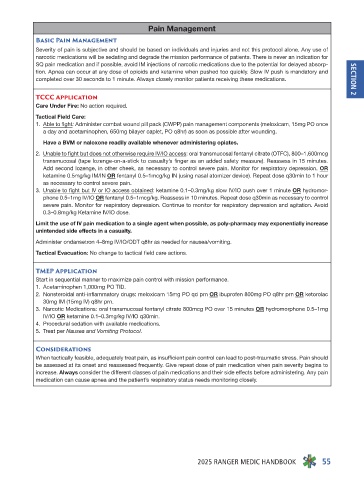
Pain Management
         Basic Pain Management
         Severity of pain is subjective and should be based on individuals and injuries and not this protocol alone. Any use of
         narcotic medications will be sedating and degrade the mission performance of patients. There is never an indication for
         SQ pain medication and if possible, avoid IM injections of narcotic medications due to the potential for delayed absorp-
         tion. Apnea can occur at any dose of opioids and ketamine when pushed too quickly. Slow IV push is mandatory and
         completed over 30 seconds to 1 minute. Always closely monitor patients receiving these medications.  SECTION 2

         TCCC Application
         Care Under Fire: No action required.
         Tactical Field Care:
         1.  Able to fight: Administer combat wound pill pack (CWPP) pain management components (meloxicam, 15mg PO once
          a day and acetaminophen, 650mg bilayer caplet, PO q8hr) as soon as possible after wounding.
          Have a BVM or naloxone readily available whenever administering opiates.
         2.  Unable to fight but does not otherwise require IV/IO access: oral transmucosal fentanyl citrate (OTFC), 800–1,600mcg
          transmucosal (tape lozenge-on-a-stick to casualty’s finger as an added safety measure). Reassess in 15 minutes.
          Add second lozenge, in other cheek, as necessary to control severe pain. Monitor for respiratory depression. OR
          ketamine 0.5mg/kg IM/IN OR fentanyl 0.5–1mcg/kg IN (using nasal atomizer device). Repeat dose q30min to 1 hour
          as necessary to control severe pain.
         3.  Unable to fight but IV or IO access obtained: ketamine 0.1–0.3mg/kg slow IV/IO push over 1 minute OR hydromor-
          phone 0.5–1mg IV/IO OR fentanyl 0.5–1mcg/kg. Reassess in 10 minutes. Repeat dose q30min as necessary to control
          severe pain. Monitor for respiratory depression. Continue to monitor for respiratory depression and agitation. Avoid
          0.3–0.8mg/kg Ketamine IV/IO dose.
         Limit the use of IV pain medication to a single agent when possible, as poly-pharmacy may exponentially  increase
         unintended side effects in a casualty.
         Administer ondansetron 4–8mg IV/IO/ODT q8hr as needed for nausea/vomiting.
         Tactical Evacuation: No change to tactical field care actions.
         TMEP Application
         Start in sequential manner to maximize pain control with mission performance.
         1.  Acetaminophen 1,000mg PO TID.
         2.  Nonsteroidal anti-inflammatory drugs: meloxicam 15mg PO qd prn OR ibuprofen 800mg PO q8hr prn OR ketorolac
          30mg IM (15mg IV) q8hr prn.
         3.  Narcotic Medications: oral transmucosal fentanyl citrate 800mcg PO over 15 minutes OR hydromorphone 0.5–1mg
          IV/IO OR ketamine 0.1–0.3mg/kg IV/IO q30min.
         4.  Procedural sedation with available medications.
         5.  Treat per Nausea and Vomiting Protocol.
         Considerations
         When tactically feasible, adequately treat pain, as insufficient pain control can lead to post-traumatic stress. Pain should
         be assessed at its onset and reassessed frequently. Give repeat dose of pain medication when pain severity begins to
         increase. Always consider the different classes of pain medications and their side effects before administering. Any pain
         medication can cause apnea and the patient’s respiratory status needs monitoring closely.


                                            2025 RANGER MEDIC HANDBOOK  55

