


Page 232 - 2025 Ranger Medic Handbook
P. 232
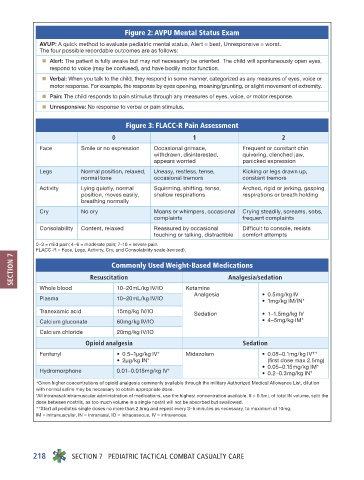
Figure 2: AVPU Mental Status Exam
          AVUP: A quick method to evaluate pediatric mental status, Alert = best, Unresponsive = worst.
          The four possible recordable outcomes are as follows:
          ■    Alert: The patient is fully awake but may not necessarily be oriented. The child will spontaneously open eyes,
            respond to voice (may be confused), and have bodily motor function.
          ■    Verbal: When you talk to the child, they respond in some manner, categorized as any measures of eyes, voice or
            motor response. For example, the response by eyes opening, moaning/grunting, or slight movement of extremity.
          ■    Pain: The child responds to pain stimulus through any measures of eyes, voice, or motor response.
          ■    Unresponsive: No response to verbal or pain stimulus.
                            Figure 3: FLACC-R Pain Assessment
                         0                 1                  2
          Face     Smile or no expression  Occasional grimace,   Frequent or constant chin
                                   withdrawn, disinterested,   quivering, clenched jaw,
                                   appears worried    panicked expression
          Legs     Normal position, relaxed,   Uneasy, restless, tense,   Kicking or legs drawn up,
                   normal tone     occasional tremors  constant tremors
          Activity  Lying quietly, normal   Squirming, shifting, tense,   Arched, rigid or jerking, gasping
                   position, moves easily,   shallow respirations  respirations or breath holding
                   breathing normally
          Cry      No cry          Moans or whimpers, occasional   Crying steadily, screams, sobs,
                                   complaints         frequent complaints
          Consolability  Content, relaxed  Reassured by occasional   Difficult to console, resists
                                   touching or talking, distractible  comfort attempts
         0–3 = mild pain; 4–6 = moderate pain; 7–10 = severe pain.
         FLACC-R = Face, Legs, Activity, Cry, and Consolability scale (revised).
    SECTION 7        Resuscitation                 Analgesia/sedation
                         Commonly Used Weight-Based Medications

          Whole blood     10–20mL/kg IV/IO  Ketamine
                                           Analgesia      •  0.5mg/kg IV
          Plasma          10–20mL/kg IV/IO                •  1mg/kg IM/IN*
          Tranexamic acid  15mg/kg IV/IO   Sedation       •  1–1.5mg/kg IV
          Calcium gluconate  60mg/kg IV/IO                •  4–5mg/kg IM*
          Calcium chloride  20mg/kg IV/IO
                    Opioid analgesia                  Sedation
                                                                     ++
          Fentanyl        •  0.5–1µg/kg IV +  Midazolam   •  0.05–0.1mg/kg IV
                          •  2µg/kg IN*                    (first dose max 2.5mg)
          Hydromorphone   0.01–0.015mg/kg IV +            •  0.05–0.15mg/kg IM*
                                                          •  0.2–0.3mg/kg IN*
         + Given higher concentrations of opioid analgesia commonly available through the military Authorized Medical Allowance List, dilution
         with normal saline may be necessary to obtain appropriate dose.
         *All intranasal/intramuscular administration of medications, use the highest concentration available. If > 0.5mL of total IN volume, split the
         dose between nostrils, as too much volume in a single nostril will not be absorbed but swallowed.
         ++ Start all pediatric single doses no more than 2.5mg and repeat every 3–5 minutes as necessary, to maximum of 10mg.
         IM = intramuscular, IN = intranasal, IO = intraosseous, IV = intravenous.

        218      SECTION 7   PEDIATRIC TACTICAL COMBAT CASUALTY CARE

