


Page 229 - 2025 Ranger Medic Handbook
P. 229
Pediatric Tactical Combat Casualty Care Guidelines
         Patient assessment and TCCC application largely remain unchanged for pediatric prehospital trauma patients, as com-
         pared to adults, except for the following considerations:
         Massive hemorrhage: Owing to much smaller blood volumes in children than in adults, immediate control of massive
         hemorrhage is necessary to prevent hemorrhagic shock, and blood-based resuscitation must begin rapidly with any
         significant loss of blood. Use tourniquets high and tight. U.S. military-approved tourniquets are effective in children with
         limb circumferences ≥13cm (around 5 inches), generally children aged 2 years and over. Use of commercial windlass
         tourniquets will likely require more wraps around the limb and more turns of the windlass to achieve hemostasis as
         compared to adults. If the tourniquet is ineffective, use direct pressure, hemostatic gauze, and/or pressure dressings to
         stop life-threatening extremity hemorrhage. If the casualty is younger than 2 years of age or has a limb circumference
         < 13cm, use an improvised windlass tourniquet or elastic (ACE) bandage wrapped tightly. Circumferential and direct
         manual pressure is highly recommended at arterial pressure points.
         Airway: A crying pediatric casualty’s airway is intact. If the child is semiconscious or unconscious, their tongue is the
         most common source of airway obstruction. The younger the child, the larger the occiput compared to the rest of the
         body and the greater the importance of ensuring full head extension (by using a shoulder roll). Inadequate head exten-
         sion results in airway occlusion. Although TCCC should always consider cervical spine injury in trauma, survivable
         pediatric cervical spine fractures are extremely rare and should not take precedence over establishing a patent airway.
         Airway adjuncts (oropharyngeal/nasopharyngeal airways) can be used to maintain a patent airway. An adult bag valve
         mask (BVM) can be used for pediatric ventilatory support, but only use enough pressure to generate adequate chest
         rise, which is much less than required for an adult (avoid hyper- or overinflation). In extreme circumstances, surgical
         cricothyroidotomy can be performed on casualties younger than 8 years old, but caution must be taken in younger chil-
         dren because of immature thyroid cartilage and the small size or limited space of the cricothyroid membrane. Standard
         adult cricothyroid tubes are too large to fit a pediatric trachea, but pediatric endotracheal tubes can be modified to fit
         the cricothyroid membrane.
         Resuscitation: Unlike in adult shock, hypotension is a late finding in the pediatric population. Children should be resus-
         citated early, before the onset of hypotension. Early signs of shock (before hypotension) include tachycardia and capillary
         refill ≥ 3 seconds. Signs of uncompensated shock include altered mental status, weak distal pulses, and hypotension.
         Permissive hypotension after hemorrhage is  NOT RECOMMENDED in children. Adequate blood-based resuscitation
         should improve heart rate, respiratory rate, capillary refill, mental status, hypotension, and urine output (goal = 1mL/kg/hr).
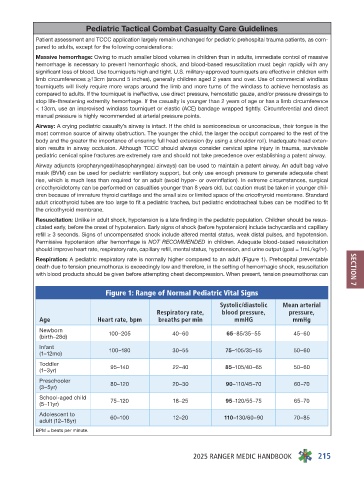
         Respiration: A pediatric respiratory rate is normally higher compared to an adult (Figure 1). Prehospital preventable
         death due to tension pneumothorax is exceedingly low and therefore, in the setting of hemorrhagic shock, resuscitation   SECTION 7
         with blood products should be given before attempting chest decompression. When present, tension pneumothorax can
                        Figure 1: Range of Normal Pediatric Vital Signs
                                                 Systolic/diastolic   Mean arterial
                                   Respiratory rate,   blood pressure,    pressure,
          Age         Heart rate, bpm  breaths per min  mmHG     mmHg
          Newborn
          (birth–28d)    100–205       40–60      65–85/35–55    45–60
          Infant         100–180       30–55      75–105/35–55   50–60
          (1–12mo)
          Toddler        95–140        22–40      85–105/40–65   50–60
          (1–3yr)
          Preschooler
          (3–5yr)        80–120        20–30      90–110/45–70   60–70
          School-aged child
          (5–11yr)       75–120        18–25      95–120/55–75   65–70
          Adolescent to   60–100       12–20      110–130/60–90  70–85
          adult (12–18yr)
         BPM = beats per minute.


                                           2025 RANGER MEDIC HANDBOOK  215

