


Page 34 - JSOM Winter 2019
P. 34
was not identified as a critical requirement, it is desirable as   TABLE 7  Combat and Civilian Usage Scoring
          time of application is a need at next level treatment echelons. It   5  Usage reports >50 applications.
          was not determined critical in this review but is recommended   4  Published case studies with efficacy reports.
          for all future designs.                              3  Known or recorded usage without efficacy reported.
                                                               2  Unknown combat or civilian usage (starting score).
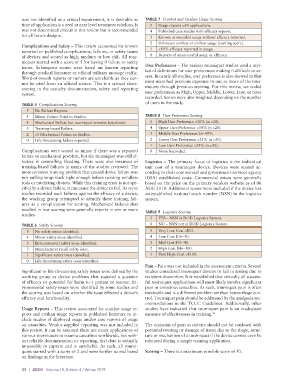
          Complications and Safety – This review accounted for known
          reported or published complications, failures, or safety issues   1  <80% efficacy reported in usage.
          of devices and scored as high, medium or low risk. All tour-  0  Reports of unsuccessful usage or efficacy.
          niquets started with a score of 5 for having 0 failure or safety
          issues. Subsequent scores were based on known reporting   User Preferences – The various tourniquet studies used a myr-
          through medical literature or official military message traffic.   iad of definitions for user preferences making it difficult to as-
          Word-of-mouth reports or rumors are unreliable as they can-  sess. In nearly all studies, user preference is also skewed in that
          not be cited from an official source. This is a critical short-  most users had previous exposure to one or more of the tour-
          coming in the casualty documentation, safety and reporting   niquets through previous training. For this review, we scaled
          system.                                            user preferences as High, Upper, Middle, Lower, Low, or none
                                                             recorded. Scores were also weighted depending on the number
                                                             of users in the study.
          TABLE 5  Complications Scoring
            5  No Failure Reports.
            4  Minor Failure Point in Studies.               TABLE 8  User Preference Scoring
            4  Mechanical Failure but tourniquet remains functional.  5  High User Preference >50% (n >20).
            3  Training-based Failure.                         4  Upper User Preference >50% (n <20).
            2  >5 Mechanical Failure in Studies.               3  Middle User Preference 26–49%.
            0  Life-threatening failure reported.              2  Lower User Preference <25% (n <20).
                                                               1  Low User Preference <25% (n >20).
          Complications were scored as minor if there was a reported   0  None Recorded.
          failure or mechanical problem, but the tourniquet was still ef-
          fective in controlling bleeding. There were also instances of   Logistics – The primary focus of logistics is the individual
          training-based failures in many of the studies reviewed. The   unit cost of a tourniquet device. Devices were scored ac-
          most common training problem that caused device failure was   cording to their commercial and government-services agency
          not pulling strap slack tight enough before twisting windlass   (GSA) established costs. Commercial prices were generally
          rods or ratcheting devices. While this training error is not spe-  based on the price on the primary vendors website as of 06
          cifically a device failure, it can cause the device to fail. As some   AUG 2019. Additional scores were included if the device has
          studies recorded such failures against the efficacy of a device,   an established national stock number (NSN) in the logistics
          the working group attempted to identify these training fail-  system.
          ures as a complication for scoring. Mechanical failures that
          resulted in low scoring were generally reports in one or more
          studies.                                           TABLE 9  Logistics Scoring
                                                               5  YES – NSN in DOD Logistics System.
          TABLE 6  Safety Scoring                              0  NO – NSN not in DOD Logistics System.
            5  No safety issues identified.                    5  Very Low Cost <$15.
            4  Minor safety issue identified.                  4  Low Cost $16–30.
            3  Environmental safety issue identified.          3  Mid Cost $31–45.
            3  Manufacturer recall safety issue.               2  High Cost $46–100.
            1  Significant safety issue identified.            1  Very High Cost >$100.
            0  Life-threatening safety issue identified.
                                                             Pain – Pain was not included in the assessment criteria. Several
          Significant or life-threatening safety issues were defined by the   studies considered tourniquet devices to fail in testing due to
          working group as device problems that signaled a question   recipient discomfort. It is established that virtually all success-
          of efficacy or potential for harm to a patient or rescuer. En-  ful tourniquet applications will most likely involve significant
          vironmental safety issues were identified by some studies and   pain in conscious casualties. As such, tourniquet pain is often
          the scoring was based on whether the issue effected a device’s   inevitable and is a different problem set than hemorrhage con-
          efficacy and functionality.                        trol. Tourniquet pain should be addressed by the analgesia rec-
                                                             ommendations in the TCCC Guidelines. Additionally, other
          Usage Reports – This review accounted for combat usage re-  studies have indicated that tourniquet pain is an inadequate
          ports and civilian usage reports in published literature to in-  measure of effectiveness in training. 16
          clude studies of deployed usage and/or case reports of usage
          on casualties. Vendor-supplied reporting was not included in   The omission of pain as criteria should not be confused with
          this review. It can be assumed there are many applications of   potential twisting or damage of tissue due to the shape, struc-
          various tourniquets to trauma casualties worldwide, but with-  ture or mechanism of a tourniquet if the device cannot even be
          out reliable documentation or reporting, that data is virtually   tolerated during a simple training application.
          impossible to capture and is unreliable. As such, all tourni-
          quets started with a score of 2 and were further scored based   Scoring – There is a maximum possible score of 50.
          on findings in the literature.


          32  |  JSOM   Volume 19, Edition 4 / Winter 2019

