


Page 32 - JSOM Winter 2019
P. 32
to ten (10) or zero (0) to five (5). The intent was to ensure that   Time (or speed) of Application – The second critical criteria
          results with studies with N >20 were weighted over studies   was how quickly the TQ device could be applied by trained
          with N <20. As such, the maximum score a tourniquet could   individuals. While there has not been a firmly established stan-
          receive was fifty (50). It was determined by the senior author   dard for the speed of tourniquet applications, it is generally
          with  consensus  from  co-authors  that  only  non-pneumatic   accepted that a hemorrhaging casualty can bleed out in 3–5
          tourniquets with a score of 40 or higher would be considered   minutes.  While most of the studies held 1 minute (60 seconds)
                                                                    9
          for CoTCCC recommendations. As the pneumatic tourniquets   as an arbitrary time standard for tourniquet application, they
          in the combat setting are only recommended as tourniquet re-  did not all delineate the steps of the application procedure that
          placements, then speed of application and simplicity were not   were to be completed within time constraints. Additionally,
          considered with same degree of importance and were not held   most published DoD tourniquet application grading criteria
          to the same overall score of 40 as the non-pneumatic devices.   include 60 seconds as the time standard for application. How-
          As such, occlusion, pressure and specifications were the crite-  ever, neither  the  studies  nor  some  of the  DoD  publications
          ria for pneumatic recommendations.                 clearly differentiate the time required to achieve occlusion
                                                             and to complete further application steps such as securing the
          Arterial Occlusion – First and foremost, a limb tourniquet must   tourniquet or time recording. Furthermore, the studies did not
          adequately demonstrate that it can effectively occlude arterial   have consistency in defining the start of timing of the proce-
          blood flow of an extremity. Evidence would be further scored   dure or standardization for tourniquet access for the test.
          high and as acceptable with a greater  than  90% efficacy of
          occlusion on studies including total N >20 applications and   For future analysis, the working group determined that the
          medium-high and acceptable on studies with 90% efficacy   most critical step in stopping hemorrhage, time to occlusion,
          including with N <20 applications. Studies with efficacy re-  should be differentiated from the additional steps of appli-
          sults of 80-89% were scored in the middle and categorized   cation. The optimal time to occlusion would be <60 seconds
          as concerning and requiring additional scrutiny. Devices with   with an additional maximum of 90 seconds more to com-
          occlusion  results  of  70–79%  were  considered  significantly   plete the tourniquet application, including securing the device
          concerning and scored low. Studies of devices with occlusion   and marking the time. Accordingly, devices with application
          efficacy <70%  were consider unacceptable and scored zero.   speeds of <60 seconds to occlusion and <90 seconds comple-
          Devices with occlusion efficacy <50% were scored zero and   tion in studies with N >20 applications were scored high and
          considered disqualified.                           acceptable; <60 seconds and <90 seconds in studies with N
                                                             <20 scored medium and acceptable. Devices with occlusion
          Additionally, only studies that determined occlusion efficacy   times of 61–90 seconds were scored low and considered con-
          using tourniquet application to humans assessed by Doppler   cerning and devices with time to occlusion >90 seconds were
          ultrasonography or using high-fidelity limb tourniquet sim-  scored zero and considered unacceptable.
          ulators were included in this review. A Doppler ultrasound
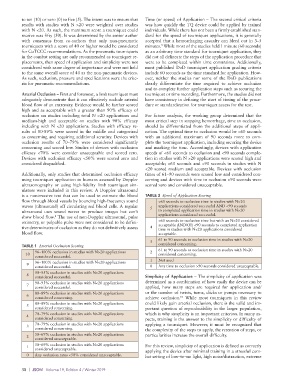
          is a noninvasive test that can be used to estimate the blood   TABLE 2  Speed of Application Scoring
          flow through blood vessels by bouncing high-frequency sound   <60 seconds to occlusion time in studies with N>20
          waves (ultrasound) off circulating red blood cells. A regular   5  applications considered successful AND <90 seconds
          ultrasound uses sound waves to produce images but can’t   to completed application time in studies with N>20
          show blood flow.  The use of non-Doppler ultrasound, pulse   applications considered successful.
                        8
          oximetry, or palpable pulse were not considered to be defini-  <60 seconds to occlusion time but with an N<20 considered
          tive determinates of occlusion as they do not definitively assess   4  acceptable AND/OR <90 seconds to completed application
                                                                  time in studies with N<20 applications considered
          blood flow.                                             acceptable.
                                                                  61 to 90 seconds to occlusion time in studies with N<20
                                                               3
          TABLE 1  Arterial Occlusion Scoring                     considered concerning.
                                                                  61 to 90 seconds to occlusion time in studies with N>20
               96–100% occlusion in studies with N>20 applications   2
            10                                                    considered concerning.
               considered successful.
               96–100% occlusion in studies with N<20 applications   1  Not used
            9
               considered successful.                          0  Any time to occlusion >90 seconds considered unacceptable.
               90–95% occlusion in studies with N>20 applications
            8
               considered successful.                        Simplicity of Application – The simplicity of application was
               90–95% occlusion in studies with N<20 applications   determined as a combination of how easily the device can be
            7
               considered successful.                        applied,  how  many  steps  are  required  for  application  and/
               80–89% occlusion in studies with N>20 applications   or the number of twists, turns, clicks or pumps necessary to
            6                                                              10
               considered concerning.                        achieve occlusion.  While most tourniquets in this review
               80–89% occlusion in studies with N<20 applications   could likely gain arterial occlusion, there is the valid and im-
            5
               considered concerning.                        portant question of reproducibility in the larger population,
               70–79% occlusion in studies with N>20 applications   which is why simplicity is an important criterion. In many as-
            4
               considered concerning.                        pects, training is the answer to the simplicity or difficulty of
               70–79% occlusion in studies with N<20 applications   applying a tourniquet. However, it must be recognized that
            3
               considered concerning.                        the complexity of the steps to apply, the retention of steps, or
               50–69% occlusion in studies with N>20 applications   particularities increase the overall difficulty.
            2
               considered unacceptable.
               50–69% occlusion in studies with N<20 applications   For this review, simplicity of application is defined as correctly
            1
               considered unacceptable.                      applying the device after minimal training in a stressful com-
            0  Any occlusion rates <50% considered unacceptable.  bat setting of low–to–no light, high noise/distraction, extreme
          30  |  JSOM   Volume 19, Edition 4 / Winter 2019

