


Page 88 - Journal of Special Operations Medicine - Winter 2014
P. 88
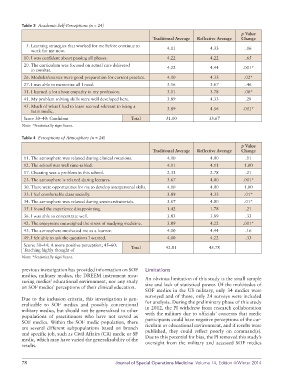
Table 3  Academic Self-Perceptions (n = 24)
                                                                                                     p Value
                                                                Traditional Average  Reflective Average  Change
            5.  Learning strategies that worked for me before continue to   4.11        4.33          .16
              work for me now.
           10. I was confident about passing all phases.              4.22              4.22          .65
           20.  The curriculum was focused on actual care delivered    4.22             4.44         .001*
              in combat.
           26. Modules/courses were good preparation for current practice.  4.00        4.33          .02*
           27. I was able to memorize all I need.                     3.56              3.67          .46
           31. I learned a lot about empathy in my profession.        3.11              3.78          .00*
           41. My problem solving skills were well developed here.    3.89              4.33          .28
           45.  Much of what I had to learn seemed relevant to being a    3.89          4.56         .001*
              team medic.
           Score 30–40: Confident                      Total          31.00            33.67
          Note: *Statistically significant.

          Table 4  Perceptions of Atmosphere (n = 24)
                                                                                                     p Value
                                                                Traditional Average  Reflective Average  Change
           11. The atmosphere was relaxed during clinical rotations.  4.00              4.00          .11
           12. The school was well time-tabled.                       4.11              4.11          1.00
           17. Cheating was a problem in this school.                 2.33              2.78          .21
           23. The atmosphere is relaxed during lectures.             3.67              4.00         .001*
           30.  There were opportunities for me to develop interpersonal skills.  4.00  4.00          1.00
           33. I feel comfortable class socially.                     3.89              4.33          .01*
           34. The atmosphere was relaxed during seminars/tutorials.  3.67              4.00          .01*
           35. I found the experience disappointing.                  1.42              1.78          .21
           36. I was able to concentrate well.                        3.83              3.89          .33
           42. The enjoyment outweighed the stress of studying medicine.  3.89          4.22         .001*
           43. The atmosphere motivated me as a learner.              4.00              4.44          .16
           49. I felt able to ask the questions I wanted.             4.00              4.22          .33
           Score: 30–44: A more positive perception; 45–60:   Total   42.81            45.78
           Teaching highly thought of
          Note: *Statistically significant.

          previous investigation has provided information on SOF   Limitations
          medics, military medics, the DREEM instrument mea-  An obvious limitation of this study is the small sample
          suring medics’ educational environment, nor any study   size and lack of statistical power. Of the multitudes of
          on SOF medics’ perceptions of their clinical education.
                                                             SOF medics in the US military, only 34 medics were
                                                             surveyed and of those, only 24 surveys were included
          Due to the inclusion criteria, this investigation is gen-  for analysis. During the preliminary phase of this study
          eralizable to SOF medics and possibly conventional   in 2012, the PI withdrew from research collaboration
          military medics, but should not be generalized to other   with the military due to officials’ concerns that medic
          populations of practitioners who have not served as   participants could have negative perceptions of the cur-
          SOF  medics. Within the SOF medic population, there   riculum or educational environment, and if results were
          are several different subpopulations based on branch   published, they could reflect poorly on command(s).
          and specific job, such as Civil Affairs (CA) medic or SF   Due to this potential for bias, the PI removed this study’s
          medic, which may have varied the generalizability of the   oversight from the military and accessed SOF medics
          results.


          78                                     Journal of Special Operations Medicine  Volume 14, Edition 4/Winter 2014

